Attention
이날 Reading Club(GIST, KAIST, UBC)에서 내가 presenter라 absent.
Chapter 1 Introducing cognitive neuroscience
Overview
- 연구 배경: 인지 신경과학의 역사적 발전과 정신-뇌 문제에 대한 철학적 접근(이중론, 환원주의)을 다루며, 뇌 기능을 이해하기 위한 다양한 방법론의 필요성을 강조
- 핵심 방법론:
- 실험적 접근: 전두엽 자극 실험, 뇌 영상 기술(PET, fMRI), 자극 기법(TMS, tDCS) 및 전기생리학적 방법(EEG/ERP, MEG)을 활용
- 이론적 접근: 신경망 모델과 연결주의 모델을 기반으로 한 계산적 접근, 인지 신경심리학을 통한 뇌 손상 환자의 분석
- 주요 기여:
- 인지 과정을 뇌 기반 메커니즘으로 설명하는 인지 신경과학의 체계적 발전
- 역사적 사례(펜필드의 실험, 프레노로지)와 현대적 방법론의 비교를 통해 뇌-정신 관계의 이해를 심화
- 계산 모델(예: 연결주의 모델)을 통한 인지 기능의 생물학적 기초 탐구
- 실험 결과: 1928년부터 1947년까지 400명 이상의 환자에 대한 직접적인 뇌 자극 실험을 통해 감각, 운동, 언어 등 다양한 인지 기능의 뇌 기전을 실증적으로 규명
- 의의 및 한계:
- 인지 과학과 신경과학의 통합적 접근을 통해 뇌 기능과 정신 활동의 상호작용을 체계적으로 탐구하는 데 기여
- 그러나 이중론과 환원주의의 철학적 논쟁, 과거의 비과학적 이론(프레노로지)의 영향 등에 대한 비판적 고찰 필요
📋 목차
대단원 구조
- Cognitive Neuroscience in Historical Perspective — 인지 신경과학의 역사적 발전과 철학적 배경
- 1.1 Philosophical approaches to mind and brain — 이원론, 환원주의 등 심신 문제의 철학적 접근
- 1.2 Scientific approaches to mind and brain — 프레놀로지에서 현대 신경과학까지의 과학적 발전
- 1.3 Computational and Connectionist Models of Cognition — 연결주의 모델과 계산적 접근
- 1.4 The birth of cognitive neuroscience — 뇌 영상 기술의 발전과 인지 신경과학의 탄생
- Does Cognitive Psychology Need the Brain? — 인지 심리학이 뇌 기반 증거를 필요로 하는가에 대한 논의
- Does Neuroscience Need Cognitive Psychology? — 신경과학이 인지 심리학의 이론적 틀을 필요로 하는가
- 3.1 Domain specificity — 도메인 특이성과 뇌 영역의 기능적 전문화
- 3.2 Is the Brain Modular? — 모듈성 이론에 대한 실증적 검토와 비판
Summary
인지 신경과학은 Wilder Penfield의 뇌 전기 자극 실험(1928-1947, 400명 이상)을 통해 특정 뇌 영역이 감각, 운동, 인지 경험에 연결됨을 실증적으로 밝혀낸 역사적 기반 위에 성립되었다. 이 장에서는 인지 심리학과 신경과학의 상호 관계, 뇌 영상 기술의 발전이 가져온 학문적 성장, 그리고 역사적 방법론과 현대적 연구 기법의 비교를 다룬다.
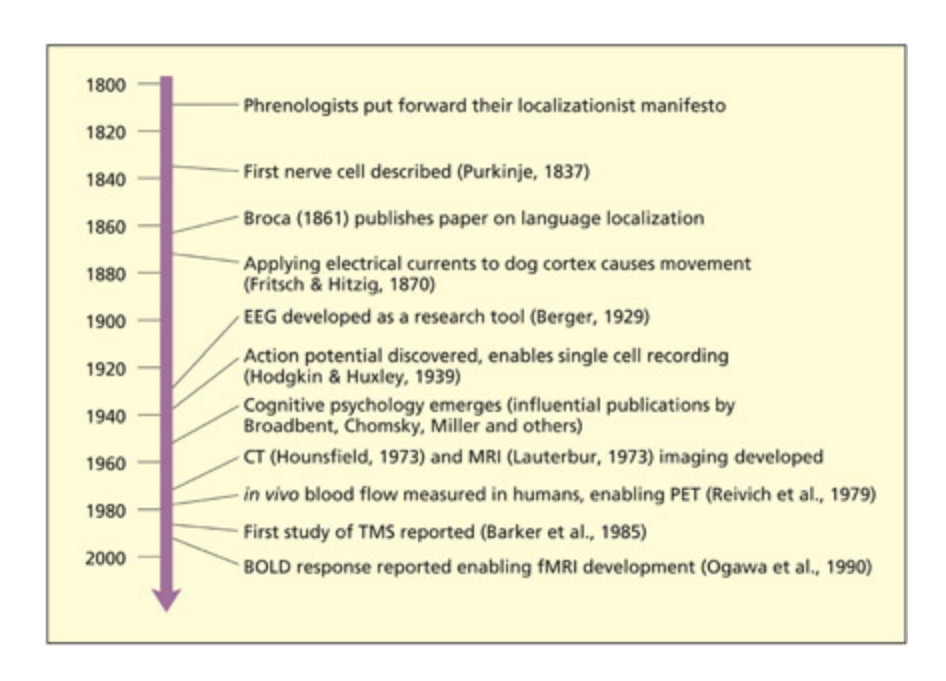
A timeline for the development of methods and findings relevant to cognitive neuroscience, from phrenology to present day.
📊 그림 설명
인지 신경과학의 발전 과정을 시간 순서대로 보여주는 타임라인이다. 골상학(phrenology)에서 시작하여 브로카의 언어 국소화 연구, 뇌 영상 기술(PET, fMRI)의 등장, 현대 인지 신경과학의 확립까지 주요 방법론과 발견의 역사적 흐름을 한눈에 파악할 수 있다.
Summary
Phrenologist(골상학)
Key Terms
Cognition
A variety of higher mental processes such as thinking, perceiving, imagining, speaking, acting and planning.
인지란 thinking, perceiving, imagining, speaking, acting, planning과 같은 다양한 고차원 정신 과정이다.
Cognitive neuroscience
Aims to explain cognitive processes in terms of brain-based mechanisms.
인지 과정(cognitive processes)을 뇌 기반 메커니즘(brain-based mechanisms)을 통해 설명하는 것을 목표로 하며, 감각(sensory), 운동(motor), 인지(cognitive) 기능의 신경생물학적 기초를 탐구한다.
Mind–body problem
The problem of how a physical substance (the brain) can give rise to our sensations, thoughts and emotions (our mind).
물리적인 구조인 뇌(physical substance)가 감각, 사고, 감정과 같은 정신적 경험(our mind)을 어떻게 생성하는지를 탐구하는 근본적인 철학적 문제를 제기한다. 이는 이전 섹션에서 정의된 인지(cognition)의 다양한 고차원 정신 과정이 물리적 기반(physical substrate)과 어떻게 연결되는지를 설명하는 데 기여하며, 특히 정신적 현상(sensations, thoughts, emotions)이 신경 과정(neural processes)을 통해 실현되는 메커니즘을 이해하는 것이 핵심 과제로 제시된다.
Dualism
The belief that mind and brain are made up of different kinds of substance.
이 섹션에서는 이중주의(Dualism)라는 개념을 소개하며, 이는 정신(mind)과 뇌(brain)가 서로 다른 종류의 물질(substance)로 구성되어 있다는 신념을 설명한다. 이는 이전 섹션에서 다룬 인지 기능과 뇌 영역의 실증적 연결이라는 물질주의적 관점과 대비되는 철학적 틀로, 인지 과정이 단순히 뇌의 물리적 활동에 국한되지 않을 수 있다는 가능성을 제시한다. 특히, 이 이론은 정신과 뇌가 상호작용하는 방식에 대한 논의를 촉진하며, 이후 섹션에서 다룰 인공지능 시스템의 설계 원리나 인지 과정의 모델링 방식에 대한 이론적 기반을 제공하는 역할을 한다.
Cognitive Neuroscience in Historical Perspective
Summary
마음-뇌 문제(mind-brain problem)는 물리적 구조인 뇌가 정신적 경험을 어떻게 생성하는지를 묻는 근본적 질문이다. 데카르트의 이원론(dualism)은 정신과 뇌를 서로 다른 물질로 보고 송과선(pineal gland)을 통한 상호작용을 제안했으나, 이원론이 참이라면 인지 신경과학은 비물질적 영역을 탐구할 수 없다는 한계에 직면한다.
Philosophical approaches to mind and brain
Summary
심신 문제(mind-body problem)에 대한 세 가지 주요 철학적 입장을 소개한다. 이원론(dualism)은 정신과 뇌를 다른 물질로 보며, 이중면 이론(dual-aspect theory)은 동일 실체의 두 가지 설명 수준으로 간주하고, 환원주의(reductionism)는 정신 개념이 궁극적으로 생물학적 설명으로 대체될 것이라고 주장한다. 특히 스피노자의 이중면 이론은 파동-입자 이중성에 비유되며, 환원주의는 플로지스톤 개념의 폐기와 같은 역사적 선례를 근거로 삼는다.
Philosophers as well as scientists have long been interested in how the brain can create our mental world. How is it that a physical substance can give rise to our sensations, thoughts and emotions? is has been termed the mind–body problem, although it should more properly be called the mind– brain problem, because it is now agreed that the brain is the key part of the body for cognition. One position is that the mind and brain are made up of different kinds of substance, even though they may interact. is is known as dualism, and the most famous proponent of this idea was René Descartes (1596–1650). Descartes believed that the mind was non-physical and immortal whereas the body was physical and mortal. He suggested that they interact in the pineal gland, whi lies at the center of the brain and is now considered part of the endocrine system. According to Descartes, stimulation of the sense organs would cause vibrations in the body/brain that would be pied up in the pineal gland, and this would create a non-physical sense of awareness. ere is lile hope for cognitive neuroscience if dualism is true
because the methods of physical and biological sciences cannot tap into the non-physical domain (if su a thing were to exist).
Key Terms
Dual-aspect theory
The belief that mind and brain are two levels of description of the same thing.
이 섹션에서는 이중면 이론(Dual-aspect theory)을 소개하며, 이는 정신(mind)과 뇌(brain)가 동일한 물리적 실체의 두 가지 설명 수준(description level)일 뿐, 본질적으로 분리된 물질(substance)이 아니라는 관점을 설명한다. 이는 이전 섹션에서 다룬 이중주의(dualism)와 대비되며, 정신과 뇌를 서로 다른 물질로 간주하는 대신, 단일한 실체(single entity)의 두 가지 면(aspects)로 보는 단일주의적(monistic) 접근을 제시한다. 특히, 이 이론은 정신적 경험(sensations, thoughts)과 신경 활동(neural processes)이 동일한 기초를 공유하지만, 서로 다른 관점에서 설명될 수 있음을 강조하며, 마음-뇌 문제(mind-brain problem)에 대한 철학적 해법으로서의 가능성을 제시한다.
Reductionism
The belief that mind-based concepts will eventually be replaced by neuroscientific concepts.
이 섹션에서는 정신-뇌 문제(mind–brain problem)에 대한 감소주의(reductionism) 접근을 설명하며, 정신 기반 개념(mind-based concepts)이 궁극적으로 생물학적 메커니즘(biological constructs)으로 대체될 것이라고 주장한다. 감소주의자들은 감정, 기억, 주의 등 현재 인지 과학에서 유용한 개념이 향후 뉴런 활동 패턴이나 신경전달물질 방출과 같은 생물학적 설명으로 대체될 것이라 보며, 이는 심리학이 뇌에 대한 이해가 깊어질수록 생물학으로 축소될 것이라고 예측한다. 이 관점은 과거 과학적 이론의 변화 사례(예: 연소 시 포글리스톤(phlogiston) 개념의 붕괴)를 인용하며, 감정 같은 주관적 경험도 향후 뇌 기반 이론(brain theory)에서 포글리스톤과 같은 역사적 개념으로 남을 수 있다고 주장한다. 반면, 이중측면 이론(dual-aspect theory)을 지지하는 학자들은 정신 기반 개념이 신경 기초를 완전히 이해하더라도 감정의 주관적 성격이 유지될 것이며, 따라서 이들 개념의 실용성은 결코 완전히 대체될 수 없다고 반박한다. 이론적 토론은 레네 데카르트(René Descartes)의 이중주의와 스피노자(Spinoza)의 이중측면 이론을 대비하며, 정신과 뇌의 관계를 설명하는 철학적 틀의 다양성을 강조한다. 감소주의는 과학적 설명의 진보가 기존 개념을 대체하는 역사적 전례를 근거로 하며, 이는 인공지능 및 신경과학에서 정신적 경험(conscious experience)의 물리적 기반 탐구에 중요한 의미를 제공한다.
Even in Descartes’ time, there were critics of his position. One can identify a number of broad approaes to the mind–body problem that still have a contemporary resonance. Spinoza (1632–1677) argued that mind and brain were two different levels of explanation for the same thing, but not two different kinds of thing. is has been termed dual-aspect theory and it remains popular with some current researers in the field (Velmans, 2000). An analogy can be drawn to wave–particle duality in physics, in whi the same entity (e.g. an electron) can be described both as a wave and as a particle.
An alternative approa to the mind–body problem that is endorsed by many contemporary thinkers is reductionism (Churland, 1995; Cri, 1994). is position states that, although cognitive, mind-based concepts (e.g. emotions, memories, aention) are currently useful for scientific
exploration, they will eventually be replaced by purely biological constructs (e.g. paerns of neuronal firings, neurotransmier release). As su, psyology will eventually reduce to biology as we learn more and more about the brain. Advocates of this approa note that there are many historical precedents in whi scientific constructs are abandoned when a beer explanation is found. In the seventeenth century, scientists believed that flammable materials contained a substance, called phlogiston, whi was released when burned. is is similar to classical notions that fire was a basic element along with water, air and earth. Eventually, this construct was replaced by an understanding of how emicals combine with oxygen. e process of burning became just one example (along with rusting) of this particular emical reaction. Reductionists believe that mind-based concepts, and conscious experiences in particular, will have the same status as phlogiston in a future theory of the brain. ose who favor dual-aspect theory over reductionism point out that an emotion will still feel like an emotion even if we were to fully understand its neural basis and, as su, the usefulness of cognitive, mind-based concepts will never be fully replaced.
Scientific approaches to mind and brain
Summary
뇌에 대한 과학적 이해는 역사적으로 늦게 발전했다. 아리스토텔레스는 뇌 크기-체중 비율을 관찰했으나 인지를 심장의 산물로 오인했고, 갈레노스는 뇌 손상을 관찰했으나 정신이 뇌실(ventricles)에 위치한다고 주장하여 1,500년간 지속된 오류를 남겼다. 베살리우스의 해부도조차 피질을 부정확하게 묘사했으며, Gall과 Spurzheim(1810)에 이르러서야 현대적 뇌 구조가 인식되기 시작했다.
Our understanding of the brain emerged historically late, largely in the nineteenth century, although some important insights were gained during classical times. Aristotle (384–322 BC) noted that the ratio of brain size to body size was greatest in more intellectually advanced species, su as humans. Unfortunately, he made the error of claiming that cognition was a product of the heart rather than the brain. He believed that the brain acted as a coolant system: the higher the intellect, the larger the cooling system needed. In the Roman age, Galen (circa AD 129–199) observed brain injury in gladiators and noted that nerves project to and from the brain. Nonetheless, he believed that mental experiences themselves resided in the ventricles of the brain. is idea went essentially unallenged for well over
1,500 years. For example, when Vesalius (1514–1564), the father of modern anatomy, published his plates of dissected brains, the ventricles were drawn in exacting detail, whereas the cortex was drawn crudely and sematically. Others followed in this tradition, oen drawing the surface of the brain like the intestines. is situation probably reflected a la of interest in the cortex rather than a la of penmanship. It is not until one looks at the drawings of Gall and Spurzheim (1810) that the features of the brain become recognizable to modern eyes.
Key Term
Summary
골상학(Phrenology)은 뇌 영역의 기능적 특화와 두개골 형태를 통한 인지 차이 측정이라는 두 가지 가정에 기반했다. 전자는 현대 신경과학에서도 유지되는 개념이나, 후자는 실증적 근거가 없는 비과학적 주장으로 폐기되었다. Fowler의 두개골 도면에서 “부모 사랑”, “파괴성” 등을 특정 영역에 할당한 것은 경험적 근거 없이 이루어진 대표적 사례이다.
Phrenology
The failed idea that individual differences in cognition can be mapped on to differences in skull shape.
이 섹션에서는 인상학(Phrenology)이라는 실패한 이론을 다루며, 이는 인지 차이가 두개골 모양의 차이와 연결될 수 있다는 비과학적 가설을 제시했다는 점을 강조한다. Gall과 Spurzheim이 제안한 이 이론은 두 가지 핵심 가정을 기반으로 했는데, 첫째, 뇌의 특정 영역이 다른 기능과 행동에 연결되어 있고, 둘째, 이 영역의 크기가 두개골의 변형을 유발하며 인지 및 성격 차이와 상관관계가 있다는 점이다. 이 중 기능적 특화(functional specialization)의 개념은 현대 인지 신경과학에서 지속적으로 유지되었으나, 두개골 모양이 인지 기능과 관련이 없다는 점에서 이론적 및 실증적 근거가 부족하다는 한계를 지녔다. 예를 들어, Fowler의 유명한 인상학 모델에서는 “부모의 사랑”, “파괴성”, “단호함”과 같은 기능이 특정 두개골 부위에 할당되어 있었으나, 이는 경험적 근거 없이 인지 이론과 무관하게 제시된 것으로 평가된다. 반면, Penfield의 전기 자극 실험은 뇌의 특정 영역이 특정 기능과 연결되는 기능적 특화의 실증적 예를 제시하며, 현대 신경과학의 이론적 틀을 형성하는 데 기여했다. 이는 인상학의 비과학적 접근과 대비되는 실험적 근거 기반의 신경과학 발전을 보여주는 사례로, 이후 인지 과정의 신경생물학적 기초 탐구에 중요한 영향을 미쳤다.
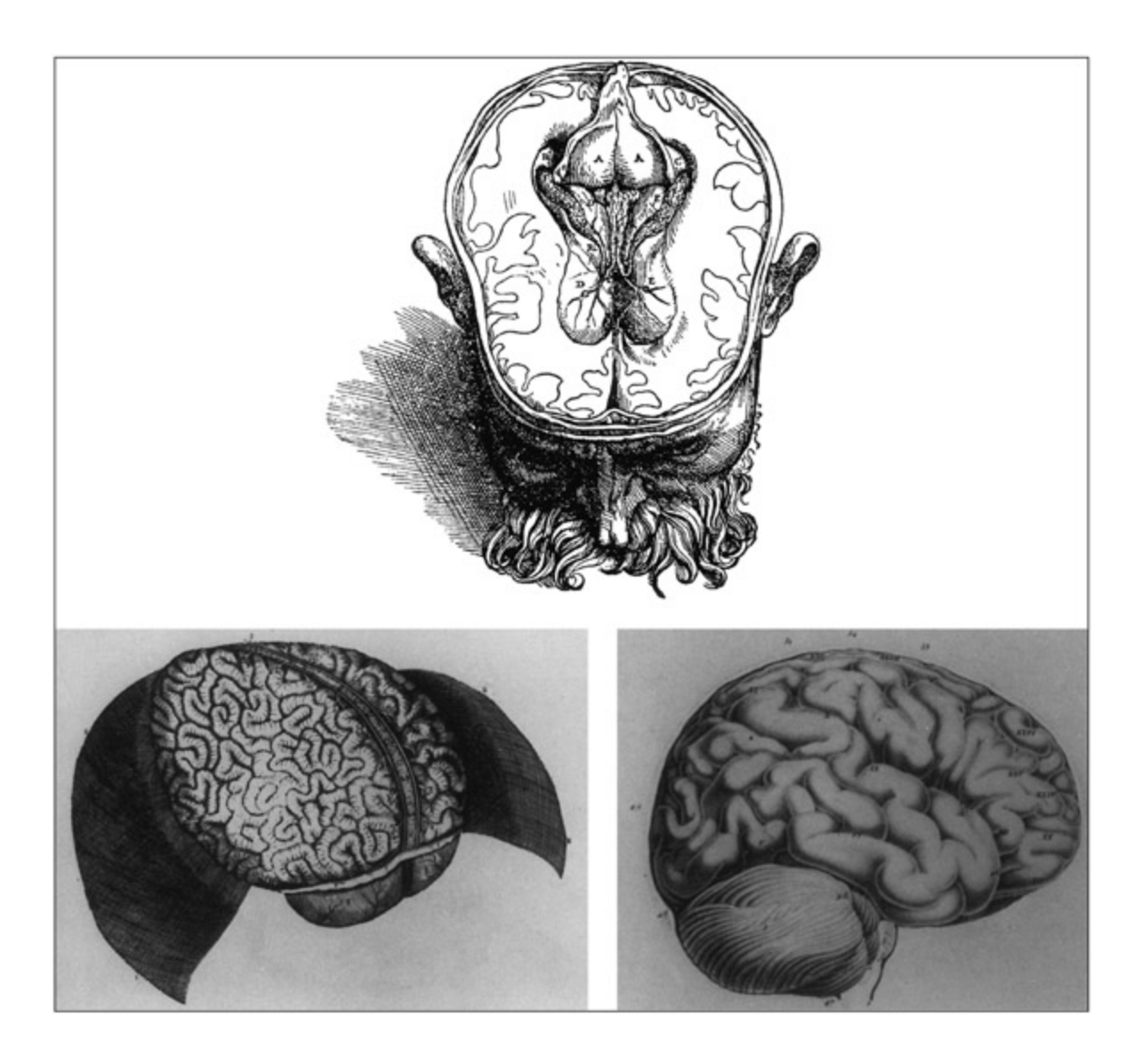
Drawings of the brain from Vesalius (1543) (top), de Viessens (1685) (boom le) and Gall and Spurzheim (1810) (boom right). Note how the earlier two drawings emphasized the ventricles and/or misrepresented the cortical surface.
📊 그림 설명
세 시대의 뇌 해부도를 비교한 그림이다. 베살리우스(1543)와 de Viessens(1685)의 초기 그림은 뇌실을 강조하고 피질 표면을 부정확하게 묘사한 반면, Gall과 Spurzheim(1810)의 그림에서야 현대적으로 인식 가능한 뇌 구조가 나타난다. 이는 피질에 대한 과학적 관심이 역사적으로 늦게 발전했음을 시각적으로 보여준다.
Gall (1758–1828) and Spurzheim (1776–1832) received a bad press, historically speaking, because of their invention and advocacy of phrenology. Phrenology had two key assumptions; first, that different regions of the brain perform different functions and are associated with different behaviors; and second, that the size of these regions produces distortions of the skull and correlates with individual differences in cognition and personality. Taking these two ideas in turn, the notion of
functional specialization within the brain has effectively endured into modern cognitive neuroscience, having seen off a number of allenges over the years (Flourens, 1824; Lashley, 1929). e observations of Penfield and co-workers on the electrically stimulated brain provide some striking examples of this principle. However, the functional specializations of phrenology were not empirically derived and were not constrained by theories of cognition. For example, Fowler’s famous phrenologist’s head had regions dedicated to “parental love,” “destructiveness,” and “firmness.” Moreover, skull shape has nothing to do with cognitive function.
Key Terms
Functional specialization
Different regions of the brain are specialized for different functions.
이 섹션에서는 기능적 특화(functional specialization) 개념을 통해 다양한 뇌 영역(brain regions)이 특정 인지, 감각, 운동 기능에 특화되어 있음을 설명한다. 예를 들어, 피각(occipital lobe)은 주로 시각 정보 처리에, 중심 두개골 경계(central sulcus)는 운동 제어, 측두엽(temporal lobe)은 청각 및 언어 인식에 특화되어 있으며, 이는 이전 섹션에서 논의된 인지 기능의 뇌 기반 메커니즘과 직접적으로 연결된다. 이러한 기능적 분화(functional differentiation)는 고차원 정신 과정(thinking, perceiving, planning)의 실현을 위한 신경생물학적 기초를 제공하며, 인공지능 시스템의 의사결정 및 행동 생성(decision-making and action generation) 설계에 있어 뇌 영역의 기능적 역할을 이해하는 것이 핵심적이다. 특히, 정신-뇌 문제(mind-brain problem)와 관련된 이중주의(dualism) 및 감소주의(reductionism) 논쟁에서 이러한 기능적 특화는 정신적 경험이 물리적 구조(physical substrate)와 어떻게 상호작용하는지를 실증적으로 규명하는 데 기여한다.
Cognitive neuropsychology
The study of brain-damaged patients to inform theories of normal cognition.
인지 신경심리학은 뇌 손상 환자 연구를 통해 정상 인지 기능의 구조를 역추적하는 방법론이다. 브로카(1861)가 언어의 뇌 국소화를 밝힌 이후, 베르니케 등은 언어를 인식/생산/개념 지식으로 세분화하여 뇌 손상이 특정 기능만 선택적으로 손상시킬 수 있음을 보였다. 한편, 19세기 후반 심리학은 컴퓨터 비유와 정보 처리 모델의 발전으로 뇌와 무관하게 인지를 설명하는 방향으로 발전했으나, 이러한 모델은 신경과학과의 연계가 부족한 한계가 있다.
Although phrenology was fatally flawed, the basic idea of different parts of the brain serving different functions paved the way for future developments in the nineteenth century, the most notable of whi are Broca’s (1861) reports of two brain-damaged patients. Broca documented two cases in whi acquired brain damage had impaired the ability to speak but le other aspects of cognition relatively intact. He concluded that language could be localized to a particular region of the brain. Subsequent
studies argued that language itself was not a single entity but could be further subdivided into spee recognition, spee production and conceptual knowledge (Litheim, 1885; Wernie, 1874). is was motivated by the observation that brain damage can lead either to poor spee comprehension and good production, or good spee comprehension and poor production (see Chapter 11 for full details). is suggests that there are at least two spee faculties in the brain and that ea can be independently impaired by brain damage. is body of work was a huge step forward in terms of thinking about mind and brain. First, empirical observations were being used to determine what the building blos of cognition are (is language a single faculty?) rather than listing them from first principles. Second, and related, they were developing models of cognition that did not make direct reference to the brain. at is, one could infer that spee recognition and production were separable without necessarily knowing where in the brain they were located, or how the underlying neurons brought these processes about. e approa of using patients with acquired brain damage to inform theories of normal cognition is called cognitive neuro psyology and remains influential today (Chapter 5 discusses the logic of this method in detail). Cognitive neuropsyology is now effec tively subsumed within the term “cognitive neuroscience,” where the laer phrase is seen as being less restrictive in terms of methodology.
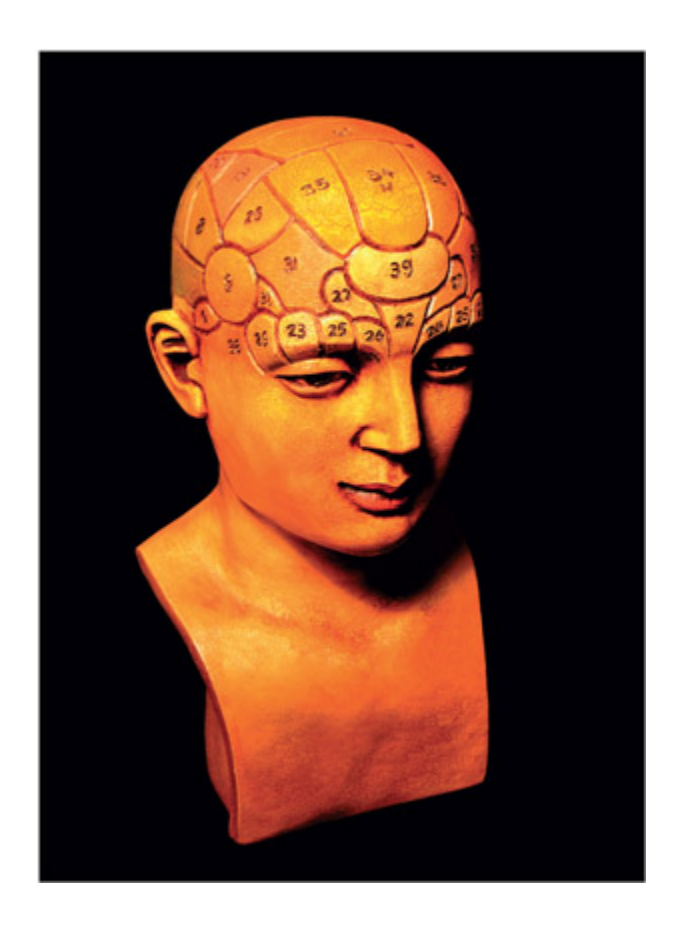
The phrenologist’s head was used to represent the hypothetical functions of different regions of the brain.
📊 그림 설명
골상학자의 두상 모형으로, 두개골의 각 영역에 “부모 사랑”, “파괴성”, “단호함” 등의 인지 및 성격 기능이 할당되어 있다. 이 모형은 기능적 특화의 초기 개념을 반영하지만, 경험적 근거 없이 만들어진 비과학적 분류의 대표적 사례로, 현대 인지 신경과학과의 대비를 보여준다.
Whereas discoveries in the neurosciences continued apace throughout the nineteenth and twentieth centuries, the formation of psyology as a discipline at the end of the nineteenth century took the study of the mind away from its biological underpinnings. is did not reflect a belief in dualism. It was due, in part, to some pragmatic constraints. Early pioneers of psyology, su as William James and Sigmund Freud, were interested in topics like consciousness, aention and personality. Neuroscience has had virtually nothing to say about these issues until quite recently. Another reason for the sism between psyology and biology lies in the notion that one can develop coherent and testable theories of cognition that do not make claims about the brain. e modern foundations of cognitive psyology lie in the computer metaphor of the brain and the information-processing approa, popular from the 1950s onwards. For example, Broadbent (1958)
argued that mu of cognition consists of a sequence of processing stages. In his simple model, perceptual processes occur, followed by aentional processes that transfer information to short-term memory and thence to long-term memory (see also Atkinson & Shiffrin, 1968). ese were oen drawn as a series of box-and-arrow diagrams. e implication was that one could understand the cognitive system in the same way as one could understand the series of steps performed by a computer program, and without reference to the brain. e idea of the mind as a computer program has advanced over the years along with advances in computational science. For example, many cognitive models contain some element of interactivity and parallel processing. Interactivity refers to the fact that stages in processing may not be strictly separate and that later stages can begin before earlier stages are complete. Moreover, later stages can influence the outcome of early ones (top-down processing). Parallel processing refers to the fact that lots of different information can be processed simul taneously (serial computers process ea piece of information one at a time). Although these compu tationally explicit models are more sophisticated than earlier boxand-arrow diagrams, they, like their predecessors, do not always make contact with the neuroscience literature (Ellis & Humphreys, 1999).
Key Terms
Information processing
An approa in whi behavior is described in terms of a sequence of cognitive stages.
이 섹션에서는 행동(behavior)을 인지 단계(cognitive stages)의 연속적인 시퀀스로 설명하는 정보 처리(information processing) 접근법을 소개한다. 이 모델은 사고(thinking), 인식(perceiving), 행동 생성(action generation)과 같은 고차원 인지 과정(higher-order cognitive processes)이 시스템 내에서 어떻게 단계적으로 처리되는지를 강조하며, 이는 이전 섹션에서 논의된 인지 기능의 뇌 기반 메커니즘(brain-based mechanisms of cognition)과 직접적으로 연결된다. 특히, 기능적 특화(functional specialization) 개념과 마찬가지로, 이 접근법은 복잡한 환경에서의 의사결정(decision-making) 및 행동 생성(action generation)을 이해하는 데 필요한 정보 흐름(information flow)의 구조를 명확히 하며, 인공지능 시스템 설계에 있어 인지 과정의 단계적 분석(step-wise analysis of cognitive processes)이 핵심적인 설계 요소로 작용할 수 있음을 제시한다.
Interactivity
Later stages of processing can begin before earlier stages are complete.
이 섹션에서는 인지 처리(cognitive processing)의 단계적 상호작용(interactivity)을 강조하며, 이는 초기 단계의 완료 전에 후기 단계가 시작될 수 있음을 설명한다. 이 개념은 뇌 기반 인지 메커니즘(brain-based cognitive mechanisms)에서 관찰되는 병렬 처리(parallel processing) 및 하위 시스템 간 피드백(feedback between sub-systems)의 특성을 반영하며, 예를 들어 피각(occipital lobe)의 시각 정보 처리와 측두엽(temporal lobe)의 언어 인식이 서로 중첩되며 통합된 인지 기능(integrated cognitive functions)을 형성하는 방식을 설명하는 데 기여한다. 특히, 이는 이전 섹션에서 논의된 기능적 특화(functional specialization) 개념과 연결되어, 정신적 경험(mental experiences)이 뇌 영역 간 동적 상호작용(dynamic interactions between brain regions)을 통해 생성됨을 시사한다. 이러한 상호작용 메커니즘(interactive mechanisms)은 인공지능 시스템의 의사결정(decision-making) 및 행동 생성(action generation) 설계에서 핵심적인 설계 원칙으로 작용하며, 감각-운동-인지(sensory-motor-cognitive) 기능의 비선형적 정보 흐름(non-linear information flow)을 모델링하는 데 기초가 된다.
Top-down processing
The influence of later stages on the processing of earlier ones (e.g. memory influences on perception).
이 섹션에서는 탑다운 처리(top-down processing) 메커니즘을 다루며, 이후 단계(예: 기억)가 이전 단계(예: 인식)에 미치는 영향을 설명한다. 특히, 기억과 같은 고차원 인지 기능이 시각 인식과 같은 저차원 감각 처리 과정에 영향을 주는 방식을 강조하며, 이는 이전 섹션에서 논의된 기능적 특화(functional specialization) 개념과 연결된다. 예를 들어, 측두엽(temporal lobe)에서 형성된 기억 정보가 피각(occipital lobe)의 시각 처리 과정에 편향을 줌으로써, 인지 시스템이 환경 정보를 해석하는 방식에 직접적인 영향을 미친다. 이러한 메커니즘은 인공지능 시스템에서 의사결정(decision-making) 및 행동 생성(action generation)을 위한 고차원 인지 기능의 하위 모듈에 대한 제어 구조(hierarchical control structure) 설계에 핵심적인 역할을 하며, 인지 신경과학(cognitive neuroscience)에서 밝혀낸 뇌 기반 인지 메커니즘의 실증적 근거를 반영한다.
Parallel processing
Different information is processed at the same time (i.e. in parallel).
이 섹션에서는 병렬 처리(parallel processing) 개념을 통해 다양한 정보가 동시에 처리되는 메커니즘을 설명하며, 인지 과정(cognitive processes)을 설명하는 데 있어 뇌 구조와 직접적인 연관 없이 박스-화살표 모델(box-and-arrow model)과 연결주의 모델(connectionist model)을 예시로 제시한다. 특히, 초기 단계와 후기 단계의 중첩적 처리는 이전 섹션에서 논의된 단계적 상호작용(interactivity)과 기능적 특화(functional specialization) 개념과 연결되며, 피각(occipital lobe)의 시각 정보 처리와 측두엽(temporal lobe)의 언어 인식이 병렬적으로 작동함으로써 통합된 인지 기능(integrated cognitive functions)을 형성하는 방식을 설명한다. 이러한 모델들은 뇌 기반 메커니즘(brain-based mechanisms)을 직접적으로 참조하지 않으면서도 고차원 인지 과정(higher-order cognitive processes)을 설명하는 대안적인 접근법으로 제시되며, 탑다운 처리(top-down processing)와 같은 정보 처리(information processing)의 복잡성을 보완하는 역할을 수행한다.
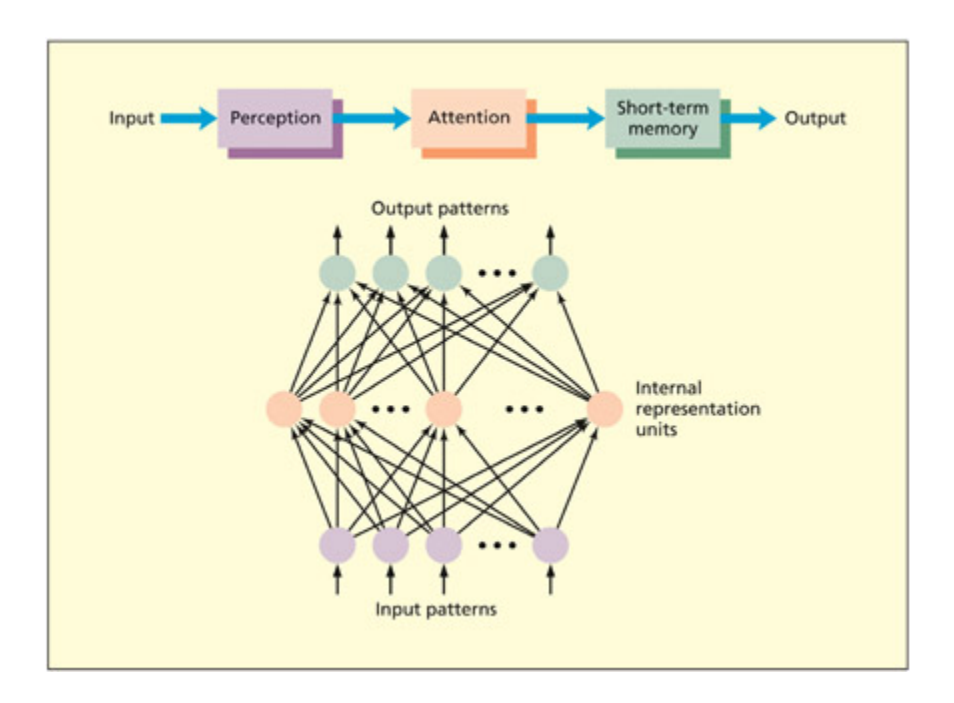
Examples of box-and-arrow and connectionist models of cognition. Both represent ways of describing cognitive processes that need not make direct reference to the brain.
📊 그림 설명
박스-화살표 모델과 연결주의 모델의 비교 예시이다. 박스-화살표 모델은 인지 과정을 순차적 단계(지각 → 주의 → 단기기억 → 장기기억)로 도식화하며, 연결주의 모델은 상호 연결된 노드들의 네트워크를 통해 병렬적 정보 처리를 표현한다. 두 모델 모두 뇌 구조를 직접 참조하지 않고 인지 과정을 설명하는 방식이다.
Computational and Connectionist Models of Cognition
Summary
1980년대 컴퓨터 발전으로 연결주의(connectionist) 또는 PDP 모델이 등장했다. 이 모델은 노드, 활성화, 가중치로 구성되며, 경험을 통한 가중치 조정으로 학습하고 병렬 처리가 가능하다. 노드-뉴런, 활성화-발화율, 가중치-신경 연결의 유사성에서 신경생물학적 타당성이 주장되나, 실제 뇌보다 과도하게 강력하다는 비판도 존재한다. 이 모델이 뇌의 실제 작동 방식을 반영하는지는 인지 신경과학의 실험적 검증이 필요하다.
In the 1980s, powerful computers became widely accessible as never before. is enabled cognitive psyologists to develop computationally explicit models of cognition (that literally calculate a set of outputs given a set of inputs) rather than the computationally inspired, but underspecified, box-and-arrow approa. One particular way of implementing computational models has been very influential; namely the neural network, connectionist or parallel distributed processing (PDP) approa (McClelland et al., 1986). ese models are considered in a number of places throughout this book, notably in the apters dealing with memory, speaking and literacy.
Connectionist models have a number of aritectural features. First, they are composed of arrays of simple information-carrying units called nodes. Nodes are information-carrying in the sense that they respond to a particular set of inputs (e.g. certain leers, certain sounds) and produce a restricted set of outputs. e responsiveness of a node depends on how strongly it is connected to other nodes in the network (the “weight” of the connection) and how active the other nodes are. It is possible to calculate, mathematically, what the output of any node would be, given a set of input activations and a set of weights. ere are a number of advantages to this type of model. For example, by adjusting the weights over time as a result of experience, the model can develop and learn. e parallel processing enables large amounts of data to be processed simultaneously. A more controversial claim is that they have “neural plausibility.” Nodes, activation and weights are in many ways analogous to neurons, firing rates and neural connectivity, respectively. However, these models have been criticized for being too powerful in that they can learn many things that real brains cannot (Pinker & Prince, 1988). A more moderate view is that
connectionist models provide examples of ways in whi the brain might implement a given cognitive function. Whether or not the brain actually does implement cognition in that particular way will ultimately be a question for empirical resear in cognitive neuroscience.
The birth of cognitive neuroscience
Summary
현대 인지 신경과학의 탄생은 뇌 영상 기술의 발전에 기반한다. 1970년대까지 뇌 영상은 신경과학 공동체에서 주목받지 못했으나, 1980년대 인지 심리학자들의 참여로 기존의 실험 설계와 정보 처리 모델이 영상 기술과 결합되면서 비약적으로 발전했다. 이 기술은 기능적 영상의 도입뿐 아니라 뇌 손상의 정밀한 생체 내 분석도 가능하게 했다.
It was largely advances in imaging tenology that provided the driving force for modern-day cognitive neuroscience. Raile (1998) describes how brain imaging was in a “state of indifference and obscurity in the neuroscience community in the 1970s” and might never have reaed prominence if it were not for the involvement of cognitive psyologists in the 1980s. Cognitive psyologists had already established experimental designs and information-processing models that could potentially fit well with these emerging methods. It is important to note that the tenological advances in imaging not only led to the development of functional imaging, but also enabled brain lesions to be described precisely in ways that were never possible before (except at post mortem).
Key Terms
Neural network models
Computational models in whi information processing occurs using many interconnected nodes.
이 섹션에서는 신경망 모델(Neural network models)의 기초 개념을 설명하며, 정보 처리가 다양한 연결된 노드(interconnected nodes)를 통해 이루어지는 계산 모델(computational models)의 구조를 강조한다. 이는 이전 섹션에서 논의된 기능적 특화(functional specialization)와 병렬 처리(parallel processing) 개념과 직접적으로 연결되며, 뇌 기반 인지 메커니즘(brain-based cognitive mechanisms)을 모사하는 데 기여한다. 특히, 연결주의(connectionist) 접근법은 신경망(neural network)의 분산 처리(distributed processing) 특성을 반영하며, 초기 단계와 후기 단계의 중첩적 처리를 통해 통합된 인지 기능(integrated cognitive functions)을 형성하는 방식을 설명한다. 이러한 모델은 인공지능 시스템의 의사결정(decision-making) 및 행동 생성(action generation) 메커니즘 설계에 필요한 이론적 틀을 제공하며, 피각(occipital lobe)의 시각 정보 처리와 측두엽(temporal lobe)의 언어 인식과 같은 기능적 특화(functional specialization)를 모방하는 데 기반을 둔다.
Nodes
The basic units of neural network models that are activated in response to activity in other parts of the network.
이 섹션에서는 신경망 모델의 기본 단위(nodes)가 네트워크 내 다른 영역의 활동에 반응하여 활성화되는 메커니즘을 설명하며, 현대 인지 신경과학(cognitive neuroscience)에서 사용되는 다양한 방법론의 다양성을 강조한다. 기록 방법(recording methods)과 자극 방법(stimulation methods)의 구분은 핵심적이며, 인간 뇌에 대한 직접적인 전기 자극은 현재 거의 사용되지 않으며, 대신 두개골을 통해 자극(transcranial stimulation)을 활용하는 경두개 자극(TMS, tDCS)이 주요 기법으로 자리 잡았다. 또한 전기생리학적(EEG/ERP, single-cell recordings) 및 자기생리학적(MEG) 방법은 뉴런 자체의 전기·자기 특성을 기록하는 반면, 기능적 영상(PET, fMRI)은 뇌 혈류 변화에 따른 생리적 반응을 기록하는 혈관학적(hemodynamic) 방법으로 구분되며, 이들은 각각 제3장(Chapter 3)과 제4장(Chapter 4)에서 자세히 다루어진다.
Present-day cognitive neuroscience is composed of a broad diversity of methods. ese will be discussed in detail in subsequent apters. At this juncture, it is useful to compare and contrast some of the most prominent methods. e distinction between recording methods and stimulation methods is crucial in cognitive neuroscience. Direct electrical stimulation of the brain in humans is now rarely carried out. e modern-day equivalent of these studies uses stimulation across the skull rather than directly to the brain (i.e. transcranially). is includes transcranial magnetic stimulation (TMS) and transcranial direct current stimulation (tDCS). ese will be considered in Chapter 5, alongside the effect of organic brain lesions. Electrophysiological methods (EEG/ERP and single-cell recordings) and magnetophysiological methods (MEG) record the electrical and magnetic properties of neurons themselves. ese methods are considered in Chapter 3. In contrast, functional imaging methods (PET and fMRI) record physiological anges associated with blood supply to the brain, whi evolve more slowly over time. ese are called hemodynamic methods and are considered in Chapter 4.
Key Term
Temporal resolution
The accuracy with whi one can measure when an event (e.g. a physiological ange) occurs.
이 섹션에서는 시간 해상도(temporal resolution)를 중심으로 인지 신경과학에서 사용되는 다양한 방법론의 특성을 분석한다. 시간 해상도는 특정 사건이 발생하는 시점을 얼마나 정확하게 측정할 수 있는지를 나타내며, EEG/ERP, MEG, TMS, 단일 세포 기록(single-cell recordings)은 밀리초 단위의 높은 해상도를 제공하지만, fMRI는 천만 분자 반응의 느린 특성으로 인해 수초 단위의 낮은 해상도를 보인다. 반면 공간 해상도(spatial resolution)는 사건이 발생하는 위치를 측정하는 정확도로, 기능적 영상(functional imaging)과 뇌 손상 분석(lesion analysis)은 밀리미터 수준의 해상도를 가지지만, 단일 세포 기록은 신경세포 수준의 극도로 높은 해상도를 제공한다. 또한 침습성(invasiveness)에 따라 PET은 방사성 동위원소 주입이 필요해 침습적이지만, tDCS나 TMS는 비침습적 기법으로 활용되고 있으며, 단일 세포 기록은 일반적으로 비인간 동물에서만 수행된다. 이러한 방법론들은 시간 해상도, 공간 해상도, 침습성, 측정 대상 뇌 특성(전기, 자기, 혈류 등)에 따라 분류되며, **Churland and Sejnowski(1988)**의 연구를 바탕으로 설명된다.
The Difference Methods used ing cognitive neuroscience
| Method | Method type | Invasiveness | Brain propertyused |
|---|---|---|---|
| EEG/ERP | Recording | Non-invasive | Electrical |
| Single-cell(and multi-unit)recordings | Recording | Invasive | Electrical |
| TMS | Stimulation | Non-invasive | Electromagnetic |
| tDCS | Stimulation | Non-invasive | Electrical |
| MEG | Recording | Non-invasive | Magnetic |
| PET | Recording | Invasive | Hemodynamic |
| fMRI | Recording | Non-invasive | Hemodynamic |
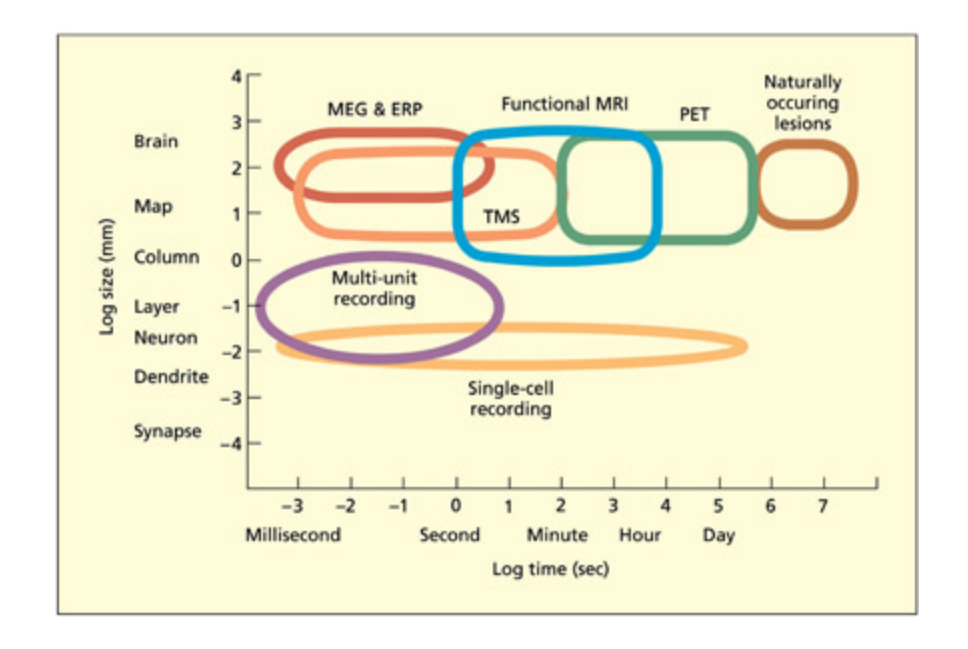
The methods of cognitive neuroscience can be categorized according to their spatial and temporal resolution.
Adapted from Churland and Sejnowski, 1988.
📊 그림 설명
인지 신경과학의 주요 연구 방법들을 공간 해상도(spatial resolution)와 시간 해상도(temporal resolution) 두 축으로 분류한 도표이다. EEG/MEG는 밀리초 단위의 높은 시간 해상도를, fMRI는 밀리미터 수준의 높은 공간 해상도를, 단일 세포 기록은 양 차원 모두에서 높은 해상도를 제공한다. 각 방법의 상대적 장단점을 비교하여 연구 목적에 맞는 기법 선택에 도움을 준다.
The methods of cognitive neuroscience can be placed on a number of dimensions:
- The temporal resolution refers to the accuracy with whi one can measure when an event is occurring. e effects of brain damage are permanent and so this has no temporal resolution as su. Methods such as EEG, MEG, TMS, and single-cell recording have millisecond resolution. fMRI has a temporal resolutions of several seconds that reflects the slower hemodynamic response.
- The spatial resolution refers to the accuracy with whi one can measure where an event is occurring. Lesion and functional imaging methods have comparable resolution at the millimeter level, whereas single-cell recordings have spatial resolution at the level of the neuron.
- The invasiveness of a method refers to whether the equipment is located internally or externally. PET is invasive because it requires an injection of a radio-labeled isotope. Single-cell recordings are performed on the brain itself and are normally only carried out in non-human animals.
Key Term
Spatial resolution
The accuracy with whi one can measure where an event (e.g. a physiological ange) is occurring.
이 섹션에서는 공간 해상도(spatial resolution)를 중심으로, 특정 사건(예: 생리적 변화)의 발생 위치를 얼마나 정확하게 측정할 수 있는지를 설명한다. 이는 시간 해상도(temporal resolution)와 구별되며, fMRI와 같은 기법은 높은 공간 해상도를 제공해 뇌 내 특정 영역의 활동을 세부적으로 파악할 수 있는 반면, EEG/ERP는 공간 해상도가 상대적으로 낮아 전체적인 전두엽 또는 두정엽 같은 대규모 영역만을 감지하는 경향이 있다. 이와 같은 해상도 특성은 이전 섹션에서 논의된 기능적 특화(functional specialization) 분석과 연결되어, 뇌 기반 인지 메커니즘을 이해하는 데 핵심적인 역할을 한다.
Does Cognitive Psychology Need the Brain?
Summary
Coltheart(2004b)는 뇌 영상 데이터가 인지 이론에 기여할 수 있는지 의문을 제기했으나, Henson(2005)은 fMRI 데이터도 반응 시간처럼 인지 이론을 검증하는 종속 변수로 활용될 수 있다고 반박한다. 단어 인식 실험에서 반응 시간과 좌측 방추 피질의 fMRI 활성화가 동일한 패턴을 보인 사례가 이를 뒷받침한다. 또한 뇌를 단순한 하드웨어로 보는 컴퓨터 비유는 부적절하며, 뇌의 느린 신경 반응 속도가 병렬 탐색을 선호하는 이유처럼, 뇌는 정보 처리에 인과적 제약을 부여한다.
As already noted, cognitive psyology developed substantially from the 1950s, using information-processing models that do not make direct reference to the brain. If this way of doing things remains successful, then why ange? Of course, there is no reason why it should ange. e claim is not that cognitive neuroscience is replacing cognitive psyology
(although some might endorse this view), but merely that cognitive psyological theories can inform theories and experiments in the neurosciences and vice versa. However, others have argued that this is not possible by virtue of the fact that information-processing models do not make claims about the brain (Coltheart, 2004b; Harley, 2004).
Coltheart (2004b) poses the question: “Has cognitive neuroscience, or if not might it ever (in principle, or even in practice), successfully used data from cognitive neuroimaging to make theoretical decisions entirely at the cognitive level (e.g. to adjudicate between competing information-processing models of some cognitive system)?” (p. 21). Henson (2005) argues that it can in principle and that it does in practice. He argues that data from functional imaging (blood flow, blood oxygen) comprise just another dependent variable that one can measure. For example, there are a number of things that one could measure in a standard forced-oice reaction-time task: reaction time, error rates, sweating (skin conductance response), muscle contraction (electromyograph), scalp electrical recordings (EEG) or hemodynamic anges in the brain (fMRI). Ea measure will relate to the task in some way and can be used to inform theories about the task.
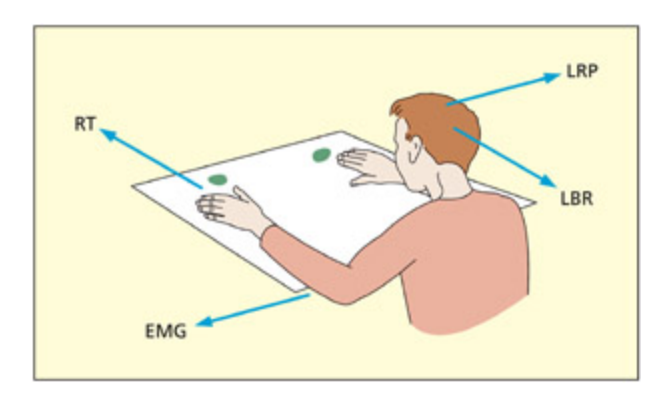
One could take many different measures in a forced-oice response task: behavioral (reaction time [RT], errors) or biological (electromyographic [EMG], lateralized readiness potential [LRP], lateralized BOLD response [LBR]). All measures could potentially be used to inform cognitive theory. Adapted from Henson, 2005. By kind permission of the Experimental Psyology Society.
📊 그림 설명
강제 선택 반응 과제에서 측정 가능한 다양한 종속 변수를 보여준다. 행동적 측정(반응 시간, 오류율)과 생물학적 측정(EMG, LRP, fMRI BOLD 반응) 모두 인지 이론을 검증하는 데 활용될 수 있음을 시각적으로 제시하며, 뇌 기반 측정이 행동 측정과 상호 보완적임을 강조한다.
To illustrate this point, consider an example. One could ask a simple question su as: Does visual recognition of words and leers involve computing a representation that is independent of case? For example, does the reading system treat “E” and “e” as equivalent at an early stage in processing or are “E” and “e” treated as different leers until some later stage (e.g. saying them aloud)? A way of investigating this using a reaction-time measure is to present the same word twice in the same or different case (e.g. radio-RADIO, RADIO-RADIO) and compare this with situations in whi the word differs (e.g. mouse-RADIO, MOUSE-RADIO). One general finding in reaction-time studies is that it is faster to process a stimulus if the same stimulus has recently been presented. For example, if asked to make a speeded decision about RADIO (e.g. is it animate or inanimate?) then performance will be faster if it has been previously encountered. Dehaene et al. (2001) investigated this meanism by comparing reaction-time measures with functional imaging (fMRI) measures. In this task, the first word in ea pair was presented very briefly and was followed by visual noise. is prevents the participants from consciously perceiving it and, hence, one can be sure that they are not saying the word. e second word is consciously seen and requires a response. Dehaene et al. found that reaction times are faster to the second word when it follows the same word, irrespective of case. Importantly, there is a region in the le fusiform cortex that shows the same effect (although in terms of “activation” rather than response time). In this concrete example, it is meaningless to argue that one type of measure is “beer” for informing cognitive theory (to return to Coltheart’s question) given that both are measuring different aspects of the same thing. One could explore the nature of this effect further by, for instance, presenting the same
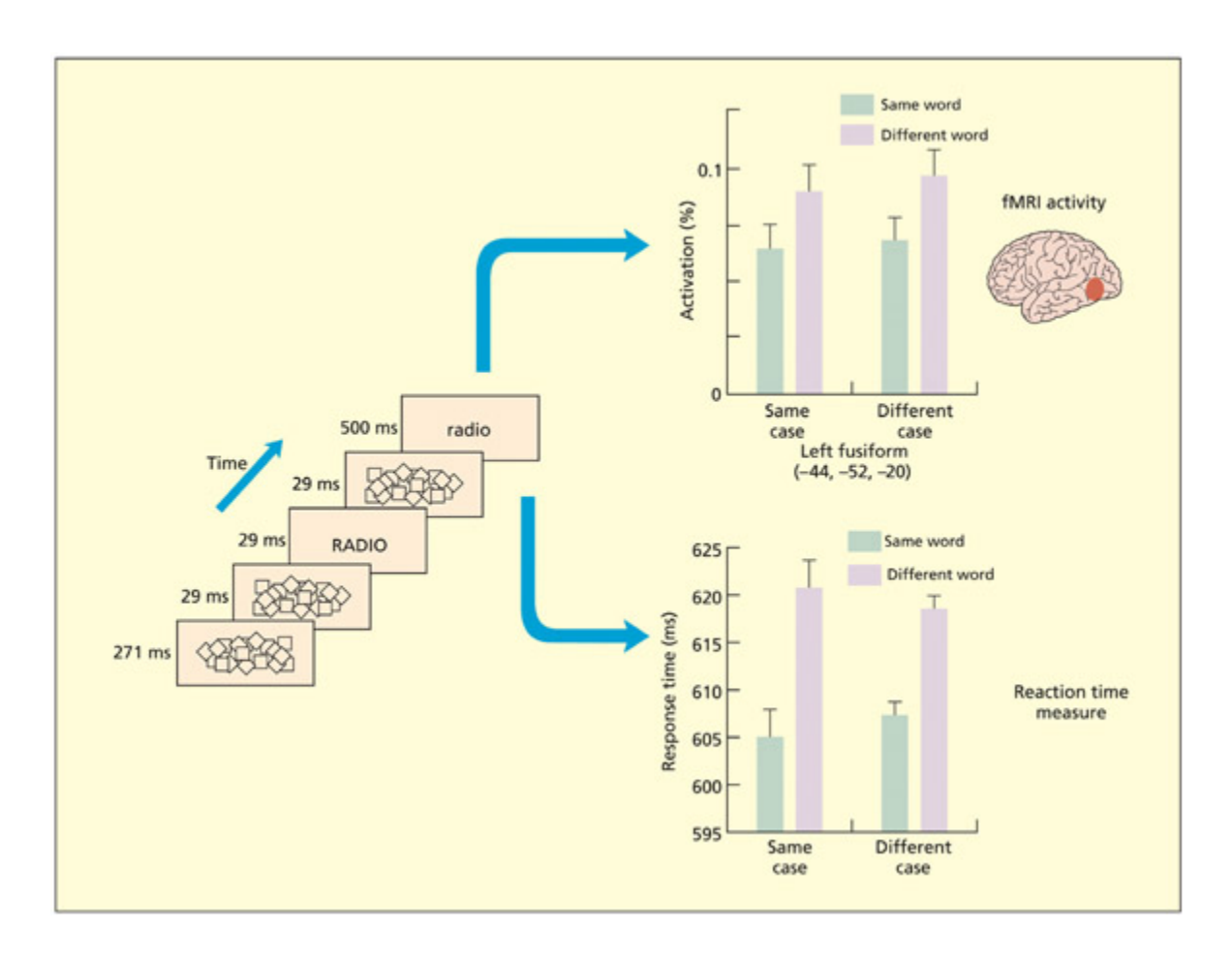
Both reaction times and fMRI activation in the le fusiform region demonstrate more efficient processing of words if they are preceded by subliminal presentation of the same word, irrespective of case.
Adapted from Dehaene et al., 2001.
📊 그림 설명
Dehaene 등(2001)의 실험 결과로, 동일 단어의 역하 제시(subliminal presentation) 후 반응 시간과 좌측 방추 피질의 fMRI 활성화가 모두 감소하는 반복 점화(repetition priming) 효과를 보여준다. 대소문자(case)와 무관하게 이 효과가 나타나, 시각적 단어 인식이 초기 단계에서 대소문자 독립적 표상을 형성함을 시사한다.
word in different languages (in bilingual speakers), presenting the words in different locations on the screen, and so on. is would provide further insights into the nature of this meanism (e.g. what aspects of vision does it entail? Does it depend on word meaning?). However, both reaction-time measures and brain-based measures could be potentially informative. It is not the case that functional imaging is merely telling us where cognition is happening and not how it is happening.
Another distinction that has been used to contrast cognitive psyology and cognitive neuroscience is that between soware and hardware, respectively (Coltheart, 2004b; Harley, 2004). is derives from the familiar
computer analogy in whi one can, supposedly, learn about information processing (soware) without knowing about the brain (hardware). As has been shown, to some extent this is true. But the computer analogy is a lile misleading. Computer soware is wrien by computer programmers (who, incidentally, have human brains). However, information processing is not wrien by some third person and then inscribed into the brain. Rather, the brain provides causal constraints on the nature of information processing. is is not analogous to the computer domain in whi the link between soware and hardware is arbitrarily determined by a computer programmer. To give a simple example, one model of word recognition suggests that words are recognized by searing words in a mental dictionary one by one until a mat is found (Forster, 1976). e weight of evidence from cognitive psyology argues against this serial sear, and in favor of words being seared in parallel (i.e. all candidate words are considered at the same time). But why does human cognition work like this? Computer programs can be made to recognize words adequately with both serial sear and parallel sear. e reason why human information processing uses a parallel sear and not a serial sear probably lies in the relatively slow neural response time (acting against serial sear). is constraint does not apply to the fast processing of computers. us, cognitive psyology may be sufficient to tell us the structure of information processing but it may not answer deeper questions about why information processing should be configured in that particular way.
Does Neuroscience Need Cognitive Psychology?
Summary
기능적 영상 기술이 뇌과학에 혁신을 가져왔으나, 뇌를 관찰할 때 보이는 것은 회백질, 백질, 혈관 등 물리적 구조이지 기억이나 사고 같은 정신적 현상이 아니다. 따라서 뇌 영상이 골상학의 오류를 반복하지 않으려면, 인지 심리학의 이론적 틀이 적절한 연구 질문을 설정하는 데 필수적이다. 인지 개념이 궁극적으로 생물학적 설명으로 대체될지 공존할지는 미래의 과제이나, 현재로서는 인지 심리학이 인지 신경과학에서 핵심적 역할을 수행한다.
It would be no exaggeration to say that the advent of teniques su as functional imaging have revolutionized the brain sciences. For example, consider some of the newspaper headlines that have appeared in recent years. Of course, it has been well known since the nineteenth century that pain, mood, intelligence, and sexual desire are largely products of processes
in the brain. e reason headlines su as these are extraordinary is because now the tenology exists to be able to study these processes in vivo. Of course, when one looks inside the brain one does not “see” memories, thoughts, perceptions, and so on (i.e. the stuff of cognitive psyology). Instead, what one sees is gray maer, white maer, blood vessels, and so on (i.e. the stuff of neuroscience). It is the laer, not the former, that one observes when conducting a functional imaging experiment. Developing a framework for linking the two will necessarily entail dealing with the mind–body problem either tacitly or explicitly. is is a daunting allenge.
Is functional imaging going to lead to a more sophisticated understanding of the mind and brain than was aieved by the phrenologists? Some of the newspaper
Key Terms
Modularity
Summary
모듈성(Modularity)은 특정 인지 과정이나 뇌 영역이 처리할 수 있는 정보 유형에 제한이 있다는 개념으로, 기능적 특화와 밀접하게 연결된다. 모듈 간 정보 처리의 분리성을 강조하며, 인지 기능의 구조적 분리와 기능적 통합 사이의 균형을 설명하는 이론적 틀을 제공한다.
e notion that certain cognitive processes (or regions of the brain) are restricted in the type of information they process.
Domain specificity
Summary
도메인 특이성(domain specificity)은 특정 인지 과정이나 뇌 영역이 색상, 얼굴, 단어 등 한 가지 유형의 정보에만 전담된다는 개념이다. 이는 기능적 특화의 구체적 형태로, 뇌 영역이 처리하는 정보의 범위에 대한 논쟁을 반영한다. 언론은 이러한 발견을 과도하게 단순화하여 보도하는 경향이 있다.
e idea that a cognitive process (or brain region) is dedicated solely to one particular type of information (e.g. colors, faces, words).
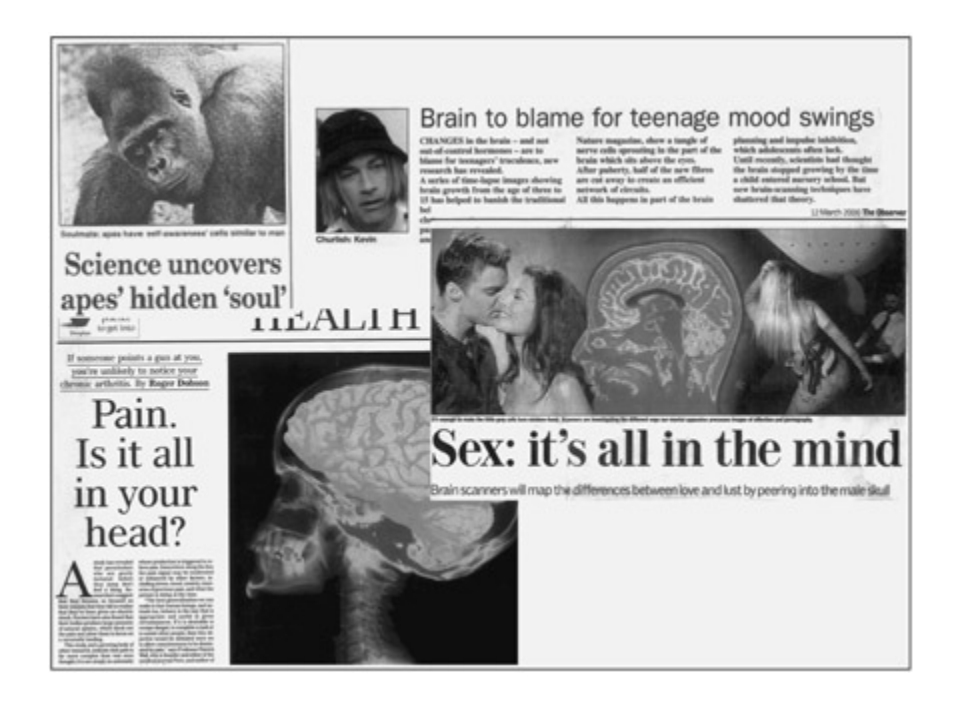
e media loves to simplify the findings of cognitive neuroscience. Many newspaper stories appear to regard it as counterintuitive that sex, pain and mood would be products of the brain. Sunday Times, 21 November 1999; Metro, 5 January 2001; The Observer, 12 Mar 2000; The Independent, 27 May 1999.
📊 그림 설명
인지 신경과학 연구 결과를 보도한 신문 헤드라인 모음이다. 성욕, 통증, 기분 등이 뇌의 산물이라는 사실을 마치 새로운 발견인 것처럼 보도하는 사례들을 보여주며, 대중 매체가 과학적 발견을 과도하게 단순화하거나 도메인 특이성 개념을 왜곡하여 전달하는 경향을 비판적으로 제시한다.
Is the Brain Modular?
Summary
Fodor(1983)의 모듈성 이론은 모듈(색, 형태, 얼굴 등 특정 정보 처리)과 중앙 시스템(기억, 주의 등 도메인 독립적 처리)을 구분한다. 그러나 도메인 특이성이 반드시 선천적이지 않을 수 있고, 독서처럼 진화적으로 최근 등장한 기능은 유전적 기원을 가질 수 없으며, 상호작용 증거는 모듈의 완전한 분리를 부정한다. 실증적 증거는 강한 모듈성을 지지하지 않으나, 도메인 특이성과 도메인 일반성의 경계에 대한 논쟁은 여전히 활발하다.
e notion that the brain contains different regions of functional specialization has been around in various guises for 200 years. However, one particular variation on this theme has aracted particular aention and controversy—namely Fodor’s (1983, 1998) theory of modularity. First, Fodor makes a distinction between two different classes of cognitive process: central systems and modules. e key difference between them relates to the types of information they can process. Modules are held to demonstrate domain specificity in that they process only one particular type of information (e.g. color, shape, words, faces), whereas central systems are held to be domain independent in that the type of information processed is non-specific
(candidates would be memory, aention, executive functions). According to Fodor, one advantage of modular systems is that, by processing only a limited type of information, they can operate rapidly, efficiently and in isolation from other cognitive systems. An additional claim is that modules may be innately specified in the genetic code.
Many of these ideas have been criticized on empirical and theoretical grounds. For example, it has been suggested that domain specificity is not innate, although the means of acquiring it could be (Karmiloff-Smith, 1992). Moreover, systems like reading appear modular in some respects but cannot be innate because they are recent in evolution. Others have argued that evidence for interactivity suggests that modules are not isolated from other cognitive processes (Farah, 1994).
On balance, the empirical evidence does not favor this strong version of modularity. However, there is still an active debate over the organizing principles of the brain. For instance, the extent to whi different regions of the brain are domain specific or are domain general is still debated (Fedorenko et al., 2013).
reports in the figure suggest it might not. One reason why phrenology failed is because the method had no real scientific grounding; the same cannot be said of functional imaging. Another reason why phrenology failed was that the psyological concepts used were naïve. It is for this reason that functional imaging and other advances in neuroscience do require the insights from cognitive psyology to frame appropriate resear questions and avoid becoming a new phrenology (Ual, 2001).
e question of whether cognitive, mind-based concepts will eventually become redundant (under a reductionist account) or coexist with neuralbased accounts (e.g. as in dual-aspect theory) is for the future to decide. But for now, cognitive, mind-based concepts have an essential role to play in cognitive neuroscience.
Summary and Key Points of the Chapter
Summary
이 장의 핵심은 네 가지로 요약된다. (1) 심신 문제는 물리적 뇌가 정신적 경험을 어떻게 생성하는지에 대한 근본적 질문이다. (2) 뇌 영역의 기능적 특화가 실증적으로 확인되었으나, 단순 국소화를 넘어 작동 메커니즘의 이해가 중요하다. (3) 기능적 뇌 영상이 분야 발전의 핵심 동력이었다. (4) 인지 심리학과 신경과학은 상호 보완적이며, 생물학적 측정은 인지 이론의 대안적 증거원이 된다.
- e mind–body problem refers to the question of how physical maer (the brain) can produce mental experiences, and this remains an enduring issue in cognitive neuroscience.
- To some extent, the different regions of the brain are specialized for different functions.
- Functional neuroimaging has provided the driving force for mu of the development of cognitive neuroscience, but there is a danger in merely using these methods to localize cognitive functions without understanding how they work.
- Cognitive psyology has developed as a discipline without making explicit references to the brain. However, biological measures can provide an alternative source of evidence to inform cognitive theory and the brain must provide constraining factors on the nature and development of the information-processing models of cognitive science.
Example Essay questions
Summary
이 장의 핵심 논점을 다루는 에세이 질문 세 가지가 제시된다: (1) 심신 문제와 이를 해결하기 위한 철학적 틀(이원론, 환원주의, 이중면 이론), (2) 인지 신경과학이 새로운 골상학인가에 대한 비판적 검토, (3) 인지 심리학과 신경과학의 상호 필요성에 대한 논의.
- What is the “mind–body problem” and what frameworks have been put forward to solve it?
- Is cognitive neuroscience the new phrenology?
- Does cognitive psyology need the brain? Does neuroscience need cognitive psyology?
Recommended Further Reading
Summary
**Henson (2005)**는 기능적 뇌 영상이 심리학 실험에서 어떤 역할을 하는지 정리하며, 해당 기술에 대한 일반적인 비판을 반박하는 내용을 담고 있다.
Henson, R. (2005). What can functional neuroimaging tell the experimental psyologist? Quarterly Journal of Experimental Psychology, 58A, 193–233. An excellent summary of the role of functional imaging in psyology and a rebual of common criticisms. is debate can also be followed in a series of articles in Cortex (2006, 42, 387–427).
**Shallice & Cooper (2011)**의 저서는 “개념적 기초”에 대한 장을 통해 이 섹션에서 다룬 주요 이슈를 보다 상세히 논의한다.
Shallice, T. & Cooper, R. P. (2011). The organisation of mind. Oxford, UK: Oxford University Press. e apters on “conceptual foundations” deal with many of the issues toued on in the present apter in more detail.
**Ual (2001)**은 인지 기능을 뇌 특정 영역에 국한시키는 데 있어 기술적 한계와 방법론적 제약을 분석한 책으로, 인지 신경과학의 발전 과정을 이해하는 데 유용하다.
Ual, W. R. (2001). The new phrenology: The limits of localizing cognitive processes in the brain. Cambridge, MA: MIT Press. An interesting overview of the methods and limitations of cognitive neuroscience.
마지막으로, **Wiens (2015)**는 뇌에 대한 이해가 어떻게 역사적으로 진화해왔는지를 다루며, 신경과학의 역사적 흐름을 파악하는 데 적합한 입문 자료로 추천된다.
Wiens, A. P. (2015). A history of the brain: How we have come to understand the most complex object in the universe. New York: Psyology Press. A good place to start for the history of neuroscience.