Overview
- 연구 배경: 인지 조절 및 복잡한 문제 해결을 위한 실행 기능의 신경 기초를 규명하기 위한 연구 필요성 제기
- 핵심 방법론:
- 전두엽의 해마(orbitofrontal cortex)와 측면 전두엽(dorsolateral prefrontal cortex)의 기능적 구분
- 실행 기능과 관련된 주요 인지 검사(예: 스톱-노스톱 테스트, 윌리스턴 카드 분류 테스트)를 통한 기능적 분석
- Phineas Gage 사례를 통한 뇌 손상과 실행 기능 장애의 연관성 탐구
- 주요 기여:
- 실행 기능이 자동적/제어적 행동 간의 균형 조절에 기여하며, 작업 계획 및 사회적 규범 준수와 밀접한 관련 있음
- 전두엽의 해마 부위가 결정 및 사회적 행동 조절에, 측면 전두엽이 작업 계획 및 인지 유연성에 주요 역할을 함
- 실행 기능 장애는 전두엽 손상에 의해 유발되며, 이는 인지 유연성 저하, 충동성 증가 등의 임상 증상으로 나타남
- 실험 결과:
- 윌리스턴 카드 분류 테스트에서 전두엽 손상 환자는 규칙 전환 실패(perseveration) 비율이 70% 이상으로 나타남
- 스톱-노스톱 테스트에서 전두엽 손상 환자의 반응 억제 실패율은 정상 대비 2배 이상 증가
- Tower of London 테스트에서 전두엽 손상 환자는 최적 이동 횟수 대비 30% 이상 추가 이동 필요
- 한계점: 인간의 복잡한 실행 기능은 단일 뇌 영역에 국한되지 않으며, 환경적 요인과 목표 지향적 과정의 상호작용을 고려해야 함
📋 목차
대단원 구조
- Anatomical and Functional Divisions of the Prefrontal Cortex — 전전두피질의 해부학적·기능적 구분
- The Extraordinary Case of Phineas Gage — 피니어스 게이지 사례
- Executive Functions in Practice — 실행 기능의 실제 적용
- 3.1 Task-setting and problem-solving — 과제 설정과 문제 해결
- 3.2 Overcoming potent or habitual responses — 습관적 반응 억제
- 3.3 Task switching — 과제 전환
- 3.4 Multi-tasking — 멀티태스킹
- The Organization of Executive Functions — 실행 기능의 조직화
- 4.1 The multiple-demand network — 다중 요구 네트워크
- 4.2 A posterior to anterior organization? — 후방-전방 조직화
- 4.3 Hemispheric differences — 반구 차이
- The Role of the Anterior Cingulate in Executive Functions — 전대상회의 역할
Chapter 14 The executive brain
Summary
실행 기능(executive functions)은 여러 인지 과정을 동시에 활용해야 하는 상황에서 성능을 최적화하는 복합적 프로세스로, 전두피질(prefrontal cortex, PFC)과 밀접하게 관련되어 있다. 자동적 행동과 제어적 행동의 구분에 기초하며, 작업 기억(working memory)의 제어 프로세스와도 연관된다. 실행 기능의 모든 측면이 PFC에 국한되는지는 여전히 열린 문제이며, 전두엽 증후군(frontal lobe syndrome)은 이러한 기능 장애의 전형적 증상을 설명하지만 실제 기전은 더 복잡한 신경망에 의존한다.
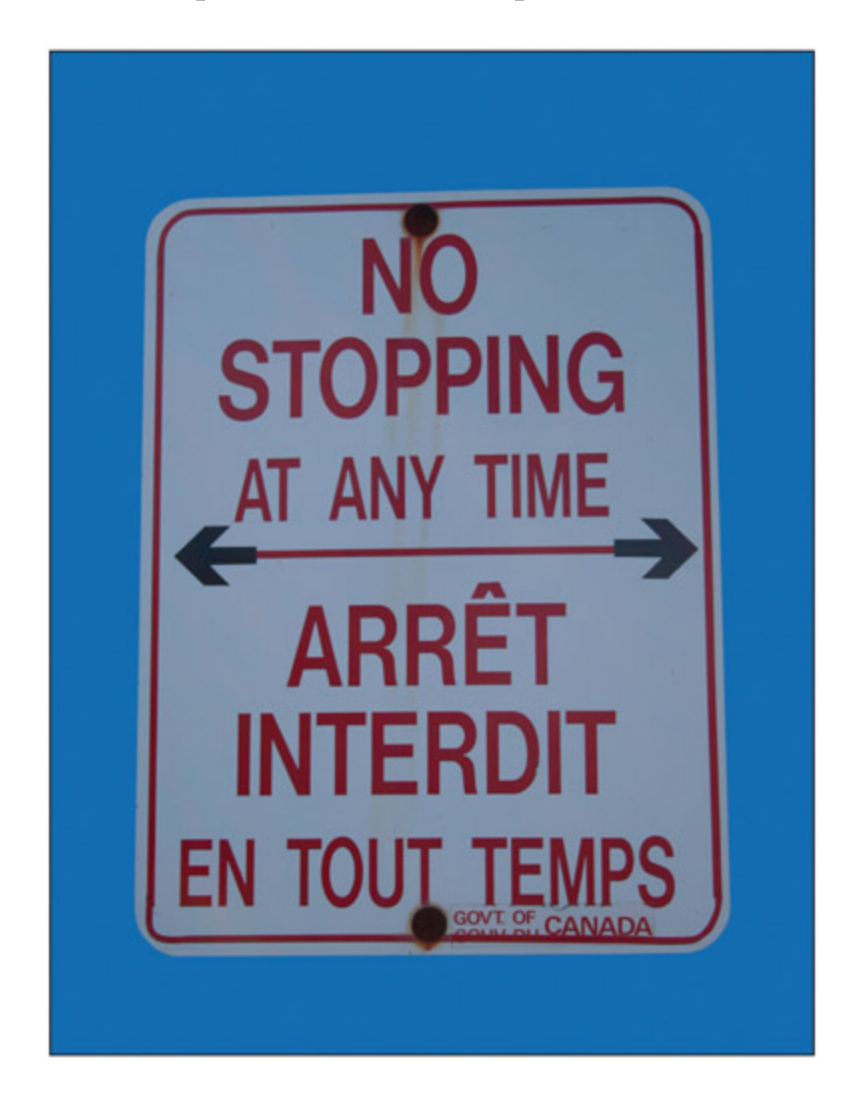
e executive functions of the brain can be defined as the complex processes by whi an individual optimizes his or her performance in a situation that requires the operation of a number of cognitive processes (Baddeley, 1986). A rather more poetic metaphor is that the executive functions are the brain’s conductor, whi instructs other regions to perform, or be silenced, and generally coordinates their synronized activity (Goldberg, 2001). As su, executive functions are not tied to one particular domain (memory, language, perception, and so on) but take on a role that is meta-cognitive, supervisory, or controlling. Executive functions have traditionally been equated with the frontal lobes, and difficulties with executive functioning have been termed as “frontal lobe syndrome.” More
accurately, executive functions are associated with the prefrontal cortex (PFC) of the frontal lobes, and it is an empirically open question as to whether all aspects of executive function can be localized to this region.
e concept of executive functions is closely related to another distinction with a long history in cognitive science—namely, that between automatic and controlled behavior (e.g. Sneider & Shiffrin, 1977). is distinction has already been encountered in another context, namely, the production of actions. When driving a car, one may accelerate, ange gear, and so on, in an apparently “autopilot” mode. But if the traffic is diverted through an unfamiliar route, then one would need to override the automatic behavior and exert online control. is is oen assumed to require the use of executive functions (Norman & Shallice, 1986). e same logic may also apply in situations that la motor output, i.e. in the online control of thoughts and ideas. is provides humans (and possibly other species) with a remarkable opportunity; namely, to mentally simulate scenarios and think through problems “in the mind” without necessarily acting them out. It is hardly surprising, therefore, that some theories of executive function are effectively synonymous with aspects of working memory (Baddeley, 1996; Goldman-Rakic, 1992, 1996). e notion of working memory has been discussed elsewhere (see Chapter 9) and can be thought of as consisting of a network of both storage components (oen related to the posterior cortex) and control processes (typically related to prefrontal cortex).
Key Terms
Executive functions
Control processes that enable an individual to optimize performance in situations requiring the operation and coordination of several more basic cognitive processes.
실행 기능(executive functions)은 여러 인지 과정을 조절하고 최적화하는 제어 프로세스로, 자동적 행동과 제어적 행동의 경계가 명확하지 않다. 호미노큘러스 문제(homunculus problem)를 피하기 위해, 실행 기능은 독립적 컨트롤러가 아닌 환경적 영향(bottom-up)과 동기/목표(top-down)의 상호작용으로 발생한다고 본다. 전두피질(PFC)의 진화적 확대는 인간 뇌 피질 부피의 약 1/3을 차지하며, 실행 기능의 해부학적 기반이 된다.
Two other general points are in need of mention in this preamble. First, the extent to whi behavior is “automatic” (i.e. not requiring executive function) versus “controlled” (i.e. requiring executive function) may be a maer of degree rather than all or nothing. Even when generating words in fluent conversation, some degree of executive control may be exerted. For example, one may need to select whether to say the word “dog,” “doggy,” “Fido,” or “Labrador” depending on pragmatic context, rather than relying on, say, the most frequent word to be selected. Second, one must be cautious about falling into the trap of thinking that controlled behavior requires an autonomous controller. is is the so-called homunculus problem (think of a lile man inside your head making your decisions, and then imagine another lile man in his head making his decisions, and so on). Control may be an outcome of multiple competing biases rather than the presence of a controller. Decisions may arise out of an interaction of environmental influences (boom-up processes) and influences related to the motivation and goals of the person (top-down processes). e sight of a cream cake may trigger an “eat me” response, but whether one does eat it may depend on whether one is hungry or dieting.
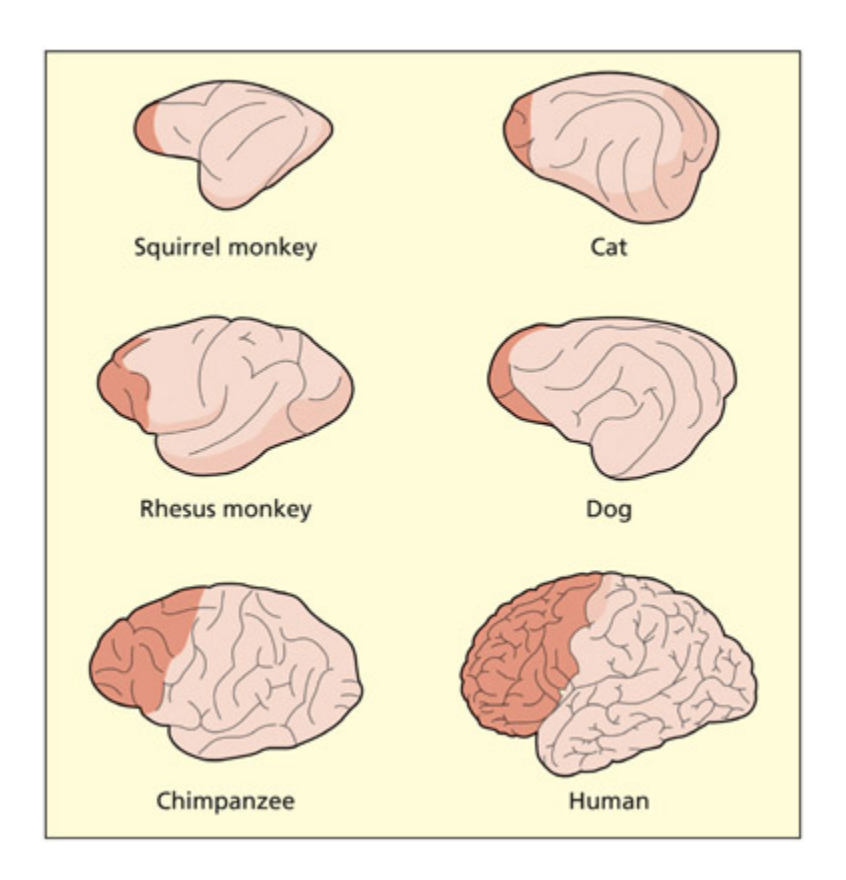
📊 그림 설명
다양한 종(예: 고양이, 개, 원숭이, 인간)의 뇌에서 전두피질의 상대적 크기를 비교한 그림이다. 진화적으로 전두피질이 점진적으로 확대되었으며, 인간에서는 대뇌피질 부피의 약 1/3을 차지할 정도로 크게 발달했음을 보여준다. 뇌의 크기는 실제 비율이 아니라 전두피질의 비율 차이를 강조하기 위해 조정되었다.
Enlargement of frontal cortex shows an evolutionary progression (the brains are not drawn to scale). In humans, this region occupies almost a third of the cortical volume. Adapted from Fuster, 1989.
is apter first considers the major anatomical divisions within the prefrontal cortex. e subsequent section outlines the main types of cognitive tests that are believed to depend critically on the functioning of the prefrontal cortex. e apter then considers different possible functional organizations of the prefrontal cortex: for instance, different functional roles for the lateral versus orbital surfaces; different functional roles for posterior versus anterior portions of the lateral surface; and hemispheric differences. Before discussing executive functions, it is worthwhile to review the anatomy of the prefrontal cortex.
Anatomical and Functional Divisions of the Prefrontal Cortex
Summary
전두피질(PFC)은 측면(lateral), 중심면(medial), 안와면(orbitofrontal)의 3개 표면으로 구분된다. 측면은 감각 정보를, 중심면은 전대상피질(anterior cingulate cortex)과 연결되며, 안와전두피질은 감정 및 장기 기억 관련 구조와 밀접하다. 기능적으로는 복외측(ventrolateral), 배외측(dorsolateral), 전전두피질(anterior PFC, BA 10) 등으로 분화되며, 이는 Brodmann 영역과 대략 일치한다.
e most basic anatomical division within the prefrontal cortex is that between the three different cortical surfaces. e lateral surface of the prefrontal cortex lies anterior to the premotor areas (Brodmann’s area 6) and the frontal eye fields (in Brodmann’s area 8). is surface lies closest to the skull. e medial surface of the prefrontal cortex lies between the two hemispheres and to the front of the corpus callosum and the anterior cingulate cortex. In terms of anatomy, the anterior cingulate is not strictly part of the prefrontal cortex, but it does have an important role to play in executive functions and, as su, will be considered in this apter. e orbital surface of the prefrontal cortex lies above the orbits of the eyes and the nasal cavity. e orbitofrontal cortex is functionally, as well as anatomically, related to the ventral part of the medial surface (termed ventromedial prefrontal cortex) (Öngür & Price, 2000). e terms orbito- and ventromedial-PFC are sometimes used inter-angeably when finer anatomical divisions are not necessary.
e prefrontal cortex has extensive connections with virtually all sensory systems, the cortical and subcortical motor system and structures involved in affect and memory. ere are also extensive connections between different regions of the prefrontal cortex. ese extensive connections enable the coordination of a wide variety of brain processes. e lateral prefrontal cortex is more closely associated with sensory inputs than the orbitofrontal cortex. It receives visual, somatosensory and auditory information, as well as receiving inputs from multi-modal regions that integrate across senses. In contrast, the medial and orbital prefrontal cortex is more closely connected with medial temporal lobe structures critical for long-term memory and processing of emotion.
Aside from these gross anatomical divisions, a number of researers have developed ways of dividing different regions into separate areas of functional specialization. ese correspond approximately, although not
exactly, with different Brodmann areas (e.g. Fleter & Henson, 2001; Petrides, 2000; Stuss et al., 2002). ese include areas on the figure on the following page as ventrolateral (including Brodmann’s areas 44, 45, and 47), dorsolateral (including Brodmann’s areas 46 and 9), the anterior prefrontal cortex (Brodmann’s area 10) and the anterior cingulate. ese terms are sufficient to capture most of the functional distinctions discussed in this apter, but it is to be noted that not all researers regard the prefrontal cortex as containing functionally different subregions.
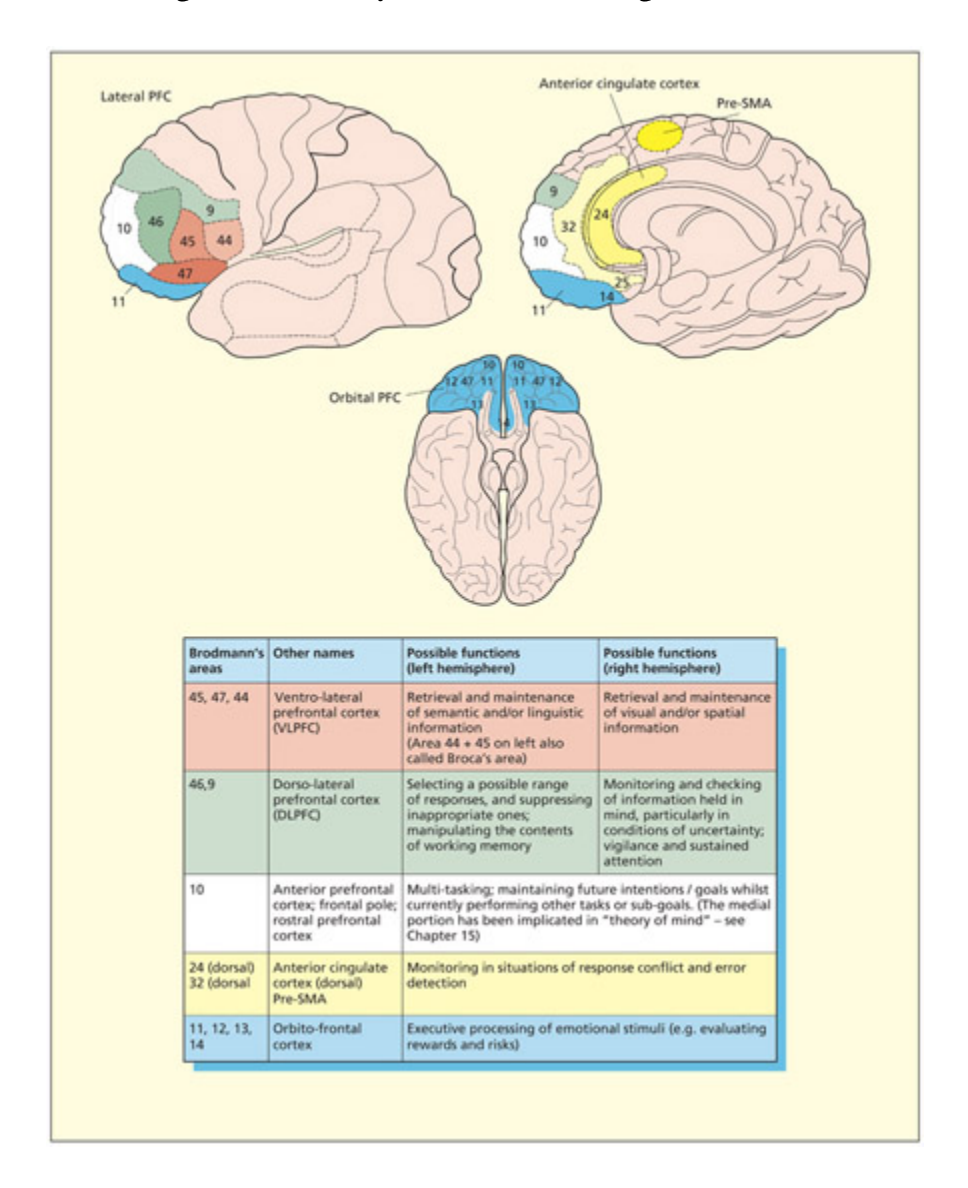
📊 그림 설명
전전두피질(PFC)의 세 가지 표면을 보여주는 해부학적 도해이다. 좌측 상단은 측면(lateral) 표면, 우측 상단은 내측(medial) 표면, 하단은 안와(orbitofrontal) 표면을 나타내며, 각 표면에 해당하는 브로드만 영역(BA) 번호가 표시되어 있다. 복외측(BA 44, 45, 47), 배외측(BA 46, 9), 전전두(BA 10) 등 기능적으로 구분되는 주요 영역을 시각적으로 확인할 수 있다.
e prefrontal cortex has three different surfaces: the lateral surface (top le), the medial surface (top right) and the orbitofrontal surface (boom). e numbers refer to Brodmann areas that are discussed
The Extraordinary Case of Phineas Gage
Summary
피니어스 게이지(Phineas Gage)는 1848년 금속 막대가 두개골을 관통하는 사고로 안와전두/복내측 전두피질(orbitofrontal/ventromedial PFC)에 국한된 손상을 입었다. 사고 후 무례함, 계획 수립 실패, 사회적 규범 준수 약화 등 심각한 행동 변화를 보였으며, “더 이상 게이지가 아니다”라는 평가를 받았다. 이 사례는 실행 기능 손상이 의사결정, 계획 수립, 사회적 행동 조절에 깊은 영향을 미친다는 것을 보여주는 대표적 증거이다.
One of the most famous cases in the neuropsyological literature is that of Phineas Gage (Harlow, 1993; Macmillan, 1986). On September 13, 1848, Gage was working on the Rutland and Burlington railroad. He was using a large metal rod (a tamping iron) to pa explosive arges into the ground when the arge accidentally exploded, pushing the tamping iron up through the top of his skull; it landed about 30 m behind him. e contemporary account noted that Gage was momentarily knoed over but that he then walked over to an oxcart, made an entry in his time book, and went ba to his hotel to wait for a doctor. He sat and waited half an hour for the doctor and greeted him with, “Doctor, here is business enough for you!” (Macmillan, 1986).
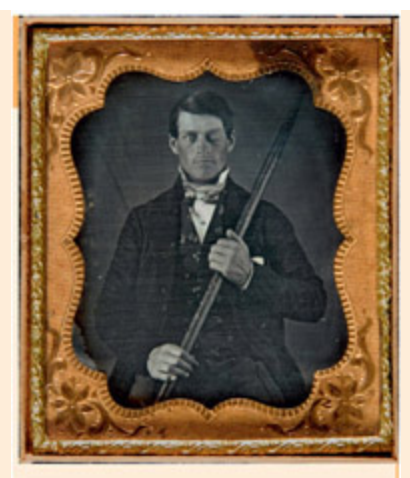
📊 그림 설명
피니어스 게이지의 두개골과 그 안에 삽입된 탬핑 철봉(tamping iron)의 실물 사진이다. 1848년 사고 당시 철봉이 좌측 안와전두/복내측 전두피질을 관통한 경로를 보여주며, 이 사례가 전두엽 손상과 실행 기능 장애의 관계를 밝히는 역사적 증거로서의 의의를 시각적으로 전달한다.
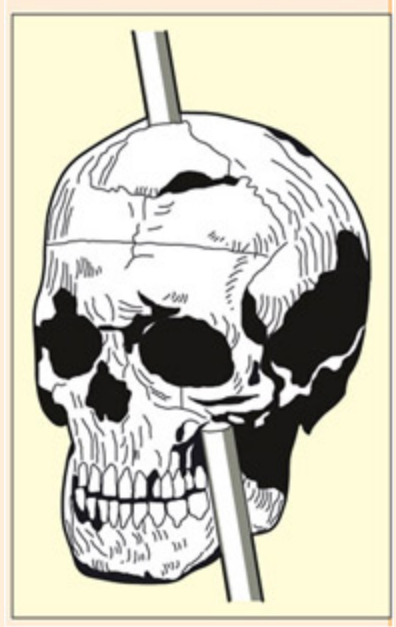
📊 그림 설명
최근 발견된 피니어스 게이지의 실제 사진이다. MRI 재구성 연구에 따르면 게이지의 뇌 손상은 내측 및 안와면 전두피질에 국한되었으며, 측면 표면은 보존된 것으로 추정된다. 이 사진은 게이지 사례의 역사적 실체를 보여주는 귀중한 자료이다.
e skull of Phineas Gage, with tamping iron in situ and a recently discovered photograph of Gage. Modern reconstructions suggest that his brain lesion may have been specific to the medial and orbital surfaces of the prefrontal cortex, sparing the lateral surfaces Damasio et al., 1994. From the collection of Ja and Beverly Wilgus.
Not only was Gage conscious aer the accident, he was able to walk and talk. Although this is striking in its own right, it is the cognitive consequences of the injury that have led to Gage’s notoriety. Before the injury, Gage held a position of responsibility as a foreman and was described as shrewd and smart. Aer the injury, he was considered
unemployable by his previous company; he was “no longer Gage” (Harlow, 1993). Gage was described as
irreverent, indulging at times in grossest profanity … manifesting but lile deference for his fellows, impatient of restraint or advice when it conflicts with his desires … devising many plans of future operation, whi are no sooner arranged than they are abandoned in turn for others.
(Harlow, 1993)
Aer various temporary jobs, including a stint in Barnum’s Museum, he died of epilepsy (a secondary consequence of his injury) in San Francisco, some 12 years aer his accident.
Where was Phineas Gage’s brain lesion? is question was answered by an MRI reconstruction of Gage’s skull, whi found damage restricted to the frontal lobes, particularly the le orbitofrontal/ventromedial region and the le anterior region (Damasio et al., 1994). Resear suggests that this region is crucial for certain aspects of decision making, planning, and social regulation of behavior, all of whi appeared to have been disrupted in Gage. Other areas of the lateral prefrontal cortex are likely to have been spared.
시험 팁
Phineas Gage 사례의 핵심은 손상 부위가 안와전두/복내측 PFC에 국한되었다는 점이다. 측면 PFC는 보존되었기 때문에 언어, 운동, 기본 인지 기능은 유지되었지만 사회적 판단과 계획 능력만 선택적으로 손상되었다. 이 사례는 “전두엽 손상 = 모든 인지 장애”가 아님을 보여주는 대표적 반례이다.
Executive Functions in Practice
Summary
실행 기능이 실제로 필요한 구체적 상황들을 다루며, 전두피질(PFC)의 하위 영역들이 이러한 행동 실행에 중요한 역할을 한다는 증거를 제시한다. 과제 설정, 습관적 반응 극복, 과제 전환, 멀티태스킹 등의 실증적 사례를 통해 PFC의 중심적 역할을 구체화한다.
is section considers some concrete situations in whi executive functions are needed. Evidence will be presented that the prefrontal cortex (or subregions within it) are important for implementing this kind of behavior.
Key Terms
FAS Test
A test of verbal fluency in whi participants must generate words beginning with a leer (e.g. “F”) in a limited amount of time.
FAS Test는 제한 시간 내 특정 글자로 시작하는 단어를 생성하도록 요구하는 언어 유창성 검사로, 전두피질(PFC)의 제어적 인지 능력을 평가하는 데 활용된다. 새로운 전략 생성, 대안 선택, 반복 회피 등을 요구하며, 특히 좌측 측면 전두피질 손상 환자에서 성과 저하가 두드러진다.
Task-setting and problem-solving
Summary
과제 설정(task-setting)과 문제 해결 능력은 전두피질(PFC)과 밀접하게 연결되며, 지능 측정과도 상관이 높다. 런던 타워(Tower of London) 테스트에서 좌측 PFC 손상 환자는 계획 대신 시행착오에 의존하며, 배외측 전두피질(DLPFC) 활성화는 문제 복잡도에 비례하여 증가한다. 인지 추정 테스트와 FAS 테스트에서도 전두피질 손상 환자의 추론 및 언어 유창성 저하가 확인된다.
Problem-solving is synonymous with many lay notions of what it is to exhibit intelligent behavior and it is not surprising that executive functions, and the prefrontal cortex, have been linked to intelligence both within and across species. For instance, performance on tests of executive function tends to correlate with ea other and also correlates with certain standardized measures of intelligence (Duncan et al., 1997). In the lab, problem-solving is oen tested by giving an end point (a goal) and, optionally, a starting point (a set of objects) and participants must generate a solution of their own. is kind of open-ended solution is also referred to as task-seing.
Patients with lesions to the prefrontal cortex oen show clinical symptoms of poor task-seing and problem solving. To test this formally, a number of tests have been devised. Shallice (1982) reports a test called the “Tower of London,” in whi patients must move beads from one stake to another to rea a specified end-point. Patients with damage to the le prefrontal cortex take significantly more moves. is implies that they perform by trial and error rather than planning their moves (see also Morris et al., 1997). Functional imaging studies of healthy participants suggest that activity within the dorsolateral prefrontal cortex increases with the number of moves needed to rea the end-point (Rowe et al., 2001).
A number of verbal tests also involve finding solutions to problems in whi there is no readily available answer. In the Cognitive Estimates Test (Shallice & Evans, 1978), patients with damage to the prefrontal cortex are impaired at producing estimates for questions in whi an exact answer is unlikely to be known (“How many camels are in Holland?”) but can be
inferred from other relevant knowledge (e.g. camels only likely to reside in a small number of zoos). In the FAS Test (Miller, 1984), participants must generate a sequence of words (not proper names) beginning with a specified leer (“F,” “A” or “S”) in a one-minute period. is test is not as easy as it sounds (have a try) and involves generating novel strategies, selecting between alternatives and avoiding repeating previous responses. Patients with le lateral prefrontal lesions are particularly impaired (Stuss et al., 1998).
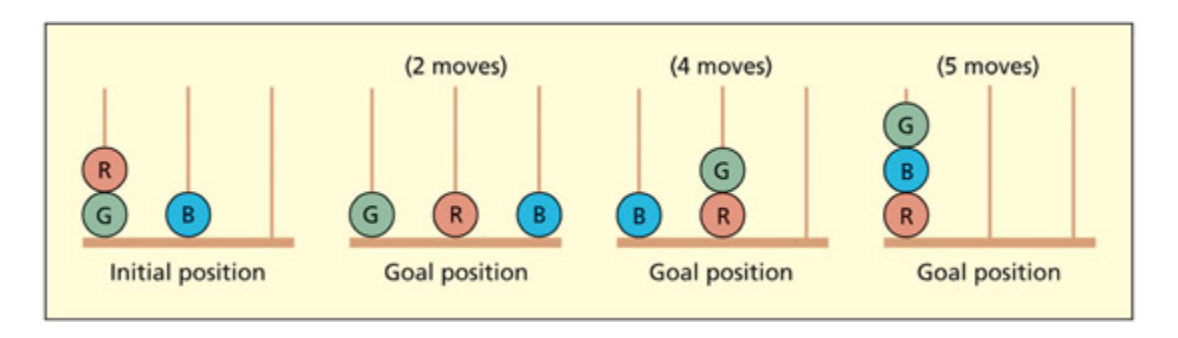
📊 그림 설명
“런던 타워”(Tower of London) 과제의 구조를 보여주는 그림이다. 참가자는 구슬을 초기 위치에서 지정된 목표 위치로 이동해야 하며, 과제 수행은 완료 시간과 이동 횟수(최적 이동 횟수 대비)로 측정된다. 좌측 전두피질 손상 환자는 계획 없이 시행착오에 의존하여 유의미하게 더 많은 이동을 필요로 한다.
🔬 실험 상세: Shallice (1982) — Tower of London 계획 과제
설계: 막대 3개에 색 구슬(R/G/B)을 끼운 초기 위치(initial position)에서 시작해, 제시된 목표 위치(goal position)에 도달하도록 구슬을 한 번에 하나씩 옮긴다. 문제마다 정답에 필요한 최소 이동 횟수가 다르다(그림의 2·4·5 moves). 핵심은 옮기기 전에 머릿속으로 수순을 계획해야 한다는 점이다.
결과: 좌측 PFC 손상 환자는 같은 목표를 푸는 데 정상인보다 유의미하게 더 많은 이동을 했다. 즉 계획 대신 시행착오로 접근한다.
그래프(fig5) 읽기: 데이터 플롯이 아니라 과제 도식이다. 맨 왼쪽이 시작 배열, 나머지 세 패널이 각각 난이도(필요 최소 이동 수 2/4/5)가 다른 목표 배열이다. 같은 시작점에서 목표가 멀어질수록 사전 계획 부담이 커진다.
함의: 좌측 PFC는 행동 전 내적 계획(task-setting)에 관여하며, 손상 시 미리 수순을 세우지 못해 비효율적 시행착오로 대체된다.
From Shallice, 1982. Royal Society of London.
Overcoming potent or habitual responses
Summary
Stroop 테스트는 습관적 반응 극복의 대표적 사례로, 잉크 색과 다른 색 이름 단어를 제시하여 자동적 읽기와 의도적 색명 간의 갈등을 유발한다. 이 과제의 수행은 전두피질(PFC)의 기능적 무결성과 밀접하게 관련되며, 전대상피질(anterior cingulate)과 preSMA 영역의 활성화가 중요한 역할을 한다.
e classic example of overcoming a habitual response is provided by the Stroop Test (Stroop, 1935). In this task, participants must name the color of the ink and ignore reading the word (whi also happens to be a color name). e standard explanation for the response conflict generated by this task is that reading of the word occurs automatically and can generate a response that is incompatible with the one required (MacLeod & MacDonald, 2000). Performance on the Stroop test has long been linked with integrity of the prefrontal cortex (Perret, 1974).
Key Terms
Stroop Test
Response interference from naming the ink color of a wrien color name (e.g. the word BLUE is printed in red ink and participants are asked to say the ink color, i.e. “red”).
Stroop 테스트는 글자로 된 색 이름의 잉크 색을 명명하도록 요구하여 반응 간섭(response interference)을 측정하는 도구이다. 자동적 읽기 반응과 의도적 색명 인식 간의 갈등을 극복해야 하며, 이는 억제력(inhibitory control)과 주의 전환(attentional control) 능력을 평가하는 핵심 지표이다. 전두피질(PFC) 활성화와 밀접히 연결되어 자동적 반응 억제 메커니즘을 탐구하는 데 널리 사용된다.
Go/No-Go Test
A test of response inhibition in whi participants must respond to a frequent stimulus (go trials) but withhold a response to another stimulus (no-go trials).
Go/No-Go Test는 빈번한 자극(go trials)에 반응하되 특정 자극(no-go trials)에는 반응을 억제해야 하는 반응 억제 검사이다. 전두피질(PFC), 특히 preSMA와 우측 측면 전두피질이 억제 과정에 중요한 역할을 하며, no-go 시행의 오류율은 충동성의 행동 지표로 활용된다.
Impulsivity
A behavioral tendency to make immediate responses or seek immediate rewards.
충동성(impulsivity)은 즉각적 반응이나 보상을 추구하는 행동 경향으로, Go/No-Go와 Stroop 테스트로 평가된다. 메타분석에 따르면 preSMA와 우측 측면 전두피질이 반응 억제에 핵심적이며, 전대상피질도 관련된다. 최근에는 억제력 대신 활성화 편향(gain)으로 실행 기능을 설명하는 모델도 제시되고 있다.
Go/No-Go tests involve the participant making a set of responses to some stimuli (“go” trials) but withholding responses to a subset of stimuli (“no-go” or “stop” trials). e no-go trials are oen infrequent, so the participant gets into the habit of making a response. No-go rules can be defined in terms of simple rules (e.g. “respond to all stimuli except the leer B”) or more complex rules (e.g. “respond to all stimuli except the leer B when it follows another leer B”). Brain activity during successful no-go trials is normally
taken as indexing response inhibition, and the proportion of errors on no-go trials is taken as a behavioral marker of impulsivity (Perry & Carrol, 2008).
Both the Stroop test and the Go/No-Go test are related by virtue of the fact that they are typically explained with respect to the concept of inhibition. Inhibition, in terms of neural activity, has a very specific definition (reduced spiking rate) with a relatively well aracterized meanism at the synaptic level. Behavioral or cognitive inhibition simply means reducing the likelihood of a particular thought/action and the meanism behind it, at the neuronal level, is not clear. Some contemporary models of executive function do not rely on the concept of inhibition at all and rely solely on biasing activation signals, also termed “gain” (Stuss & Alexander, 2007). Certainly, tasks su as the Stroop and Go/No-Go are likely to involve a variety of functions su as task-seing and monitoring ongoing performance, in addition to biasing of competing responses (either via gain or inhibition).
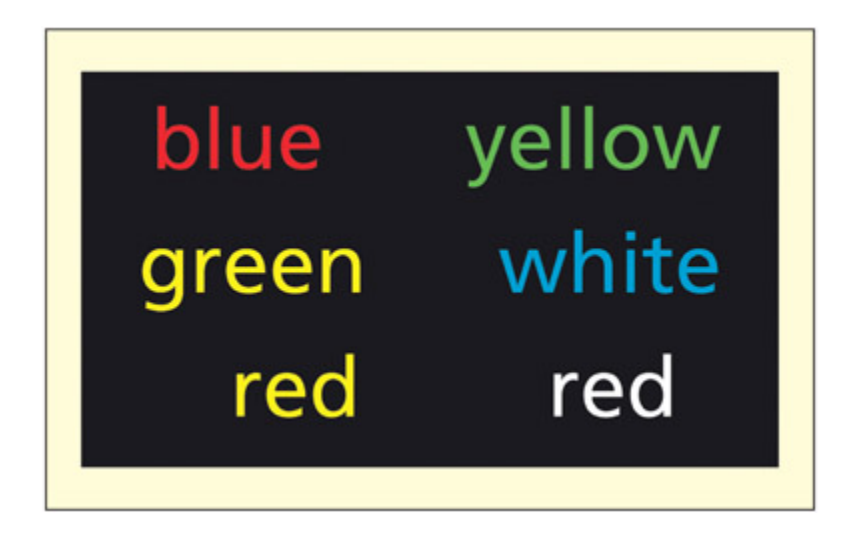
📊 그림 설명
Stroop 테스트의 자극 예시를 보여주는 그림이다. 색 이름 단어가 해당 색과 다른 잉크 색으로 인쇄되어 있으며, 참가자는 단어를 읽지 않고 잉크 색만 명명해야 한다. 자동적 읽기 반응과 의도적 색 명명 반응 간의 갈등이 발생하며, 이 과제는 전두피질의 억제 기능을 평가하는 대표적 도구이다.
🔬 실험 상세: Stroop (1935) — Stroop 색-단어 간섭 과제
설계: 색 이름 단어를 그 의미와 불일치하는 잉크 색으로 인쇄해 제시한다(예: “blue”를 빨간 잉크로). 참가자는 단어를 읽지 말고 잉크 색만 명명해야 한다(빨강). 읽기는 자동적이라 단어 의미가 잉크 색 반응과 충돌한다(반응 간섭).
결과: 불일치(incongruent) 조건에서 반응 시간이 느려지고 오류가 늘며, 이 간섭 극복 능력은 PFC 무결성과 연관된다. 영상 연구는 **전대상피질(ACC)**과 인접 preSMA 활성화를 보고한다.
그래프(fig6) 읽기: 데이터 플롯이 아니라 자극 예시 도식이다. 각 단어의 글자 의미(파랑/노랑 등)와 인쇄된 잉크 색이 서로 다르다는 점을 보여주며, 정답은 의미가 아니라 잉크 색이다.
함의: 강력한 자동 반응(읽기)을 억제하고 약한 의도적 반응(색 명명)을 선택하는 능력이 실행 기능의 핵심이며, ACC/preSMA가 이 갈등 해결에 관여한다.
e Stroop test involves naming the color of the ink and ignoring the wrien color name (i.e. “red, green, yellow, blue, yellow, white”).
Contemporary resear has suggested that performance on these tasks is related to particular brain regions rather than the “prefrontal cortex” in general. A meta-analysis of functional imaging studies of the Go/No-Go task suggests that a region of the medial prefrontal cortex (specifically the preSMA, pre-supple mentary motor area) was common across tasks for No-Go stimuli with right lateral prefrontal cortex also implicated in more complex No-Go rules (Simmonds et al., 2008). Studies of patients with damage to the prefrontal cortex confirm that the pre-SMA region and the right lateral prefrontal cortex are important for this task (Picton et al., 2007). With regards to the Stroop test, a similar picture emerges that highlights the importance of the anterior cingulate cortex and the nearby pre-SMA region (Alexander et al., 2007).
Task switching
Summary
위스콘신 카드 정렬 테스트(WCST)는 색상, 숫자, 형태 등 다양한 기준에 따라 카드를 분류하며 규칙 유도와 규칙 활용 능력을 평가한다. 전두피질(PFC) 손상 환자는 규칙 변경 시 기존 규칙에서 벗어나지 못하는 perseveration(보속증) 현상을 보이며, 이는 인지 유연성과 주의 전환 능력의 손상을 반영한다.
In the Wisconsin Card Sorting Test, a series of cards must be mated against reference cards (Milner, 1963; Nelson, 1976). e cards can be mated according to one of three dimensions, namely color, number and shape. For example, in the color condition a blue card must be grouped with blue cards and red cards grouped with red cards (ignoring number and shape). Aer ea trial, participants are told whether they are correct or not. Eventually, they are told that they are incorrect and they must then spontaneously swit task, i.e. start sorting according to number or shape. Many patients with damage to the prefrontal cortex fail to make this shi and continue to incorrectly sort according to the previous rule, a behavior termed perseveration.
Key Terms
Wisconsin Card Sorting Test
A test of executive functions involving rule induction and rule use.
WCST는 참가자가 명시된 규칙 없이 스스로 색상, 숫자, 형태 등의 분류 기준을 학습하고 적용해야 하는 규칙 유도와 규칙 활용 검사이다. 인지 유연성과 제어적 인지의 실질적 적용을 평가하며, 전두피질(PFC)의 역할을 분석하는 대표적 도구이다.
Perseveration
Failure to shi away from a previous response.
보속증(perseveration)은 이전 반응에서 벗어나지 못하는 실패로, 과제 전환 능력의 저하와 밀접하다. 전두피질(PFC) 손상 환자가 WCST에서 기존 규칙을 포기하지 못하고 오류를 반복하는 것이 대표적 사례이다.
Task switching
Discarding a previous sema and establishing a new one.
Switch cost
A slowing of response time due to discarding a previous sema and seing up a new one.
전환 비용(switch cost)은 이전 규칙을 포기하고 새로운 규칙을 적용할 때 반응 시간이 지연되는 현상으로, 예측 가능한 전환에서도 지속된다. 흥미롭게도 전환 비용은 쉬운 과제에서 어려운 과제로보다 어려운 과제에서 쉬운 과제로 전환할 때 더 크며, 이는 이전 과제의 억제가 핵심임을 시사한다. 내측 전두엽(preSMA)은 자극-반응 재할당에, 측면 전두엽은 현재 규칙 선택에 관여한다.
e Wisconsin Card Sorting Test has a number of features that make it demanding: the swites are unpredictable and, moreover, the relevant dimensions (color, shape, number) are not given but need to be inferred. is also makes it hard to know why, in cognitive terms, failure on the task happens. Other task-switing paradigms have been developed that enable more finer-grained analysis of the underlying meanisms. ese tend to be used in studies of non-braindamaged participants using fMRI or TMS. To give an example of a task that involves swites that occur predictably, imagine that you are a participant looking at a square 2 · 2 grid. A digit and/or number pair (e.g. L9) will appear in ea part of the grid, moving clowise, and you must make a response to ea stimulus. When the stimulus is in the upper half of the grid, you must decide if the leer is a consonant or vowel. When the stimulus is in the lower half, you must decide if the digit is odd or even (some participants would get the complementary set of instructions). is produces two types of trial—those in whi the task
swites and those in whi it does not. e reaction times for the swit trials are significantly slower, and this difference remains even though the ange is predictable and even if the subject is given over a second to prepare before ea stimulus is presented (Rogers & Monsell, 1995). is difference in reaction time between swit and non-swit trials is called the swit cost.
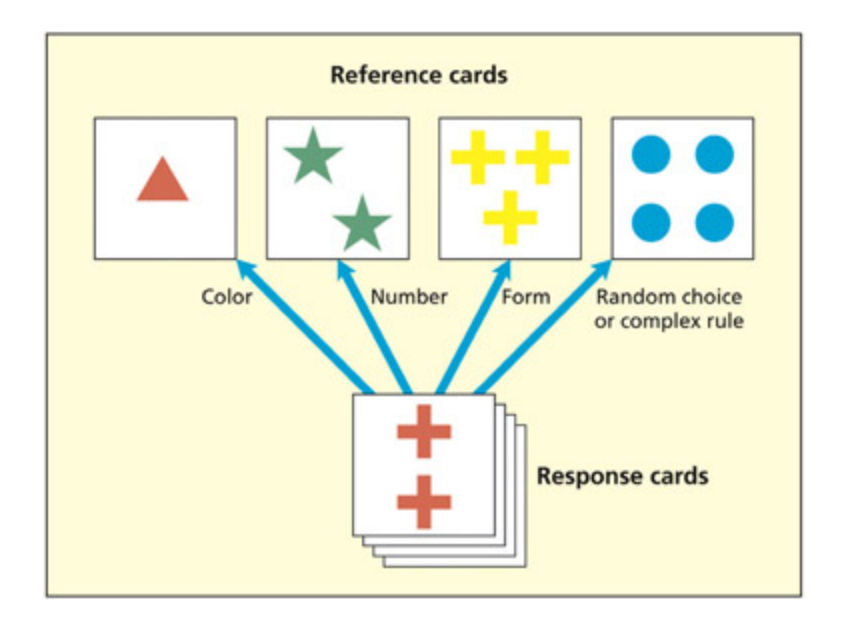
📊 그림 설명
위스콘신 카드 정렬 테스트(WCST)의 과제 구조를 보여주는 그림이다. 참가자는 제시된 카드를 형태, 숫자, 색상 중 하나의 규칙에 따라 참조 카드에 대응시켜야 한다. 규칙이 예고 없이 변경될 때 새로운 규칙으로 전환해야 하며, 전두피질 손상 환자는 이전 규칙에 고착되는 보속증(perseveration)을 보인다.
🔬 실험 상세: Milner (1963) — Wisconsin Card Sorting Test (WCST)
설계: 위에 4장의 참조 카드(reference cards)가 있고, 아래에서 반응 카드(response card)를 한 장씩 받는다. 카드는 색·숫자·형태 세 차원 중 하나로 분류할 수 있다. 정답 규칙은 알려주지 않고 매 시행 후 맞았는지만 피드백한다. 참가자가 규칙을 추론해 연속 정답을 내면, 예고 없이 정답 규칙이 바뀌고 새 차원으로 전환해야 한다.
결과: 다수의 PFC 손상 환자가 규칙 변경 후에도 이전 규칙으로 계속 분류하는 보속증(perseveration)을 보인다.
그래프(fig7) 읽기: 데이터 플롯이 아니라 과제 도식이다. 화살표는 하단의 반응 카드를 색/숫자/형태/복합규칙 중 어느 차원으로 참조 카드에 대응시킬 수 있는지를 나타낸다 — 어느 화살표가 정답인지는 피드백으로만 알 수 있다.
함의: WCST는 **규칙 유도 + 규칙 전환(인지적 유연성)**을 동시에 요구하며, 보속증은 규칙을 모르는 게 아니라 이전 규칙을 억제·전환하지 못하는 실패를 반영한다.
Based on Milner, 1963.
e swit cost could either reflect suppressing the old task or reflect seing up the new task. is can be evaluated by considering swites between easy and hard tasks. Is it more difficult to swit from an easy to a hard task or from a hard to an easy task? Surprisingly, perhaps, the swit cost is greater when switing from hard to easy. For example, bilinguals are slower at switing from their second to their first language than from their first to their second language in picture naming (Meuter & Allport, 1999). With Stroop stimuli, people are faster at switing from word naming to color naming (easy to hard) than color naming to word naming (hard to
easy) (Allport et al., 1994). e swit cost has more to do with inhibiting the old task than seing up the new one.
주의
WCST에서 전두엽 손상 환자가 보이는 **perseveration(보속증)**은 “규칙을 모르는 것”이 아니라 이전 규칙을 억제하지 못하는 것이다. 또한 전환 비용(switch cost)은 직관과 달리 어려운 과제에서 쉬운 과제로 전환할 때 더 크다는 점을 기억하자. 이는 이전에 더 강하게 활성화된 과제를 억제하는 데 더 큰 비용이 들기 때문이다.
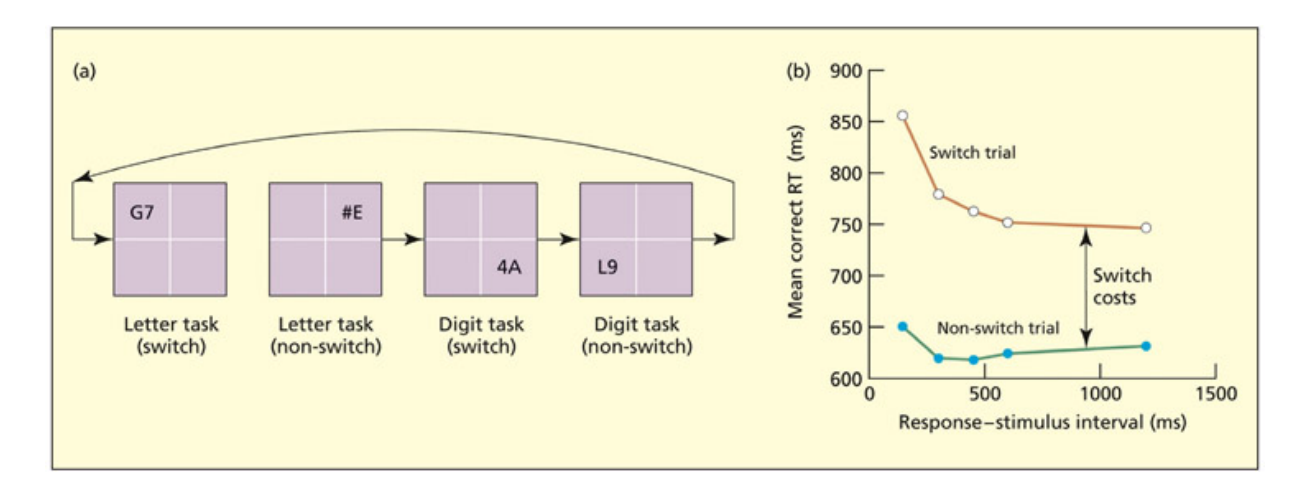
📊 그림 설명
2x2 격자를 사용한 과제 전환 패러다임을 보여주는 그림이다. 상단에 자극이 나타나면 자음/모음 판단을, 하단에 나타나면 홀수/짝수 판단을 수행한다. 전환 시행(switch trial)은 비전환 시행보다 유의미하게 느리며, 전환이 예측 가능하고 준비 시간이 1초 이상 주어져도 전환 비용(switch cost)이 지속됨을 보여준다.
🔬 실험 상세: Rogers & Monsell (1995) — 예측 가능한 과제 전환과 switch cost
설계: (a) 2×2 격자에서 문자+숫자 쌍(예: G7)이 시계 방향으로 칸을 옮겨가며 제시된다. 자극이 위쪽 절반이면 문자에 대해 자음/모음 판단, 아래쪽 절반이면 숫자에 대해 홀수/짝수 판단을 한다. 칸이 절반을 넘어가는 순간이 전환 시행(switch), 같은 절반에 머무르면 **비전환 시행(non-switch)**이다. 전환은 규칙적이라 예측 가능하고, 자극 전 준비 시간을 1초 이상 줄 수도 있다.
결과: 전환 시행의 반응 시간이 비전환보다 일관되게 느렸고, 이 차이(switch cost)는 전환이 예측 가능하고 준비 시간이 충분해도 사라지지 않았다.
그래프(fig8) 읽기: (b) X축 = 반응-자극 간격(RSI, ms) = 준비 시간, Y축 = 평균 정답 반응 시간(ms). 위쪽 곡선이 switch trial, 아래쪽 곡선이 non-switch trial. 두 곡선 모두 RSI가 길어지면 다소 빨라지지만, 1200ms에서도 두 곡선 사이 간격(=switch cost, 화살표)이 남아 있다.
함의: 전환 비용에는 준비만으로 없어지지 않는 잔여 성분(residual)이 있어, 새 과제 설정뿐 아니라 이전 과제 set의 억제·재구성이 필요함을 시사한다.
Reprinted from Monsell, 2003. © 2003, with permission from Elsevier.
Functional imaging studies reveal a variety of prefrontal regions together with the anterior cingulate cortex/pre-SMA to be involved in task switing, by comparing swit trials with no-swit trials (Ravizza & Carter, 2008) or contrasting the swit preparation time (before the stimulus) with swit execution aer the stimulus (Brass & von Cramon, 2002). However, it is not always straightforward to link specific regions with specific cognitive processes because there are oen different types of switing meanism. Most task-switing experiments involve both a switing of response rules and a switing of the stimulus selected. In the study described previously, for example, the le hand swites from responding “consonant” to re sponding “odd,” and the stimulus selected swites from leer to digit (i.e. multiple aspects of the task are swited). Rushworth et al. (2002) aempted to control for these differences in a combined fMRI and TMS study. ey found that the medial frontal lobes (the pre-SMA region) are important for
reassignment of stimulus–response pairings (e.g. whi buon to press), whereas lateral frontal regions may be involved in selection of the current rule (e.g. whether to respond to color or shape).
📊 그림 설명
이중언어자의 언어 전환 실험 결과를 보여주는 그림이다. 제1언어에서 제2언어로의 전환이 그 반대보다 더 빠르다는 역설적 결과를 제시한다. 이는 전환 비용이 새로운 과제 설정보다 이전 과제 억제에 더 관련됨을 시사하며, 더 강한 제1언어를 억제하는 데 더 큰 비용이 든다는 것을 보여준다.
Bilingual speakers are faster at switing from their first to their second language, than from their second to their first language. How can this apparently paradoxical result be explained?
Multi-tasking
Summary
멀티태스킹(multi-tasking)은 현재 목표를 처리하면서 미래 목표를 동시에 유지하는 과정으로, 태스크 전환의 확장 형태이다. 태스크 전환에서는 한 목표가 다른 목표로 대체되지만, 멀티태스킹은 여러 목표를 동시에 유지하면서 단일 목표만 실행한다. 전두피질(PFC)의 기능과 밀접하게 연결되며, 인지 유연성과 주의 전환 능력을 복합적으로 요구한다.
Multi-tasking experiments can be regarded as having an element of maintaining future goals while current goals are being dealt with. is is related to, but an extension of, task switing. In task-switing one goal is
substituted for another. In multi-tasking several goals are maintained at the same time (but only one executed).
Key Terms
Multi-tasking
Carrying out several tasks in succession; requires both task switing and maintaining future goals while current goals are being dealt with.
Patients with lesions in to the prefrontal cortex may be particularly impaired at multi-tasking, even though ea task in isolation may be successfully performed and even though they perform normally on other tests of executive function, including the Wisconsin Card Sorting Test and FAS test (Burgess et al., 2000; Shallice & Burgess, 1991). is suggests a pos sible fractionation of executive functions (assuming it isn’t simply related to task difficulty)—an idea returned to later in the apter. In the “Six Element Test” the participant is given six open-ended tasks to perform within a 15 minute period (e.g. arithmetic, writing out names of pictures). Critically, they are instructed to aempt ea task. However, they will be unable to complete all of them in the time allowed, and more points are awarded for earlier items. Con straints are placed on some of the ordering of tests. Patients with prefrontal lesions would oen fail to swit tasks, spend too long planning (e.g. taking notes) but never execute the plans, and so on. e patients could easily perform the isolated tasks, but their difficulties were only apparent when they had to coordinate between them (Shallice & Burgess, 1991).
📊 그림 설명
멀티태스킹 수행과 전전두피질(anterior prefrontal region)의 관계를 보여주는 그림이다. 현재 목표를 처리하면서 미래 목표를 동시에 유지해야 하는 멀티태스킹 상황에서 전두극(frontal pole) 영역이 핵심적 역할을 할 가능성을 제시한다. 전두피질 손상 환자는 개별 과제는 수행 가능하나 여러 과제를 조정하는 데에서 특이적 결함을 보인다.
How do we perform multi-tasking? Could the anterior prefrontal region hold the key?
주의
**Task switching(과제 전환)**과 **multi-tasking(멀티태스킹)**은 자주 혼동되지만 구분이 중요하다. Task switching은 하나의 목표가 다른 목표로 대체되는 것이고, multi-tasking은 여러 목표를 동시에 유지하면서 하나만 실행하는 것이다. WCST는 task switching을 평가하고, Six Element Test는 multi-tasking을 평가한다. 일부 전두피질 손상 환자는 WCST는 통과하지만 Six Element Test에서 실패할 수 있다.
Evaluation
Summary
1990년대 중반까지 SAS(Supervisory Attentional System) 모델을 기반으로 실행 기능의 핵심 특성에 합의가 있었으나, 일부 전두피질 손상 환자가 실험실 테스트에서는 성공하면서도 일상생활에서 심각한 장애를 보이는 사례가 이 모델의 한계를 드러냈다. 뇌 영상 기술(fMRI)의 발전으로 전두피질 내부의 기능적 분화를 더 정밀하게 분석할 수 있게 되었으며, 정서적/비정서적 자극 처리의 차이와 다양한 작업 요구 네트워크 등 실행 기능의 복잡한 구조에 대한 논의가 확장되고 있다.
By the mid-1990s there was a generally agreed upon definition of what the essential features of executive functions were: e.g. allowing flexible or “intelligent” behavior, exerting control via a biasing influence. ere was also a general consensus that the prefrontal cortex had a critical role in implementing this, and there were also a set of frequently used tasks that were assumed to be a good indicator of prefrontal functioning (e.g. the Wisconsin Card Sort, the Stroop test). ere was also agreement on the kind of model that could account for this. One simple model of executive functions is the original version of the SAS (Supervisory Aentional System) model—introduced in Chapter 8. is consists of a set of tasks and behaviors (termed semas) and a biasing meanism that activated/ suppressed these semas according to the individual’s current goals (Norman & Shallice, 1986). e activation of semas was conceptualized as a balance between boom-up processes (cues in the environment, habits, etc.) and top-down processes (task instructions, long-term plans, etc.). Disruption of this balance, for example, by a prefrontal lesion would tend to result in recent or habitual responses being inappropriately elicited (e.g. in the Stroop Test, or Wisconsin Card Sort), poor planning, and so on.
Although these core ideas and empirical results are as valid today as they were in the 1990s, the contemporary intellectual landscape relating to executive functions is far more detailed and complex. In the mid-1990s there was already some evidence that was hard to accommodate by existing theories. For instance, it was found that some patients with prefrontal lesions could pass the standard tests of executive functions, but yet show significant impairments in organizing their daily life and in their social interactions (Shallice & Burgess, 1991; Eslinger & Damasio, 1985). is revealed a potential flaw in the early accounts. However, these observations could still be explained away: for instance, by pointing out that lab tests may not be fully sensitive to deficits apparent in the “real world.” While difficulties on the Stroop task and making socially inappropriate jokes can both be conceptualized in terms of a weaker biasing influence of top-down control (e.g. “la of inhibition”) more recent evidence suggests they are related to rather different meanisms involving the prefrontal cortex (Glaser et al., 2012). Brain imaging has made a very significant contribution toward moving the debate forward. is has enabled a mu finer grained analysis of the functions of different regions of the prefrontal cortex (and their connectivity) both in studying healthy participants (in fMRI) but also in identifying more precise lesion locations in patients. e next section considers various ways in whi executive functions might be organized in the brain.
Egas Moniz and the Prefrontal Lobotomy
Summary
Egas Moniz는 1935년 전두엽 절제술(prefrontal lobotomy)을 개발하여 노벨 생리의학상을 수상했으나, 이 시술은 미국에서 5만 명 이상에게 적용되며 심각한 실행 기능 손상과 무기력함을 유발했다. 당시 정신질환의 약물 치료가 없었기에 널리 사용되었으나, 의학 발전과 함께 점차 폐지되었다.
e career of Egas Moniz was an eventful one. In politics, he served as Portuguese Ambassador to Spain and was President of the Portuguese Delegation at the Paris Peace Conference in 1918, following the First World War. However, it is his contribution to neurology and neurosurgery that gained him fame and infamy. In the 1920s he developed cerebral angiography, enabling blood vessels to be visualized with radioactive tracers. In 1935, he developed the prefrontal
lobotomy/leucotomy for the treatment of psyiatric illness. Between then and 1954, more than 50,000 patients would have the procedure in the USA (Swayze, 1995) and over 10,000 in the UK (Tooth & Newton, 1961). is brought Moniz mixed fortunes. He was awarded the Nobel Prize for Medicine. However, he had to aend the ceremony in a wheelair because, some years previously, he had been shot in the spine and partially paralyzed by one of his lobotomized patients.
Moniz’s operation was designed to sever the connections between the prefrontal cortex and other areas, notably the limbic system (Moniz, 1937, 1954). is procedure was adapted by others in frighteningly simple ways. For instance, an ice-pi-type implement was inserted through the thin bony plate above the eyes and waggled from side to side.
At that point, there were no pharmacological treatments for psyiatric complaints. Lobotomy was used for a variety of disorders, including obsessive-compulsive disorder, depression, and sizophrenia. e measurement of “improvement” in the patients was rather subjective, and the fact that the lobotomized patients tended to be duller and more apathetic than before was not sufficient to halt the appeal of the lobotomy. Formal assessments of cognitive function, if they had been carried out, would undoubtedly have revealed impairments in executive function.
Moniz died in 1955. By then, his surgical innovation had been phased out and its success has been le to history to judge.
The Organization of Executive Functions
Summary
실행 기능의 뇌 구조적 조직을 다루며, 측면 PFC는 과제 전환과 규칙 유도에, 안와전두피질은 자기 조절과 결과 예측에 관여하는 등 PFC 각 영역이 서로 다른 인지 기능을 담당한다. “hot” 제어(감정/보상 관련, 안와전두피질)와 “cold” 제어(순수 인지적, 측면 PFC)의 구분이 핵심적이며, 이후 다양한 작업 요구 네트워크, 후방-전방 조직, 반구 차이 등의 조직 원리를 검토한다.
Key Terms
Reversal learning
Learning that a previously rewarded stimulus or response is no longer rewarded.
역전 학습(reversal learning)은 이전에 보상되던 자극이 더 이상 보상되지 않는 상황에서의 학습 과정이다. Dias 등(1996)의 마모셋 실험에서 안와전두피질 손상은 보상 변화 대응을 방해하고, 측면 PFC 손상은 인지적 차원 전환에 영향을 주어, “hot”(보상 관련)과 “cold”(인지적) 억제 제어가 별개의 프로세스임을 보여주는 이중 해리가 확인되었다.
Although there are many different approaes to explaining executive functions, it is important to emphasize from the outset that there are some things that all models of executive functions appear to have in common. First, there is broad agreement as to what kinds of things that a model of executive functions needs to explain. As already outlined, this includes the ability to override automatic behavior in order to deal with novel situations, swit flexibly between tasks, and carry out a current task while holding in mind other goals. Second, in order to account for this, the different models typically have a common set of core features. e type of processing must be inherently flexible in order to cope with anging tasks from moment to moment. It can implement a seemingly infinite range of “if-then” type mappings (“wink whenever I say bumbly-doodle” to take an example from Miller and Cohen, 2001). Furthermore, almost all models assume that executive functions have a biasing influence (they make certain behaviors more or less likely) rather than dictating to the rest of the brain. is could be aieved via inhibition (suppressing certain stimuli/responses) or gain/facilitation (activating certain stimuli/responses) or both. As for differences between models, one of the key distinctions is the extent to whi different models assume that executive functions can be decomposed into several modular-like processes versus executive functions construed as a more unitary idea. is is not an all-or-nothing debate, as some models may assume relative degrees of specialization.
“Hot” versus “cold” control processes
Perhaps the least controversial principle of organisation of executive functions is the distinction between the control of affective or rewardrelated stimuli (i.e. “hot”) versus purely cognitive (i.e. “cold”) stimuli. Reward-related stimuli includes money (in humans) and food (typically used in studies of nonhuman animals), whereas purely cognitive stimuli oen involve sensory dimensions (su as color or shape). Most of the tests of executive function described thus far are of the laer kind (e.g. Stroop test, Wisconsin Card Sort). Hot cognitive control involves primarily the orbitofrontal cortex (and associated ventromedial PFC), whereas cold cognitive control involves primarily the lateral PFC. is reflects the anatomical connectivity of these frontal regions to posterior regions involved in affective versus sensory/motor processes (Öngür & Price, 2000).
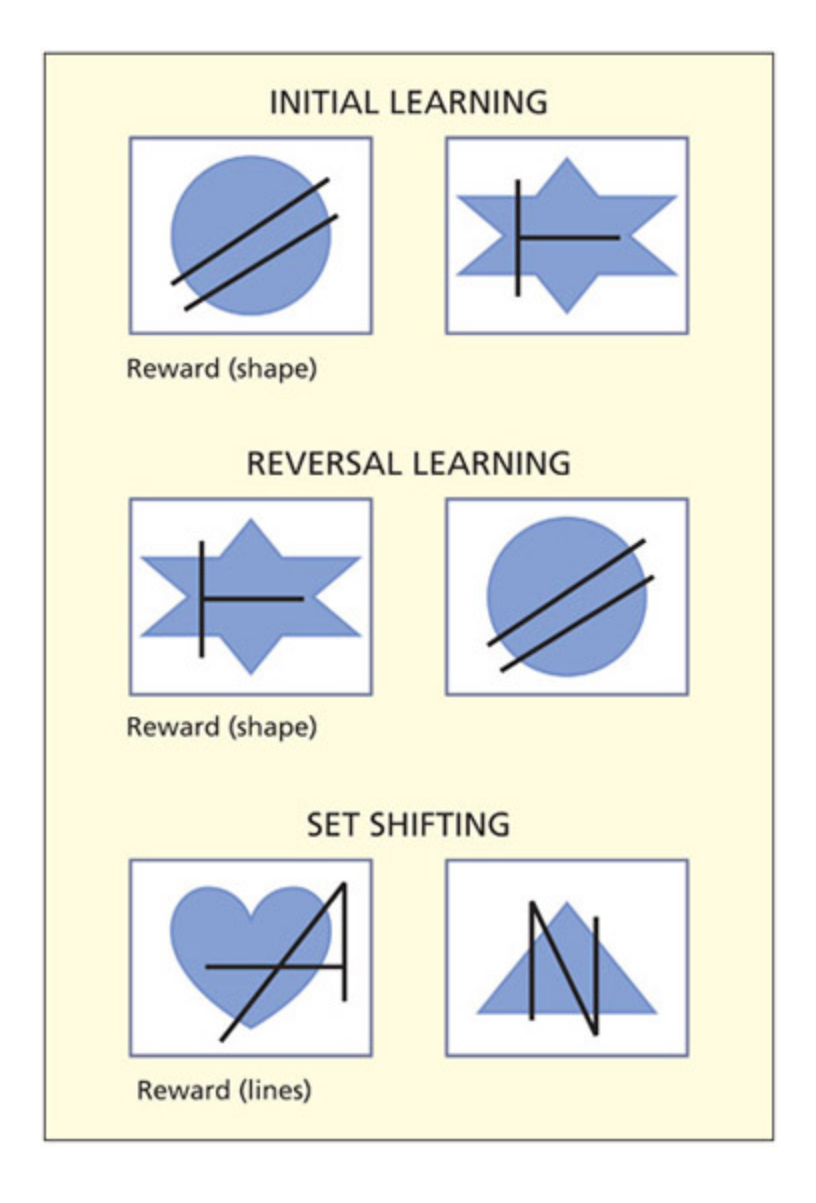
Dias et al. (1996) designed a test of task-switing that could be learned by marmosets (a species of primate). As noted before, the seemingly simple task-switing paradigm has several processes (establishing new tasks, inhibiting old tasks) that can be configured in different ways (switing stimuli, switing responses, switing rewards). e stimuli in their study consisted of compounds of bla lines superimposed on blue shapes. e animals were trained to respond to only one of these dimensions (shapes or lines) and had to remember whi shapes or lines were correct. For instance, they may learn that a blue circle is rewarded (i.e. correct), but a blue star is not. ey then received neurotoxic lesions, either to the lateral or orbital PFC, and subsequently undertook further training sessions that involved a task-swit. In the reversal learning condition, the same stimuli were presented, but su that the previously rewarded stimuli were no longer rewarded (in the example above, the blue star is now rewarded, but the blue circle is not). In the dimensional-shi condition (whi resembles the Wisconsin Card Sorting Task), new shapes and lines were presented and the animals had to learn, for instance, that lines were now rewarded and not shapes. Lesions of the orbitofrontal cortex disrupted the ability to respond to the fact that the rewards had been swited (but not that the relevant cognitive dimension had swited), whereas lesions of the lateral PFC disrupted the ability to respond to the fact that the relevant cognitive
dimension had swited from shapes to lines (but these animals were able to learn that previously rewarded shapes were no longer rewarded). ey interpreted this double dissociation as evidence for two separate inhibitory control processes: one reward-related and another related to stimulus dimensions.
임상 사례
Iowa Gambling Task에서 복내측 PFC 손상 환자는 장기적으로 손해인 카드 묶음(A, B)을 계속 선택하며, 선택 전 **예기적 SCR(피부전도반응)**도 나타나지 않는다. 흥미로운 점은 이 환자들이 Stroop이나 WCST 같은 “cold” 실행 기능 검사는 정상적으로 통과한다는 것이다. 반대로 측면 PFC 손상 환자는 Iowa Gambling Task는 정상이지만 Stroop/WCST에서 실패한다. 이 **이중 해리(double dissociation)**는 “hot”과 “cold” 실행 기능이 별개의 시스템임을 강력히 시사한다.
Key Terms
Somatic Marker Hypothesis
A proposal that emotional and bodily states associated with previous behaviors are used to influence decision making.
체성 표지 가설(Somatic Marker Hypothesis)은 과거 경험에서 비롯된 정서적/신체적 상태가 의사결정에 영향을 미친다는 이론이다. 복내측 전두피질에 저장된 체성 표지가 위험 평가와 사회적 상호작용에서 행동을 조절하며, 안와전두피질이 이러한 감정-신체 연합 처리에 중심적 역할을 한다.
Iowa Gambling Task
A task in whi participants must learn to avoid risky oices (generating a net loss) in favor of less risky (and more rewarding) oices.
아이오와 도박 과제(Iowa Gambling Task)에서 참가자는 4가지 카드 묶음 중 선택하며, A/B는 장기 손실, C/D는 장기 이익을 초래한다. 복내측 전두피질 손상 환자는 유리한 선택을 학습하지 못하고 예기적 피부전도반응(SCR)도 보이지 않는다. 이들은 Stroop이나 WCST에서는 정상이지만 도박 과제에서만 손상을 보이며, 측면 PFC 손상 환자는 반대 프로필을 보여 이중 해리가 확인된다.
📊 그림 설명
Dias 등(1996)의 마모셋 실험 설계와 결과를 보여주는 그림이다. 마모셋이 터치스크린으로 형태와 선으로 구성된 복합 자극에 반응하도록 훈련된 후, 안와전두피질 또는 측면 전두피질에 병변을 만들었다. 안와전두피질 손상은 역전 학습(이전 보상 자극이 더 이상 보상되지 않는 상황)에, 측면 전두피질 손상은 차원 전환(형태에서 선으로의 전환)에 각각 선택적 장애를 초래하여, “hot”과 “cold” 억제 제어의 이중 해리를 입증한다.
🔬 실험 상세: Dias et al. (1996) — 마모셋의 reversal vs. set-shifting 이중 해리
설계: 검은 선이 파란 형태 위에 겹쳐진 복합 자극을 쌍으로 제시하고, 한 차원(예: 형태)에만 반응하도록 훈련한다(예: 파란 원=보상, 파란 별=무보상). 이후 안와전두(OFC) 또는 측면 PFC에 신경독성 병변을 가하고 두 종류의 전환을 시킨다. ① 역전 학습(reversal): 같은 자극·같은 차원인데 보상-무보상 짝이 뒤바뀜(원↔별). ② 차원 전환(set-shifting): 새로운 형태·선이 나오고 보상 차원이 형태→선으로 바뀜(WCST와 유사).
결과: OFC 병변 → reversal에서만 장애(차원 전환은 정상), 측면 PFC 병변 → set-shifting에서만 장애(역전은 정상)의 이중 해리.
그래프(fig11) 읽기: 데이터 플롯이 아니라 자극·조건 도식이다. 위 단(INITIAL LEARNING)은 보상 차원(형태)을, 가운데(REVERSAL)는 보상 짝만 뒤집힌 같은 자극을, 아래(SET SHIFTING)는 보상 차원이 선으로 바뀐 새 자극을 보여준다.
함의: 보상 기반(“hot”) 억제 제어와 인지 차원(“cold”) 억제 제어가 해부학적으로 분리된 별개 과정임을 시사한다.
Marmosets were trained to respond using a tou screen to compound stimuli, presented in pairs, either to certain shapes or lines. Aer lesioning to the orbitofrontal cortex or lateral prefrontal cortex there were several kinds of task-swites. In the reversal learning condition, the same stimuli were presented, but previously rewarded shapes/lines were no longer rewarded (lesions to orbitofrontal cortex impairs responding to this task-swit). In the dimensional shi condition, different shapes and lines were presented and the animals had to shi from responding to shapes and respond to lines or vice versa (lesions to the lateral prefrontal cortex impairs responding to this task-swit). Adapted from Dias et al., 1996.
e distinction between executive processing of affective versus nonaffective stimuli can account for one puzzle from the older literature.
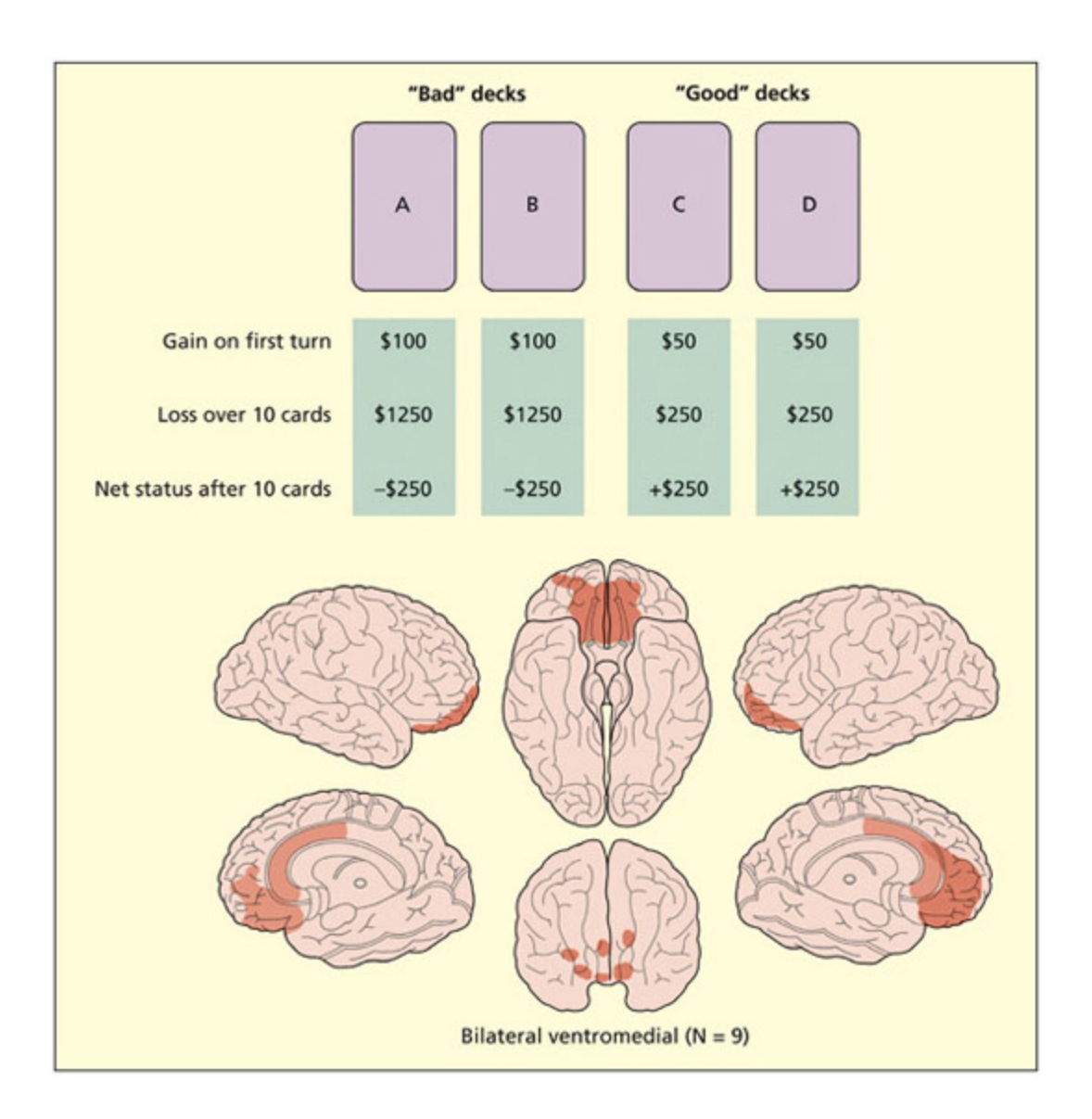
Namely, the fact that some brain-damaged patients with known pathology of the prefrontal cortex exhibit poor regulation of behavior in the “real world” (particularly with regards to financial management and social interactions) despite passing standard (i.e. “cold”) tests of executive function (Eslinger & Damasio, 1985). Damasio and colleagues have developed the Somatic Marker Hypothesis to account for this (Damasio, 1994, 1996). In this theory, somatic markers form the link between previous situations stored throughout the cortex and the “feeling” of those situations stored in regions of the brain dedicated to emotion (e.g. the amygdala) and the representation of the body states (e.g. the insula). e somatic markers are assumed to be stored in the ventromedial frontal cortex (including parts of the orbital sur face) and have a direct role in controlling ongoing behavior, notably in those situations in whi feelings are critical (e.g. when taking risk, or inter acting socially). To investigate this hypo thesis, they devised the Iowa Gambling Task that has been shown to distinguish between different lesion sites and cognitive profiles (Beara et al., 1994; Beara et al., 1998; Beara et al., 1999). Players are given four des of cards (A to D), a “loan” of $2,000 in fake bank notes, and are instructed to play so that they win the most and lose the least. On turning ea card, the player receives either a monetary penalty or gain. Playing mostly from pas A and B leads to a net loss, whereas playing mostly from pas C and D will lead to a net gain. Control participants, without a brain lesion, learn to oose from C and D and to avoid A and B. Patients with lesions to the ventromedial frontal cortex do not (Beara et al., 1994). Moreover, control participants generate an anticipatory skin conductance response (SCR) before making a selection from a risky pile (A and B), whereas these patients do not (suggesting the patients cannot use affective states to regulate behavior). Patients with lesions to the orbital/ventromedial PFC are impaired on the Iowa Gambling Task, but not on working memory tests (Beara et al., 1998) and not impaired on tests su as the Stroop or Wisconsin Card Sorting (Glaser et al., 2012). Patients with lesions to the lateral PFC show the reverse profile.
Key Terms
Sociopathy
A personality disorder (now called Anti-Social Personality Disorder) associated with irresponsible and unreliable behavior that is not personally advantageous; an inability to form lasting commitments or relationships; egocentric thinking; and a marked degree of impulsivity.
사회병(sociopathy, 현 반사회적 성격 장애)은 책임감 부족, 충동성, 공격성 등으로 특징지어진다. 안와/복내측 전두피질 손상 환자가 APA 사회병 진단 기준을 충족하는 경우가 많으며, 이를 후천적 사회병(acquired sociopathy)이라 한다. 이는 사회적 규칙에 대한 지식 부족이 아닌 사회적/정서적 정보의 실행 기능적 조절 결함에 기인한다.
📊 그림 설명
아이오와 도박 과제(Iowa Gambling Task)의 구조를 보여주는 그림이다. 참가자는 $2,000의 가상 대출금으로 시작하여 A, B, C, D 네 묶음의 카드 중에서 선택한다. A와 B 묶음은 장기적으로 손실을, C와 D 묶음은 장기적으로 이익을 가져온다. 복내측 전두피질 손상 환자는 유리한 묶음을 학습하지 못하며, 선택 전 예기적 피부전도반응(SCR)도 나타나지 않는다.
🔬 실험 상세: Bechara et al. (1994, 1998) — Iowa Gambling Task와 복내측 PFC
설계: 100) 장기적으로 순손실, **좋은 묶음(C, D)**은 이득이 작지만(100, C/D 250, C/D +$250)을 보여준다. 아래 뇌 그림은 환자군의 공통 병변 부위(양측 복내측, N=9)를 표시한다.
함의: 복내측 PFC는 정서/신체 신호(체성 표지)를 이용해 유리한 의사결정을 유도하며, 손상 시 “cold” 검사는 통과해도 실제 위험 의사결정이 무너진다.
From Beara et al., 1998. © 1998 by the Society for Neuroscience.
When testing their patients with orbital and ventromedial prefrontal lobe lesions, Damasio and colleagues (1990) noted that many of their patients met a published American Psyiatric Association (APA) criterion for sociopathy (or Anti-Social Personality Disorder as it is now termed). e term acquired sociopathy is used to refer to those individuals who did not
exhibit su symptoms prior to their brain injury. It is diagnosed by behavior su as: a failure to conform to social norms; irritability and aggressiveness; impulsivity or failure to plan ahead; and having shallow or seemingly nonexistent feelings. is is linked to poor executive control of social and emotional information, rather than la of knowledge of conventional social rules (Saver and Damasio, 1991).
Key Terms
Delay discounting (or temporal discounting)
e tendency for future rewards to have less subjective value than the same reward received now (or in the nearer future).
지연 할인(delay discounting)은 미래 보상이 현재 동일 보상보다 주관적 가치가 낮아지는 경향이다. 즉각적 보상 선택 시 내측 안와전두피질과 보상 회로가, 미래 보상 간 비교 시 측면 PFC/두정엽이 활성화되어 **“hot”**과 “cold” 실행 시스템의 구분을 뒷받침한다.
Multiple-demand network
A set of brain regions in lateral prefrontal and parietal lobes activated by a large range of tasks relative to baseline.
다양한 작업 요구 네트워크(multiple-demand network)는 측면 PFC와 두정엽이 다양한 인지 과제에서 공통적으로 활성화되는 네트워크이다. 아이오와 도박 과제의 결과는 역전 학습 실패로도 해석 가능하며, 복내측 전두피질 손상 환자는 초기 보상이 없으면 정상 수행을 보인다. 지연 할인 연구는 즉각적 보상 시 안와전두피질/보상 회로, 미래 보상 비교 시 측면 PFC/두정엽의 차별적 활성화를 확인했다.
A somewhat different explanation of the results from the Iowa Gambling Task is that it reflects a failure of reversal learning (Maia and McClelland, 2004). is is because cards from bad des A and B are rewarded with $100 dollars on the first turn, and cards from the good des C and D are rewarded with only $50. us, patients must have to learn to avoid the previously advantageous des, A and B. If there is initially no larger reward on the first trial of the bad des, then patients with ventromedial frontal lesions perform normally (Fellows & Farah, 2003). Other studies have shown
a link between failure on reversal learning and poor regulation of social behavior (Hornak et al., 2004).
Finally, studies of delay discounting (or temporal discounting) also point to a clear difference between the lateral and orbital PFC. Delay discounting refers to the fact that future rewards are valued less than equivalent current rewards (e.g. $100 now has a higher subjective value than $100 next year). Tasks of delay discounting require decisions to be made whether to oose reward X at time 1 or reward Y at time 2. In the real world, one is faced with decisions su as whether to go on holiday this year or invest the money for a beer holiday in the future or to spend money now or invest in a pension seme. Recall that patients with orbitofrontal lesions fail to plan ahead and exhibit impulsive behavior by opting for immediate rewards. McClure et al. (2004a) argued, from the results of an fMRI study of normal participants, that there are two different meanisms for delay discounting, depending on whether an immediate reward was an option (i.e. a reward now compared with at some future time) or not (i.e. different rewards at two future points in time). Whereas the former was associated with activation in the medial orbitofrontal cortex and reward circuitry (e.g. nucleus accumbens), the laer was more associated with lateral prefrontal and parietal regions (the nonaffective/cold executive system). e same paern is found when the rewards are food-related and the time intervals are shorter (McClure et al., 2007).
The multiple-demand network
Summary
다양한 작업 요구 네트워크(Multiple-Demand Network) 이론에 따르면, 측면 PFC 내부에는 추가적인 기능적 분화가 크지 않으며, 측면 PFC와 두정엽이 다양한 인지 제어 과제에 공통적으로 활성화된다. 이 네트워크는 유동적 지능(fluid intelligence)과 밀접한 관련이 있으며, 안와전두피질과 전두극은 제외된다.
e evidence above suggests that executive functions are organized into at least two broad divisions: those requiring control or evaluation of affectively loaded stimuli (requiring orbitofrontal and ventromedial cortex) and those requiring control or evaluation of nonaffective stimuli (requiring lateral PFC). However, are there further sub-divisions of organization within the lateral PFC itself? In this section, one theory is considered (the MultipleDemand Network) that provides a generally negative answer to this question. In subsequent sections, alternative viewpoints are elaborated.
e multiple-demand network refers to a set of brain regions predominantly in the prefrontal cortex that are activated in fMRI studies by a wide set of tasks involving cognitive control and also by tasks in general relative to a resting baseline (Duncan, 2010). e network is identified by meta-analysis of large numbers of fMRI studies (Duncan & Owen, 2000). is network includes regions
Neuroeconomics
Summary
신경경제학(Neuroeconomics)은 신경과학적 방법으로 경제적 의사결정을 설명하는 분야로, Ultimatum Game 등을 통해 감정적 반응과 이성적 판단의 상호작용을 분석한다. fMRI 연구에서 불공평한 제안 시 insula 활성화가 거절 확률을 예측하며, 측면 전두피질에 TMS를 적용하면 불공평한 제안 수락이 증가하여 감정-이성 간 경쟁적 관계를 시사한다. 다양한 작업 요구 네트워크(Multiple-Demand Network)는 측면 PFC와 두정엽이 비자동적 작업에 공통적으로 활성화되는 네트워크이다.
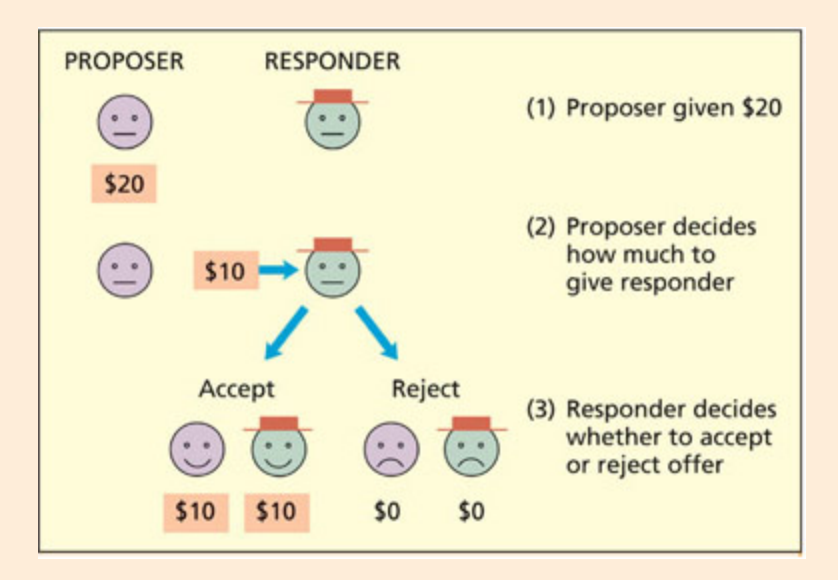
📊 그림 설명
Ultimatum Game의 fMRI 연구 결과를 보여주는 그림이다. 불공평한 제안을 받을 때 감정 처리와 관련된 뇌섬엽(insula)의 활성화가 거절 확률을 예측하며, 우측 측면 전두피질에 TMS를 적용하면 불공평한 제안의 수락률이 증가한다. 이는 전두피질의 하향식 제어 신호와 상향식 감정 반응이 행동 선택을 두고 경쟁하는 구조를 보여준다.
🔬 실험 상세: Sanfey et al. (2003) / Knoch et al. (2006) — Ultimatum Game
설계: 두 명이 참여한다. **제안자(proposer)**가 일정 금액(예: 0)을 택한다. 순수 금전 논리로는 어떤 제안이든 수락이 이득이지만, 실제로는 불공평한(약 20% 미만) 제안을 자주 거절한다. fMRI로 응답자의 뇌 활동을, 별도 연구에서는 우측 측면 PFC에 TMS를 적용해 행동 변화를 본다.
결과: 불공평한 제안 시 정서 관련 영역인 뇌섬엽(insula) 활성화가 거절 여부를 신뢰성 있게 예측했다. 우측 측면 PFC에 TMS를 가하면 불공평한 제안의 수락 확률이 증가했다.
그래프(fig13) 읽기: 데이터 플롯이 아니라 게임 절차 도식이다. (1) 제안자가 10) 결정 → (3) 응답자가 수락(각 0)하는 흐름을 보여준다.
함의: 상향식 정서 반응(공정성·insula)과 하향식 제어 신호(측면 PFC)가 행동 선택을 두고 경쟁하며, PFC를 약화시키면 정서적 거절보다 금전적 합리성이 우세해진다.
Sanfey et al. (2003) studied the Ultimatum Game using fMRI, in whi participants acted as responders and received either fair or unfair offers. Activity in a part of the brain that is linked with emotional processes (the insula) reliably predicts whether a player will reject an unfair offer. However, applying TMS over the right lateral prefrontal cortex increases the probability of accepting unfair offers (Kno et al., 2006). is is consistent with a biasing control signal (from the prefrontal cortex) and a boom-up emotional response competing for selection.
e relatively new field of neuroeconomics uses neuroscientific methods and theories to account for economic decision making (for a review see, Loewenstein et al., 2008). e term “economic” can be
construed in the broadest sense as referring not only to financial decisions (e.g. whether to spend, save or invest) but to other kinds of decisions that require allocation of a scarce resource (e.g. time) or an assignment of “value.” Whereas mu of theoretical economics describes how people should make decisions to aieve maximum benefits, the psyology of economics (and neuroeconomics) is concerned with how people actually do make decisions. For example, most people do not purase clothing for purely utilitarian reasons (i.e. to keep warm) but for other reasons, including the need to advertise one’s social status or personality, or, in some cases, because one simply enjoys the act of shopping (retail therapy). at is, the concept of value may have more to do with the perceived rewards to a given individual than the actual functional reward that may ultimately be obtained.
ere is also a strong social element as to how economic decisions are made. For example, consider the financial sharing game termed the ultimatum game (Guth et al., 1982). is involves two players: a proposer and a responder. e proposer is given a sum of money (e.g. $20) and must decide how mu to give to the responder (between $1 and $20). e responder must then decide whether to accept the offer (and the offer is then split) or reject the offer (both players leave with nothing). From a purely financial point of view, in a one-trial game, the optimal decision of the proposer is to give the minimum ($1) and the optimal decision of the responder is to accept whatever is given (because something is always beer than nothing). In reality, the responder typically rejects offers that are less than 20 percent of the pot, because they perceive the offer as unfair and wish to punish the proposer. Another way of thinking about it is that they are weighing up two values: a purely monetary value pied against a social value of fairness.
Mu of the emerging field of neuroeconomics is concerned with the interaction between one’s gut reactions (intuition or emotion) and one’s goals and beliefs. For example, one’s brand loyalty (e.g. to Pepsi versus Coke) may sometimes be at odds with one’s true taste
preferences when they are assessed blind. Whereas the dorsolateral prefrontal cortex is associated with people’s beliefs about whi of two brands they are tasting (Pepsi or Coke), the orbitofrontal cortex is associated with their actual ratings of how nice ea drink is (McClure et al., 2004b).
of the lateral PFC (le and right) and the anterior cingulate cortex. It also includes regions of the parietal lobes, notably around the intraparietal sulcus (IPS). However, it excludes the orbitofrontal cortex (and related ventromedial PFC) and generally excludes the anterior-most portion of the PFC (termed the frontal poles or BA10).
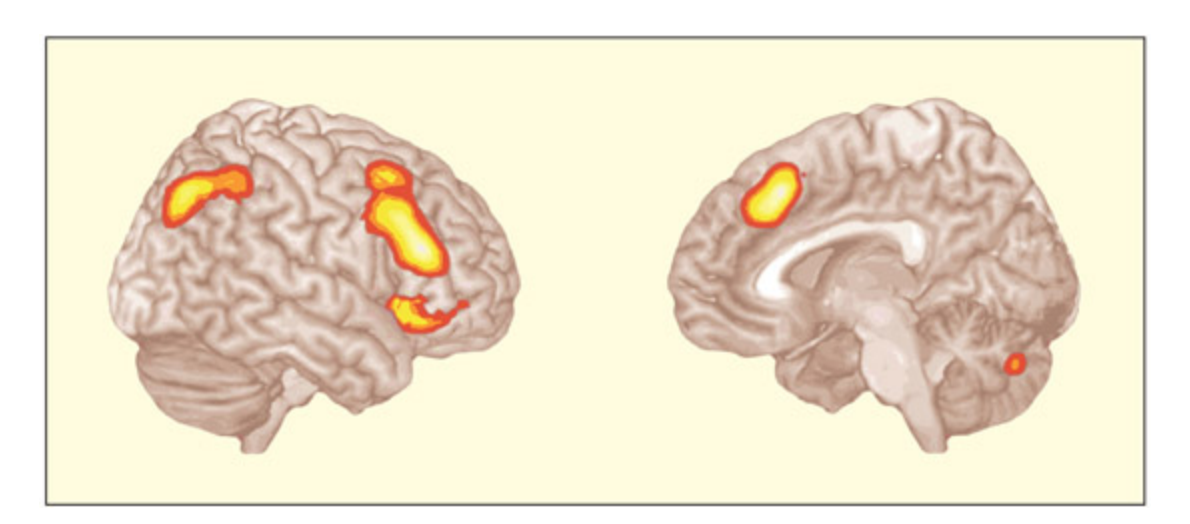
📊 그림 설명
다중 요구 네트워크(Multiple-Demand Network)의 뇌 영역을 보여주는 그림이다. fMRI 메타분석을 통해 확인된 이 네트워크는 측면 전두피질(좌/우), 전대상피질, 두정엽(두정내구 주변)이 비자동적 행동을 요구하는 다양한 과제에서 공통적으로 활성화됨을 보여준다. 안와전두피질과 전두극(BA 10)은 이 네트워크에서 제외된다.
🔬 실험 상세: Duncan & Owen (2000) / Duncan (2010) — 다중 요구 네트워크
설계: 다수의 fMRI 연구를 메타분석하여, 종류가 다른 여러 인지 제어 과제(반응 갈등, 작업기억, 새로움, 과제 수 증가 등)에서 휴지 기저선 대비 공통으로 활성화되는 영역을 추출했다.
결과: 좌·우 측면 PFC, 전대상피질(ACC), **두정엽(두정내구 IPS)**이 과제 종류와 무관하게 공통 활성화되었고, 안와전두피질과 **전두극(BA10)**은 제외되었다. 이 네트워크는 유동적 지능과 밀접하다.
그래프(fig14) 읽기: 데이터 플롯이 아니라 fMRI 활성화 지도다. 측면(왼쪽) 뇌와 내측(오른쪽) 뇌 위에 색으로 칠해진 부위가 다양한 과제에서 공통 활성화되는 영역(측면 PFC·두정엽·ACC)이다.
함의: 측면 PFC 내부는 과제별로 크게 분화되지 않은 범용 인지 제어 작업공간일 수 있음을 시사한다(후속 절의 후방-전방·반구 차이 주장과 대비된다).
From Duncan, 2010.
Key Terms
Neuroeconomics
e use of neuroscientific methods and theories to account for economic decision making.
신경경제학(Neuroeconomics)은 신경과학적 방법으로 경제적 의사결정을 설명하는 분야이다.
Ultimatum game
A two player game in whi one player proposes a split of money and a responder either accepts the money (and obtains the agreed split) or rejects it (and both players get nothing).
Ultimatum Game은 한 참가자가 자원 분배를 제안하고 다른 참가자가 수락/거절하는 실험으로, 거절 시 양측 모두 이득이 없다. 불공평한 제안 시 insula 활성화가 거절 확률을 예측하며, 측면 전두피질에 TMS를 적용하면 수락 확률이 증가하여 감정-이성 간 경쟁 관계를 시사한다.
Fluid intelligence
Flexible thinking and problem solving in novel situations, independent of acquired knowledge.
유동적 지능(fluid intelligence)은 기존 지식에 의존하지 않고 새로운 상황에서 유연하게 사고하고 문제를 해결하는 능력이다. 레이븐 매트릭스 등으로 측정되며, 다양한 작업 요구 네트워크와 밀접하게 연결된다. PFC 손상 환자는 IQ(결정화 지능)는 유지하나 유동적 지능에서 현저한 저하를 보인다.
Crystallized intelligence
e ability to use prior expertise and knowledge.
결정화 지능(crystallized intelligence)은 기존 전문 지식과 경험을 활용하는 능력으로, WAIS 등의 IQ 검사로 측정된다. PFC 손상 환자는 WAIS에서는 다른 뇌손상 환자와 유사하지만, 유동적 지능에서 22-38점 낮은 점수를 보인다. 실행 기능 검사 성과는 유동적 지능과 강한 상관관계를 보여 공통 신경 기반을 시사한다.
According to Duncan (2010), cognitive control involves several elements: focusing on the relevant features of the sub-task; as sub-tasks are completed the new elements must be focused upon and old ones discarded; and selected results must be passed from one sub-task to another. Evidence from single-cell recordings in the primate lateral PFC sheds some light as to how this is aieved. ese neurons respond primarily to the rules of the task rather than the specific stimulus or response (Asaad et al., 1998, 2000). For
example, they may respond to a conjunction of a stimulus and response (e.g. “look le when I see object A”), but not to the same stimulus out of context (“see object A”) or the same response in a different context (e.g. “look le when I see object B”). us, the coding of the task-relevant features is highly flexible. During performance of the task itself, the coding is also highly focused. In tasks su as these, up to 50 percent of all cells recorded in lateral prefrontal cortex discriminated targets from non-targets but, by contrast, many fewer cells made the task-irrelevant dis criminations between one non-target and another (Everling et al., 2002). However, when the task involves multiple sub-tasks then different sub-populations of neurons with the lateral PFC tend to separately code for different aributes of the subtasks (Sigala et al., 2008).
One claim is that the multiple-demand network is related specifically to fluid intelligence (Duncan, 2010; Woolgar et al., 2010). Fluid intelligence relates to problem-solving ability, and is tested using measures su as Raven’s matrices (Raven, 1960). is test involves aending to multiplefeatures of a problem: in the example printed here, the solution involves processing orientation, size and shape as three different sub-tasks. is can be contrasted with crystallized intelligence (Caell, 1971) whi relies heavily on prior expertise and knowledge and is assessed by measures of IQ su as the WAIS (Wesler Adult Intelligence Scale; Wesler, 1981). e laer measures mental arithmetic, factual knowledge, speed of processing, and so on. Meta-analyses of functional imaging tests of fluid intelligence produce a very similar paern to that of the multiple-demand network (Jung & Haier, 2007).
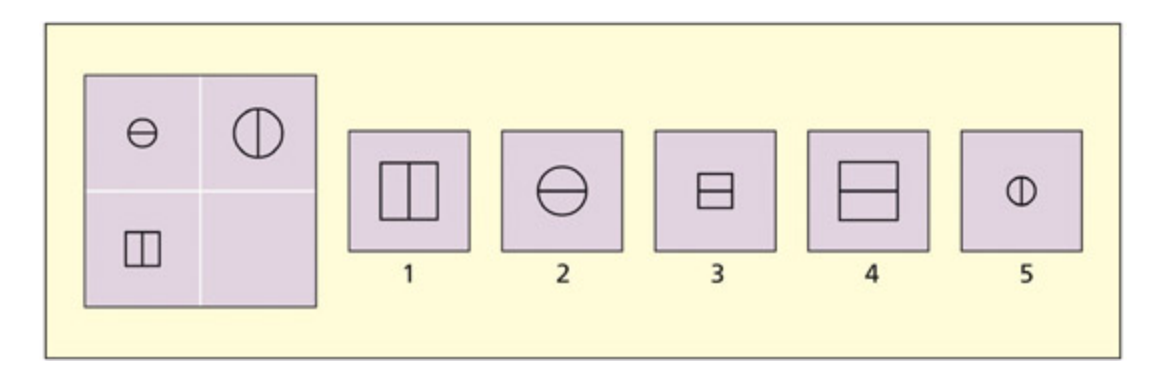
📊 그림 설명
레이븐 매트릭스(Raven’s matrices) 유형의 유동적 지능 검사 문항 예시를 보여주는 그림이다. 참가자는 방향, 크기, 형태 등 여러 차원을 동시에 처리하여 패턴의 빠진 부분을 찾아야 한다. 전두엽 손상 환자는 WAIS IQ에서는 정상 범위이지만 이러한 유동적 지능 검사에서 22-38점 낮은 점수를 보인다.
🔬 실험 상세: Raven's matrices (Duncan et al., 1995) — 유동적 지능 검사
설계: 레이븐 매트릭스형 추론 문항이다. 왼쪽의 2×2 행렬에서 한 칸이 비어 있고(여기서는 우하단), 참가자는 행렬을 지배하는 규칙을 추론해 오른쪽 보기(1
5) 중 빈칸을 채울 도형을 고른다. 한 문항을 풀려면 방향·크기·형태 같은 여러 차원을 각각 별개의 하위 과제로 동시에 처리해야 한다. PFC 손상 환자와 정상 대조군의 점수를 WAIS(결정화 지능)와 비교한다.130으로 높은 PFC 손상 환자도 이런 유동적 지능 검사에서는 22–38점 더 낮은 점수를 보였다. 실행 기능 검사 성적은 유동적 지능과 강하게 상관했다.
결과: WAIS IQ가 125
그래프(fig15) 읽기: 데이터 플롯이 아니라 검사 문항 도식이다. 왼쪽이 빈칸 포함 행렬, 오른쪽 1~5가 보기이며, 정답은 행/열의 도형이 어떻게 변하는지(분할선 방향·내부 도형) 규칙을 추론해야 정해진다.
함의: PFC는 결정화 지능(축적된 지식)과 달리 유동적 지능(새 문제의 다차원 추론)에 결정적이며, 다중 요구 네트워크와 같은 기질을 공유함을 시사한다.
Patients with frontal lobe damage are impaired on tests of “fluid intelligence” su as this. Reprinted from Duncan et al., 1995. © 1995, with permission from Elsevier.
Patients with lesions of prefrontal cortex fare no worse on tests su as the WAIS relative to other brain-damaged controls (Warrington & James, 1986). By contrast, patients with lesions to the prefrontal cortex who score well on the WAIS IQ (scores between 125–130 with a scale average of 100) score 22–38 points lower on measures of fluid intelligence (Duncan et al., 1995). Moreover, performance on standard tests of executive function by patients with PFC lesions correlates strongly with fluid intelligence measures and with ea other (Roca et al., 2010).
Claims su as these (i.e. that all tests of executive function tap the same network) have lead some researers to aracterize the multiple-demand network as an undifferentiated entity. However, some relative degree of specialization of function within the network is tentatively anowledged (Hampshire et al., 2011) but without recourse to any modularization of different executive components. Moreover, regions normally regarded as outside of the network (e.g. the frontal poles) are anowledged to have a qualitatively different functional role (Roca et al., 2010).
A posterior to anterior organization?
Summary
전두극(frontal pole, BA 10)은 주 목표와 하위 목표를 동시에 유지하는 멀티태스킹에서만 특이적으로 활성화된다. **Koechlin & Summerfield (2007)**는 후방(단순 자극-반응)에서 전방(복잡한 맥락적/에피소드적 제어)으로 이어지는 계층 구조를 제안했고, **Badre & D’Esposito (2009)**는 배측(행동 계획)과 복측(언어/객체) 두 개의 후방-전방 기울기를 제시했다. **Burgess et al. (2007)**은 전두극이 외부 자극 기반 인지와 내부 사고 간의 게이트웨이 역할을 한다고 제안한다.
Until recently, lile was known about the function of the anterior-most part of the frontal lobes (also called rostral prefrontal cortex or the frontal pole). However, a number of recent studies and reviews have suggested that the region is specifically involved when multiple tasks need to be coordinated (Burgess, 2000; Christoff et al., 2001; Koelin et al., 1999a; Ramnani & Owen, 2004). Koelin et al. (1999a) performed an fMRI experiment in whi participants were required to hold in mind a main goal while concurrently performing sub-goals. Neither holding in mind a goal by itself (working memory) nor switing between alternate goals was associated with activity in this region. Only when these two elements were combined was activity
found in this region. e fact that some patients with frontal lesions are specifically impaired on multi-tasking, but not the component tasks and not other measures of executive function (e.g. the Wisconsin Card Sort, whi involves task-switing but not multi-tasking) supports the view that there is a separate neuroanatomical substrate for this (Burgess et al., 2000). is has led to the proposal that there is a hierarical organization of executive functions su that posterior parts of the prefrontal cortex (including what Duncan refers to as the Multiple-Demand-Network) implements tasks with a single goal including those requiring switing to different sub-tasks, but that the anterior most PFC implements multiple tasks simultaneously.
Koelin and Summerfield (2007) propose a specific model along these lines consisting of a hierary that runs from the premotor cortex (posteriorly) to the frontal poles (anteriorly). e premotor cortex is not anatomically part of the PFC but is known to implement simple stimulusresponse mappings su as “press the le buon when you see red, and right for green” (Passingham, 1988). However, adding contextual information (e.g. “perform consonant/vowel discrimination for red leers and UPPER/lower case discrimination for green leers”) cannot be performed automatically, at least not without training, and does require cognitive control. Moreover, switing the instructions on a blo-by-blo basis (e.g. so that red becomes the UPPER/low task and green the consonant/vowel task) requires what Koelin and Summerfield (2007) term episodic control, i.e. knowing whi context to apply at a given moment in time. e highest level in their model, termed “braning control,” involves holding in mind pending tasks while carrying out an ongoing task (i.e. multi-tasking). In an fMRI study, Koelin et al. (2003) compared the first three types of situation (sensorimotor rules, contextual rules, episodic rules) using the leer and color stimuli described above. Implementing the sensorimotor rules (common to all tasks) invoked the premotor cortex, whereas the presence of contextual rules invoked more anterior activity, and the presence of episodic rules was more anterior still.
Badre and D’Esposito (2009) present a related view of the organization of the lateral PFC to Koelin and Summerfield (2007). One of the key differences in their formulation is that they propose two different posterior
to anterior gradients in the lateral PFC: one that is ventrally based and one that is dorsally based. is is consistent with several other prominent views that allocate different functions to dorsal and ventral regions of the lateral PFC (e.g. Fleter & Henson, 2001; Petrides, 2000). In their model, the dorsal posterior-anterior gradient is linked specifically to action planning (perhaps by virtue of connectivity to the parietal lobes), whereas the ventral posterior-anterior gradient is linked to, among others, language and objects (perhaps by virtue of connectivity to the temporal lobes). To give a concrete example from the literature, one study found a posterior-anterior gradient in the ventral part of the lateral PFC when participants were asked to make semantic decisions about objects su as “Is the object bigger than a 13-in box?” or “Is the object made of an organic substance?” (Race et al., 2009). e clever aspect of the study design is that they measured how the BOLD signal was affected when different aspects of the experiment were repeated: either by repeating the same semantic item (irrespective of task or response), the same task (e.g. size judgment), or the same manual response. is led to a gradient of activity (anterior-most for semantic repetition, posterior-most for manual repetition) running along the ventral portion of the lateral PFC.
Finally, Burgess et al. (2007) have proposed a theory concerning the functions of the frontal pole region (BA 10) but without an assumption of a gradient/ hierary across the lateral PFC. ey suggest that its specific role is to act as a “gateway” between stimulus-driven cognition (e.g. maintaining focus on a task involving sensorimotor demands) versus internal thoughts (thinking “in one’s head”). Multi-tasking involves maintaining internal cognitions (i.e. future intentions) while engaging with an external task. Moreover, they propose that, whereas the lateral surface of this region is involved in orienting to external stimuli/tasks, the medial surface of this region is involved in orienting to internal
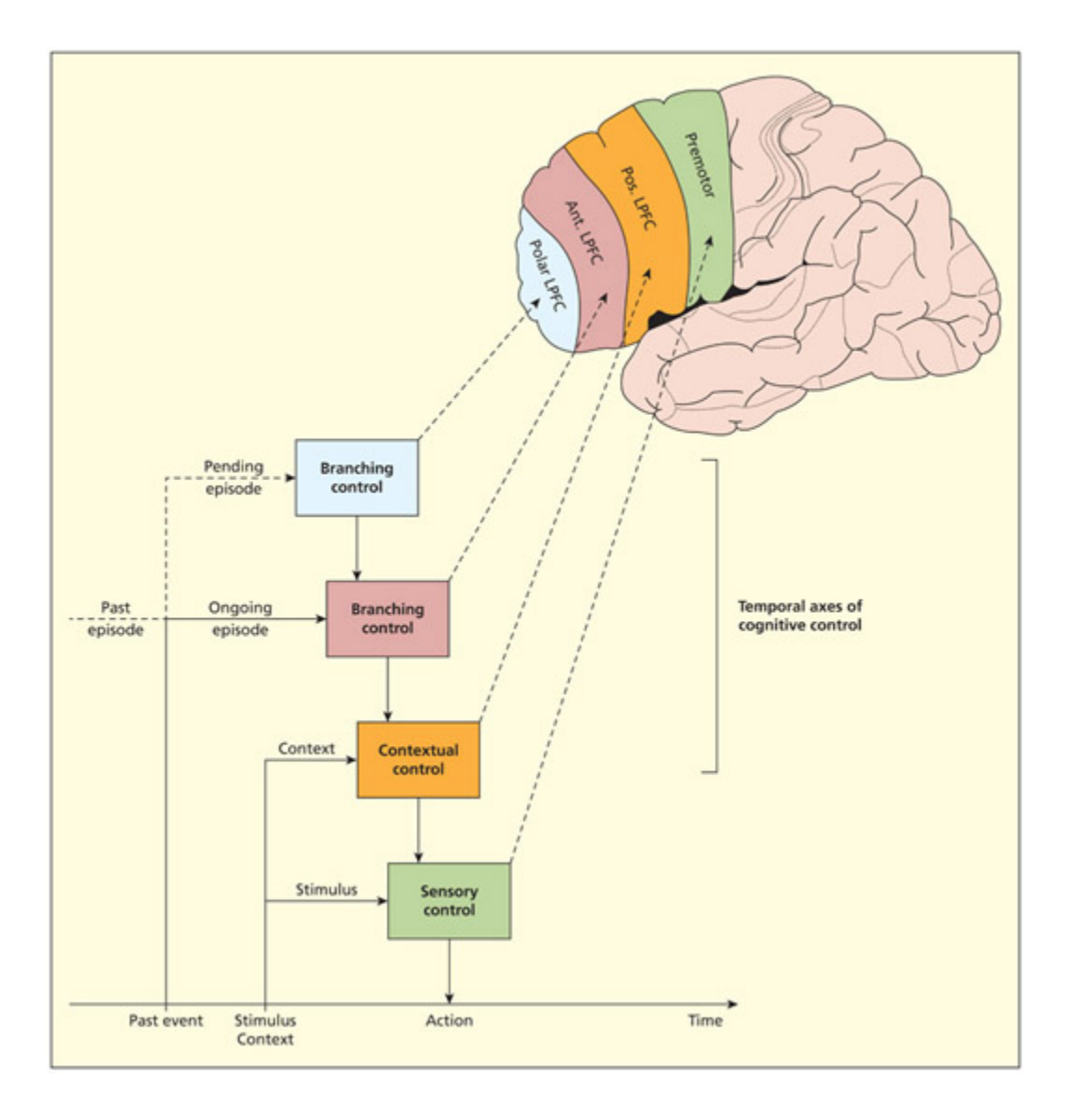
📊 그림 설명
Koechlin과 Summerfield(2007)의 전두피질 후방-전방 계층 모델을 보여주는 그림이다. 후방의 전운동피질은 단순한 자극-반응 매핑(예: “빨간 자극이면 왼쪽 버튼”)을 담당하고, 전방으로 갈수록 맥락적 제어(상황에 따른 규칙 적용), 에피소드적 제어(규칙 전환 시점 관리), 분기 제어(멀티태스킹) 등 점차 복잡한 인지 제어 기능이 배치된다.
🔬 실험 상세: Koechlin et al. (2003) / Koechlin & Summerfield (2007) — 후방-전방 제어 위계
설계: 문자/색 자극에 규칙을 적용하는 fMRI 과제에서, 제어에 필요한 정보의 종류를 단계적으로 늘려 활성화 위치를 비교했다. ① 감각운동 규칙(예: 빨강→왼쪽 버튼) ② 거기에 맥락 규칙 추가(빨간 글자는 자음/모음, 초록 글자는 대소문자 판단) ③ 블록마다 규칙 매핑이 바뀌어 어느 맥락을 적용할지(에피소드 규칙) 알아야 하는 조건. 최상위는 진행 중 과제를 하면서 대기 과제를 유지하는 **분기 제어(branching, 멀티태스킹)**다.
결과: 감각운동 규칙은 전운동피질(후방)을, 맥락 규칙은 더 전방을, 에피소드 규칙은 더욱 전방을 활성화해 후방→전방으로 갈수록 추상도가 높아지는 위계가 나타났다.
그래프(fig16) 읽기: 데이터 플롯이 아니라 모델 도식이다. 아래쪽 화살표(시간 축)를 따라 감각(sensory)→맥락(contextual)→분기(branching) 제어 상자가 쌓이고, 점선이 각 상자를 뇌 그림의 후방(Premotor)→전방(Post-LPFC→Ant-LPFC→Polar-LPFC) 영역에 대응시킨다.
함의: 실행 기능은 후방(단순 S-R)에서 전방(맥락·에피소드·멀티태스킹)으로 이어지는 위계적 조직을 가지며, 전두극이 가장 추상적인 제어를 담당한다.
Koelin and Summerfield (2007) argue for a posterior-anterior hierary of executive functions with more posterior regions involved in implementing simple stimulus-response mappings (e.g. “red stimulus → le buon press”), and more anterior regions involved in more complex mappings (e.g. “red stimulus → le buon press, but only if the stimulus is also a vowel”). From Koelin & Summerfield, 2007.
cognitions. is connects their theory to a mu wider literature showing that the medial anterior PFC region tends to be activated in tasks involving social cognition (e.g. thinking about thoughts; Amodio & Frith, 2006) and, unlike the lateral prefrontal cortex, the medial frontal poles tends to be more active during rest than when engaged in tasks (Buner et al., 2008). It is
unclear what “rest” consists of, in cognitive terms, but it is reasonable to assume that it generally consists of some kind of “inner thought” rather than absence of cognition (Morcom & Fleter, 2007). Patients with lesions limited to the frontal poles are impaired on tasks of multi-tasking and on tasks of social cognition (theory-of-mind, understanding Faux pas) but perform well on many other tests of executive function (Roca et al., 2010; Roca et al., 2011).
Key Terms
Monitoring
e process of relating information currently held in mind ba to the task requirements.
모니터링(monitoring)은 현재 인지 중인 정보를 과제 요구사항과 연결시키는 과정으로, 검색된 정보나 지각된 정보의 타당성을 확인하는 점검 메커니즘이기도 하다. 우측 배외측 전두피질(right DLPFC)이 기억 검색과 지속적 주의 과제에서 공통적으로 활성화되어, 이 영역이 기억이나 지각 자체보다 모니터링 기능에 관련됨을 시사한다.
Sustained attention
Maintaining focus on the task requirements over a period of time.
지속적 주의(sustained attention)는 시간 경과에 따라 과제 요구사항에 집중을 유지하는 과정이다. 우측 측면 PFC 손상 환자는 자극 간 간격이 길어지면 오히려 반응이 느려지는데, 이는 과제에서 이탈하기 때문으로 해석된다. 이 영역에 TMS를 적용하면 정상인에서도 유사한 효과가 나타난다.
Hemispheric differences
Summary
좌측 측면 PFC는 과제 설정(task-setting)에, 우측 측면 PFC는 과제 모니터링(task-monitoring)에 상대적으로 특화되어 있다. WCST 표준 버전(개방형)에서는 좌측 손상이, 수정 버전(규칙 제공)에서는 우측 손상이 더 큰 저하를 보인다. 과제 전환 시 좌측 손상은 전환 비용 증가, 우측 손상은 보속증 오류 증가를 보이며, 좌측 DLPFC는 “반응 공간 조각”(sculpting the response space), 우측은 지속적 모니터링에 관여한다.
Functional differences between the le and right lateral PFC are more controversial than the other principles of organization discussed thus far. For instance, they tend not to be found in single-cell recordings from the monkey PFC (Miller & Cohen, 2001), but this may not be surprising since humans are known to possess far more lateralization of higher cognitive functions than other primates. It is also less apparent in the functional
imaging data of humans (Duncan & Owen, 2000). Perhaps the most convincing evidence comes from neuropsyological investigations of lesions to the PFC whi has revealed reliable functional differences (Stuss & Alexander, 2007). Even here, it is to be noted, that the dissociations tend to be relative rather than absolute: i.e. patients with le and right PFC lesions differ with respect to ea other, but both groups are impaired relative to controls. at is, “classical” dissociations tend not to be observed (to use the terminology of Shallice, 1988). is may also explain why the functional imaging data is not so clear-cut in this regard; i.e. both hemispheres appear active, and the statistical difference in activation between hemispheres is not directly assessed. Nor is it clear whether hemispheric differences in activation relate to actual differences in behavior from fMRI studies (e.g. does activity reflect working harder or contributing more?).
One of the main models regarding hemispheric specializations of executive function originates from Stuss and colleagues (Stuss et al., 1995). In their model, the left lateral PFC is considered relatively specialized for task-seing, whereas the right lateral PFC is relatively specialized for task monitoring. Task-seing will tend to be maximized when the task itself is open-ended (e.g. problem solving) as opposed to situations in whi explicit instructions are given as to how the task is to be performed. As noted previously, these problem-solving tasks tend to be more impaired aer damage to the le frontal lobe irrespective of whether the stimuli are verbal (e.g. the FAS test; Stuss et al., 1998) or visuo-spatial (e.g. the Tower-of-London; Shallice, 1982). Task monitoring is linked to the notion of sustained attention and involves keeping “on task” and maintaining the currently relevant rules. ey associate a rather different functional role (“energization”) to medial regions of the frontal lobes, including both the anterior cingulated and pre-SMA region. e revised version of the SAS model contains many modular-like components of executive function but also groups these into different stages including a task-seing stage for creating new semas (whi they link to the le lateral PFC) and monitoring the outcomes aer sema implementation (whi is linked to the right lateral PFC) (Shallice & Burgess, 1996; Shallice, 2002).
e Wisconsin Card Sorting Test is impaired aer lesions of both the le and right lateral PFC relative to controls (Stuss et al., 2000). However, a le right hemispheric dissociation is found for different versions of administering it. In the standard version, the participant is given no information about the three rules or when they will ange. Patients with le lateral PFC damage perform worse than right PFC damage on this version. In a modified version, the patient is told of the rules, is given a starting rule (sort by color) and is told when the rules will ange (aer every 10 trials). In this version, patients with right lateral PFC lesions fare worse than their le hemispheric counterparts. In the standard/open-ended version, the performance limitations may stem primarily from task-seing (taxing the le hemisphere more), whereas in the more constrained version performance limitations may come from monitoring the current rule (taxing the right hemisphere more).
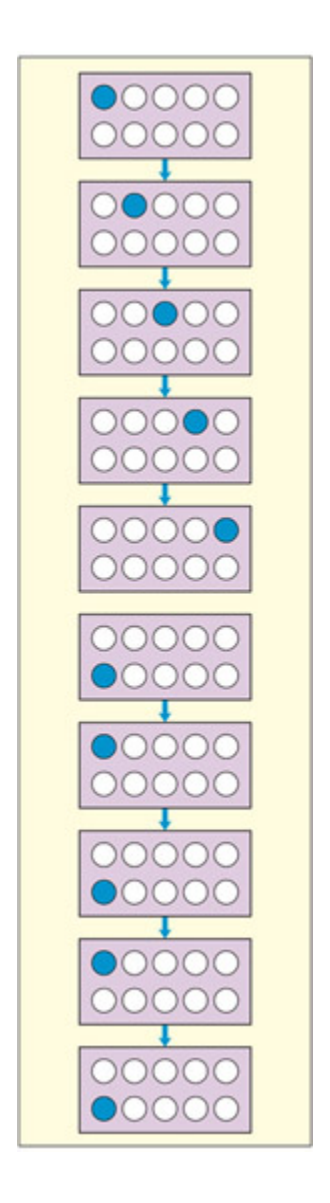
📊 그림 설명
Reverberi 등(2005)의 규칙 유도 과제를 보여주는 그림이다. 10개의 번호가 매겨진 원 중 하나가 파란색으로 칠해지며, 참가자는 다음에 어떤 원이 칠해질지 예측해야 한다. 규칙이 예고 없이 변경되며(예: +1 규칙에서 교대 규칙으로), 좌측 전두피질 손상 환자는 규칙 유도에, 우측 전두피질 손상 환자는 간섭 후 규칙 복귀에 각각 선택적 장애를 보인다.
🔬 실험 상세: Reverberi et al. (2005) — 순차 규칙 유도 과제
설계: 10개의 원이 가로로 배열된 카드를 위에서 아래로 연속 제시한다(그림). 매 카드에서 하나의 원이 파란색으로 칠해지며, 참가자는 다음 카드에서 어느 원이 칠해질지 예측해야 한다. 규칙(예: +1씩 이동, 또는 1과 6 사이 교대)은 알려주지 않고 예고 없이 바뀐다. WCST보다 규칙이 더 추상적이다. 2단계에서는 다른 규칙을 따르는 빨간 원 계열이 끼어들어 간섭을 준 뒤(빨간 원은 그냥 누르기) 원래 파란 규칙으로 복귀해야 한다.
결과: 좌측 측면 PFC 손상 환자는 규칙 유도 자체에 장애를 보였고(작업기억 손상 여부와 무관), 우측 측면 PFC(및 ACC) 손상 환자는 간섭(빨간 계열) 후 지시받았음에도 원래 파란 규칙으로 복귀하지 못했다.
그래프(fig17) 읽기: 데이터 플롯이 아니라 과제 진행 도식이다. 위→아래 각 카드에서 파란 원의 위치가 어떻게 이동하는지가 숨은 규칙이며, 아래 방향 화살표는 다음 시행으로의 진행을 나타낸다.
함의: 좌 PFC = 규칙(task set) 설정, 우 PFC = 규칙 점검·복귀(monitoring)라는 반구 기능 분화를 뒷받침한다.
Patients are shown a sequence of cards containing ten numbered circles. One of the circles is colored blue. eir task is to decide whi of the next circles will be colored in. e rules can ange unexpectedly. In this example, the rule shis from +1 to alternation (between circles 1 and 6).
Patients with both le and right prefrontal lesions are impaired at task switing but for different reasons (Aron et al., 2004a; Mayr et al., 2006). In the study of Aron et al. (2004a) patients with le lateral PFC damage tended to show mu longer swit costs (consistent with a general impairment in task-seing), but patients with right lateral PFC damage tended to be particularly error-prone, specifically in the tendency to perseverate to the
previous task-set (interpreted by the authors as a failure of response inhibition but potentially explicable in terms of failed monitoring).
Reverberi et al. (2005) devised a test of rule induction that appears to be sensitive to the laterality of prefrontal lesions. Patients are shown a sequence of cards containing ten numbered circles. One of the circles is colored blue. eir task is to decide whi of the next circles will be colored in. e rules can ange unexpectedly, and the rules themselves are more abstract than in the Wisconsin Card Sorting Test. Patients with le lateral prefrontal lesions were impaired at inducing the rules, and that this difficulty was found irrespective of whether they had a working memory impairment (as assessed by their memory of successive spatial positions). ey suggest that the difficulty lies in seing up task semas. In a second phase of the experiment, the sequence of blue circles was interspersed with sequences of red circles that followed a different rule. When red circles appeared, the task was simply to press that circle. When the blue circles appeared, the task was to predict the next in the sequence. Patients with right lateral prefrontal lesions (and those with anterior cingulate lesions) failed to revert ba to the blue rule aer the interfering red sequence, despite being instructed to do so. Reverberi et al. interpreted this as a failure to e or monitor their responses, consistent with a right frontal involvement in this function.
시험 팁
반구 차이를 기억하는 요령: 좌측 PFC = “Setting”(설정), **우측 PFC = “Surveillance”(감시/모니터링)**으로 외우면 편하다. 좌측은 새로운 규칙을 만들어내는 것, 우측은 만들어진 규칙이 제대로 지켜지는지 감시하는 것이다. WCST 표준 버전(규칙을 스스로 찾아야 함)에서는 좌측 손상이, 수정 버전(규칙이 제공됨)에서는 우측 손상이 더 큰 저하를 보인다.
In a review of the literature, Frith (2000) argues that the role of the le dorso-lateral PFC is in “sculpting the response space.” He suggests that the region is responsible for highlighting the range of possible responses and for suppressing inappropriate responses. is is related to the concept of taskseing. It suggests that this region will be recruited more when the task parameters are not strongly constrained (e.g. when there is a large range of stimulus-response mappings to oose from). For instance, this region is activated more when participants have to oose whi finger to move relative to when they are told whi finger to move, and also when they are asked to generate a word from a leer cue (e.g. “F”) relative to simple repetition of a word (Frith et al., 1991). e region is also active when participants are free to select when to make a response (Jahanshahi et al., 1995). Generating random sequences (e.g. of digits) is a cognitively
demanding task that involves seing up and selecting “freely” from a pool of potential responses. ere is a tendency, particularly under time pressure, for randomness to break down and participants start generating familiar sequences from memory, su as con secutive runs (4, 5, 6; X, Y, Z) or stored know ledge (e.g. acronyms, “B, B, C”; telephone num bers). Repetitive TMS over the le, but not right, DLPFC results in less random and more familiar sequences (Jahanshahi et al., 1998). Another study found that repetitive TMS over le DLPFC impairs “free oice” even in tasks with no working memory demands (Hadland et al., 2001). e previous responses were displayed on a monitor so they need not be held in mind.
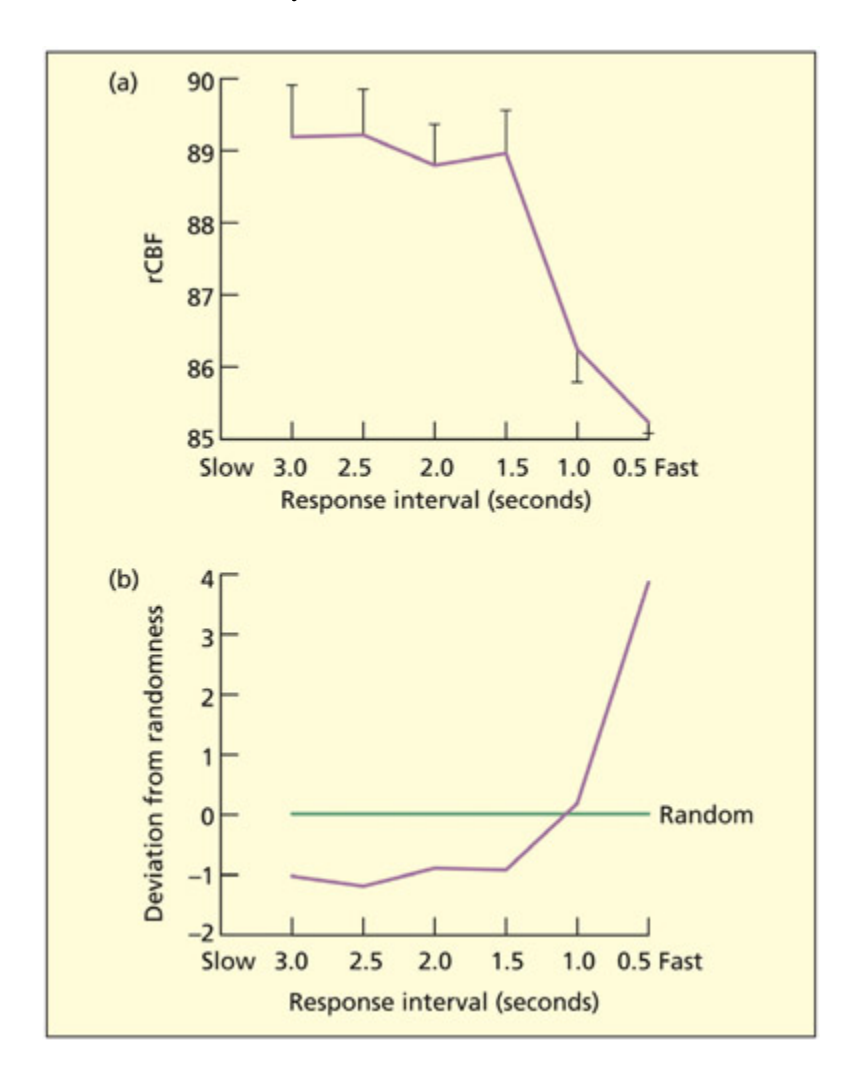
📊 그림 설명
좌측 배외측 전두피질(DLPFC)의 활성화와 무작위 시퀀스 생성 능력의 관계를 보여주는 그림이다. (a) 좌측 DLPFC의 뇌 활성화 위치, (b) 반응 속도가 빨라지면 DLPFC 활성화가 감소하고 동시에 반응의 무작위성이 크게 저하됨을 보여준다. 좌측 DLPFC에 반복 TMS를 적용하면 무작위성이 감소하고 익숙한 시퀀스가 증가한다.
🔬 실험 상세: Jahanshahi et al. (2000) — 무작위 수열 생성과 좌 DLPFC
설계: 참가자가 다양한 속도(반응 간격)로 숫자를 무작위로 산출한다. 무작위 생성은 잠재 반응 풀에서 자유롭게 선택하고 익숙한 수열(연속수 4·5·6, 전화번호 등)을 억제해야 하는 부담 큰 과제다. 속도를 빠르게(반응 간격을 짧게) 강제하면서 좌 DLPFC의 국소 뇌혈류(rCBF)와 산출 수열의 무작위성을 함께 측정한다. 별도로 좌/우 DLPFC에 반복 TMS를 가한다.
결과: 빠를수록 무작위성이 무너져 익숙한 수열이 늘었고, 좌(우 아님) DLPFC 반복 TMS도 같은 효과를 냈다.
그래프(fig18) 읽기: 위·아래 두 개의 선 그래프이며 X축은 공통으로 **반응 간격(초, 왼쪽 Slow 3.0 → 오른쪽 Fast 0.5)**이다. (a) 위 그래프 — Y축 = rCBF(좌 DLPFC의 국소 뇌혈류 = 활성화); 반응이 빨라질수록(오른쪽) 활성화가 급감한다. (b) 아래 그래프 — Y축 = 무작위성 이탈도(0 = 완전 무작위를 뜻하는 ‘Random’ 기준선, 클수록 비무작위); 빠른 쪽에서 급격히 위로 치솟아 무작위성이 붕괴한다. 좌 DLPFC 활성화가 떨어지는 그 지점(Fast 쪽)에서 무작위성도 함께 무너진다는 점이 핵심이다.
함의: 좌 DLPFC는 “반응 공간을 조각”(sculpting the response space)하여 자유 선택·비습관적 반응을 가능케 하며, 활성화가 떨어지면 습관적 수열로 회귀한다.
Reprinted from Jahanshahi et al., 2000. © 2000 with permission from Elsevier.
Monitoring is the process of relating information currently held in mind ba to the task requirements. It is also a eing meanism to ascertain whether retrieved or perceived information is valid. e region may be important both for monitoring the content of internally held inform ation, su as monitoring the content of episodic or working memory (Habib et al., 2003), as well as for monitoring the content of externally presented information, as in tasks of sustained aention (Kanwisher & Wojciulik, 2000). Cabeza et al. (2003) directly compared fMRI activity in a memory retrieval task (word recognition) with a non-memory task of sustained aention (did the stimulus blip once, twice or never during a 12-sec presentation). e study found common regions of right DLPFC activity between the two tasks. As su, it appears as if the region is related more to monitoring and aending than to memory or perception per se.
A study comparing brain-damage to the right and le lateral PFC is also consistent with a greater role of the right PFC in monitoring. Stuss et al. (2005) administered relatively simple stimulus-response paradigms (e.g. press le hand for “A” and right hand for other leers), but varied the time interval between the end of the trial (i.e. aer making a response) and the start of the next one (i.e. when the next leer is shown). For healthy controls, and indeed patients with le lateral PFC lesions, having a longer interval results in a subsequently faster response, because participants prepare themselves for the stimulus onset. For the patients with right lateral PFC lesions, the opposite was true: a longer wait for the onset of a stimulus resulted in slower responding, presumably because they had become more disengaged from the task during the waiting period. In healthy participants, TMS over the right, but not le, prefrontal cortex of neurotypical people reduces this speeding-up effect relating to longer preparatory times (Vallesi et al., 2007).
An alternative view of the function of the right (inferior) lateral prefrontal cortex is that it functionally specialized for response inhibition (Aron et al.,
2004a). is view emerges from studies on paradigms su as Go/No-Go whi are shown to activate the right more than le in healthy participants (on No-Go trials) and be particularly disrupted by lesions to the right lateral PFC (Aron et al., 2003). e inhibition explanation is not straightforward to separate from the monitoring account as a failure to monitor adequately would tend to lead to the automatic “go” response on No-Go trials. One fMRI study investigated the functional connectivity of brain regions during the processing of No-Go signals and found that the right lateral PFC was involved in the detection of the No-Go signal (i.e. consistent with the monitoring account) whi then influenced the pre-SMA area (Duann et al., 2009). e pre-SMA area is, according to Duann et al. (2009), directly implicated in response inhibition of the motor program via the basal ganglia circuitry.
Evaluation
Although contemporary models of executive function retain their earlier aracter (i.e. flexibly implement task rules, controlling nonautomatic responses) far more is now known about how (and where) they are implemented in the prefrontal cortex. e notion of a general workspace that is essentially undifferentiated in aracter is not supported by the weight of evidence. Models along these lines would be the earlier versions of the SAS model (Norman & Shallice, 1986) and the models of Miller and Cohen (2001) and Goldman-Rakic (1996). e Multiple Demand Network (Duncan, 2010) is also largely an undifferentiated workspace, but it is certainly not to be considered synonymous with the entire prefrontal cortex (but rather the mid-lateral regions and certain parietal regions). Although we could conceptualize, from first principles, that a diverse range of tasks su as the Stroop, multi-tasking, and reversal learning all require the same kind of control meanism (e.g. flexibly associating stimuli and responses) the evidence suggests that the brain treats tasks su as these rather differently. Needless to say, the most extreme alternative viewpoint—i.e. that
ea task has its own dedicated meanisms—is untenable, because this is incompatible with the behavioral flexibility that needs to be explained in the first place.
In the sections above several different levels of organization are considered. e distinction between cognitive versus affective control is well-supported empirically and suggests a division according to the type of information processed. ere is some evidence of a posterior-anterior difference in prefrontal functioning that depends on whether single or multiple tasks are being simultaneously performed (and possibly finer gradients within that). e evidence for hemispheric differences in the lateral PFC is rather different in aracter from the other principles of organization in that claims have been made about the type of operation performed (le = task-seing; right = task-monitoring) rather than the type of information processed. e next section will consider in more detail another region, not strictly part of the prefrontal cortex, but strongly connected to it and implicated in other aspects of executive function: namely the anterior cingulate cortex.
The Role of the Anterior Cingulate in Executive Functions
Summary
전대상피질(anterior cingulate cortex, ACC)은 배측 인지적 분할(DLPFC와 연결)과 복측 정서적 분할(변연계/안와전두피질과 연결)로 구분된다. 인지적 분할은 오류 감지, 반응 갈등 평가, 동기 부여에 관여하며, 오류 발생 시 오류 관련 음성파(ERN)를 생성한다. ACC는 갈등 신호를 생성하고, 실제 행동 조정은 측면 전두피질이 담당한다.
Key Terms
Error-related negativity
An event-related potential component in EEG that can be detected at the scalp when an error is made.
오류 관련 음성파(ERN)는 오류 발생과 동시에 두피에서 관찰되는 ERP 성분으로, 전대상피질(ACC)에서 기원한다. ACC는 오류 시행에서 활성화되고, 그 다음 시행의 행동 조정은 측면 전두피질에서 이루어진다. ACC는 오류와 반응 갈등뿐 아니라 보상/벌금에도 반응하며, 고보상 조건에서 지속적 활성화가 관찰되어 동기 부여 기능도 시사된다.
Historically, the anterior cingulate cortex has been classified as belonging to the limbic lobe rather than the frontal lobes. However, a more detailed understanding of its neural connectivity has suggested that it may function as an interface between limbic and frontal regions. In their review, Bush et al. (2000) distinguish between two functionally different regions of the anterior cingulate. A more dorsal region is termed the “cognitive division” and may be related to executive functions. It has strong interconnections with the DLPFC. is may explain why these regions tend to be activated together in functional imaging studies. It also has connections with parietal, premotor, and supplementary motor areas. A more rostral “affective division” is connected with limbic and orbitofrontal regions. e remainder of this section will focus on the cognitive/executive region of the anterior cingulate, and further use of the term “anterior cingulate” in this apter will be used to refer to this region unless stated otherwise.
One postulated role of the anterior cingulate in executive functions is in the detection of errors (Carter et al., 1998). In human reaction time experiments, the trial immediately aer an error (error + 1) tends to be slower and more accurate than aer a correct trial (correct + 1) (Rabbi, 1966). is implies the existence of some cognitive meanism that monitors for errors and recalibrates task performance accordingly (e.g. slowing down to ensure greater accuracy). In macaque monkeys with anterior cingulate lesions, errors are more likely on “error + 1” trials than “correct + 1” trials (Rushworth et al., 2003). is suggests that no su adjustment is made following errorful behavior, and errors are more likely to follow errors. Moreover, when monkeys (Gemba et al., 1986) and humans (Dehaene et al., 1994) make errors an error potential can be detected at the scalp that appears to have its origins in the anterior cingulate. is response is called an errorrelated negativity and its onset is simultaneous with the error being made and peaks around 100 ms aer the response (Gehring et al., 1993). e studies cited above are ambiguous as to whether the anterior cingulate is important just for the detection of the error, or also for the subsequent compensatory behavior. Event-related fMRI shows anterior cingulate activity on the error trial, with greater activity on the error + 1 trial in the
lateral prefrontal cortex associated with behavioral adjustment (Kerns et al., 2004). is suggests that the anterior cingulate’s role is limited to error detection and not compensation, and the lateral prefrontal cortex is responsible for adjusting ongoing behavior.
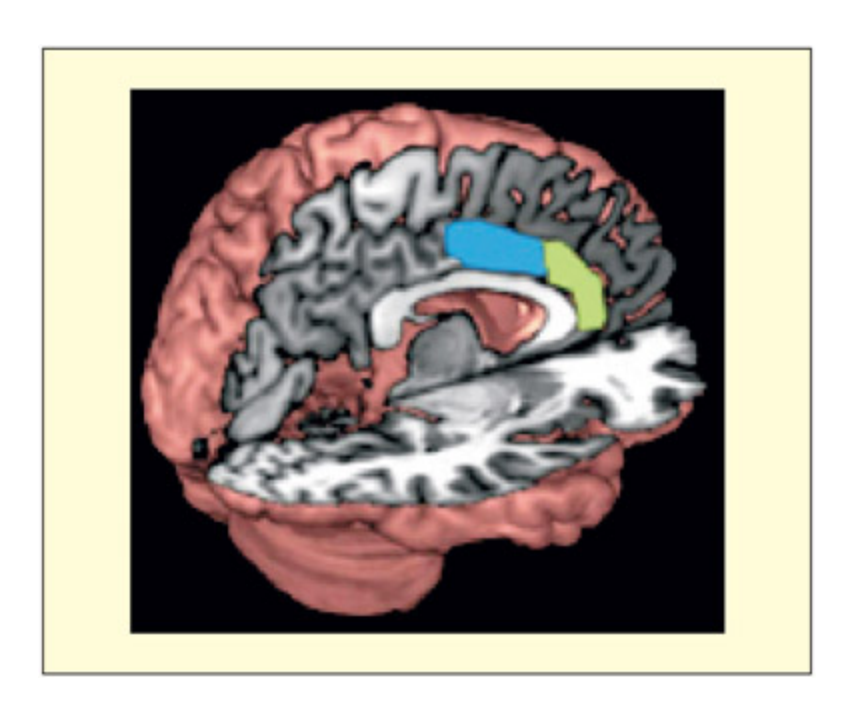
📊 그림 설명
전대상피질(anterior cingulate cortex)의 해부학적 위치와 기능적 분할을 보여주는 그림이다. 뇌량(corpus callosum) 위의 내측면에 위치하며, 배측(파란색)은 실행 기능 관련 인지적 분할로 DLPFC와 연결되고, 복측(녹색)은 정서 처리 관련 분할로 변연계 및 안와전두피질과 연결된다.
e anterior cingulate cortex lies above the corpus callosum on the medial surface of ea hemisphere. It has been suggested that there are two broad divisions: a dorsal region implicated in executive functions (blue) and a ventral region implicated in emotional processing (green).
A related role for the anterior cingulate may be in evaluating response conflict. e classic example of response conflict is provided by the Stroop test. Patients with lesions in this region perform poorly on the task (Alexander et al., 2007). In fMRI of healthy participants, a comparison of incongruent trials (with high response conflict) relative to congruent trials is linked to activity in the anterior cingulate (Carter et al., 2000). is occurs in the absence of errors. As su, one more general account of anterior cingulate functioning is that it generates a conflict signal both in situations of likely error as well as aer an actual error (e.g., van Veen & Carter, 2002).
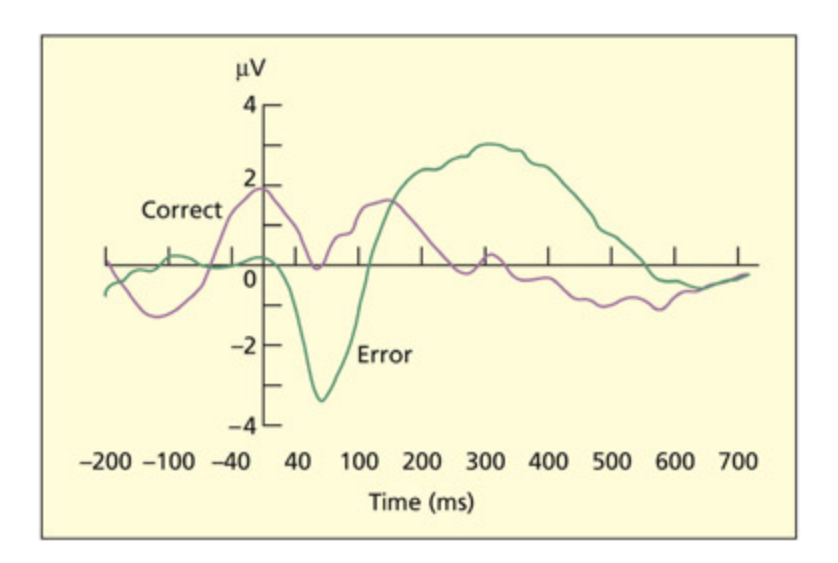
📊 그림 설명
오류 관련 음성파(Error-Related Negativity, ERN)의 EEG 두피 기록을 보여주는 그림이다. 잘못된 반응이 산출된 직후 두피에서 관찰되는 음성 전위로, 오류 발생과 동시에 시작되어 약 100ms 후 정점에 도달한다. 이 성분은 전대상피질(ACC)에서 기원하며, 오류 감지 메커니즘의 전기생리학적 증거이다.
🔬 실험 상세: Gehring et al. (1993) 등 — 오류 관련 음성파(ERN)
설계: 빠른 반응 시간 과제에서 EEG를 기록하고, 반응 시점(0 ms)에 맞춰 정답 시행과 오류 시행의 사건 관련 전위(ERP)를 따로 평균낸다. 오류 시행과 정답 시행의 파형 차이를 비교한다.
결과: 오류 반응 직후 큰 음성 편향(ERN)이 나타나며, 그 발생은 오류 산출과 거의 동시(반응 후 약 100 ms 정점)다. 원천은 ACC로 추정된다.
그래프(fig20) 읽기: X축 = 시간(ms), 0이 반응 시점(왼쪽이 반응 전, 오른쪽이 반응 후), Y축 = 두피 전위(µV). 두 곡선 중 “Error” 곡선이 반응 직후(약 +50~100 ms) 아래로 크게 꺾이는 부분이 ERN이며, “Correct” 곡선에는 이 큰 음성 편향이 없다.
함의: ACC가 오류를 빠르게 감지하는 모니터링 신호를 생성함을 보여주며, 실제 행동 조정은 이후 측면 PFC가 담당한다.
Error-related negativity is found at EEG scalp recordings following production of an incorrect response.
An alternative way of conceptualising the role of the anterior cingulate is that it is involved in motivation (Kouneiher et al., 2009) or energiza tion (Stuss & Alexander, 2007). Errors are motivationally salient events (that people work to avoid) as are rewards and punishments. e anterior cingulate also responds to the laer (e.g. monetary rewards or losses) even when there is no conflict between a habitual and nonhabitual response (Blair et al., 2006). In the fMRI study of Kouneiher et al. (2009), participants performed a task-switing study involving different monetary incentives: some blos had a high incentive (more money for being correct) and others a lower incentive. Within these blos, there were either regular trials or “bonus trials” in whi an even higher payoff could be obtained. Highincentive blos were linked to greater sustained activity of the anterior cingulate. By contrast, performance on bonus trials was linked to pre-SMA activity.
주의
ACC(전대상피질)의 역할에 대해 흔히 하는 오해: ACC는 오류를 **감지(detection)**할 뿐, 오류 후 행동을 **수정(correction)**하지는 않는다. 행동 수정은 측면 전두피질이 담당한다. fMRI에서 오류 시행에는 ACC가, 오류 다음 시행의 행동 조정에는 측면 PFC가 활성화되는 것이 이를 뒷받침한다. 또한 ACC는 단순한 “오류 감지기”를 넘어 동기 부여, 보상/처벌 평가에도 관여한다.
Summary and Key Points of the Chapter
Summary
실행 기능은 인지 과정의 조정, 새로운 상황 대응, 문제 해결에 필수적이며, 전두피질(PFC)이 핵심 역할을 한다. 안와/복내측 PFC는 감정 가치 변화에, 측면 PFC는 과제 관련 자극 변화에 대한 유연한 조절을 담당한다. 후방-전방 조직에서 전두극은 멀티태스킹에, 좌측 PFC는 과제 설정에, 우측 PFC는 모니터링에 특화되며, 배측 전대상피질은 오류/갈등 감지 후 측면 PFC가 행동을 수정한다.
- Executive functions are needed to optimize performance when: several cognitive processes need to be coordinated; a situation is novel or difficult; a situation does not require an automatic response (troubleshooting, problem solving). e role of executive functions is typically described as “supervisory” or “controlling.”
- Functional imaging studies and studies of brain-damaged patients point to a key role of the prefrontal cortex in executive functions. Patients with lesions here may have difficulties in problem solving, overcoming habitual responses, multi-tasking, and so on.
- e orbitofrontal and ventromedial prefrontal cortex has strong connections with regions involved in processing emotions; whereas the lateral (and dorsal medial) surfaces have strong connections to sensory and motor regions. Damaging these regions affects the ability to behave flexibly in response to anges in emotional value (orbital PFC) or anges in the taskrelevant stimulus features (lateral PFC).
- ere is evidence of a posterior-to-anterior organization of executive functions with the anterior most region (frontal pole) implicated in multi-tasking.
- In humans, there is a degree of relative specialization of function between the le and right lateral prefrontal cortex: with the le more implicated in task-seing, and the right more implicated in task-monitoring.
- e dorsal anterior cingulate appears to be important for detecting errors and detecting response conflict, although lateral prefrontal regions may be needed to act on this information and modify behavior.

📊 그림 설명
챕터 전체의 핵심 내용을 요약하는 도해 또는 개념도이다. 전두피질의 다양한 영역(안와전두피질, 측면 PFC, 전두극, 전대상피질)이 실행 기능의 서로 다른 측면(감정적 제어, 인지적 제어, 멀티태스킹, 오류 감지)에 각각 관여하는 조직 구조를 종합적으로 보여준다.
Visit the companion website at www.psypress/cw/ward for:
- References to key papers and readings
- Video lectures and interviews on key topics with several leading experts and author Jamie Ward, and a documentary discussing Phineas Gage and the prefrontal cortex
- Multiple oice questions and interactive flashcards to test your knowledge
- Downloadable glossary
Example Essay Questions
Summary
에세이 주제로는 실행 기능의 분리 가능성, 임상 평가 도구의 한계, 작업 기억의 실행 요소, 좌/우 전두피질의 기능 차이, 과제 전환 메커니즘 등이 제시된다.
- Can executive functions be fractionated?
- What are the problems faced by clinical tests aimed at detecting deficits in executive function?
- Is there an executive component to working memory? What is the evidence for it? (Refer also to Chapter 9.)
- Do the functions of the le prefrontal lobe differ from the right prefrontal lobe?
- How do we swit from one task to another
Recommended Further Reading
Summary
이 섹션에서는 실행 기능(executive functions)과 전두피질(prefrontal cortex)에 대한 이해를 깊이 있게 확장하기 위해 추천 도서 및 논문을 소개한다. Goldberg(2001)의 The Executive Brain은 실행 기능의 기본 개념과 전두엽의 역할을 체계적으로 설명하며, 초보자에게 적합한 기초 자료로 언급된다. Miller & Cohen(2001)의 논문은 전두피질 기능의 통합 이론을 제시하며, 신경과학적 증거를 기반으로 실행 기능의 메커니즘을 심층 분석한다. Monsell & Driver(2000)의 저서는 더 고급 수준의 연구자에게 적합한 인지 프로세스 조절 관련 논문 모음으로, 주의와 수행의 관계를 다룬다. 마지막으로 Stuss & Knight(2002)의 Principles of Frontal Lobe Function은 전두엽 기능의 이론적 기반과 임상적 적용 사례를 정리한 학술적 자료로, 실행 기능과 관련된 복잡한 주제를 다루는 데 유용하다. 이들 자료는 이전 섹션에서 다룬 실행 기능의 조절, 유연성, 억제력 등 핵심 개념을 보다 체계적으로 이해하는 데 기여한다.
- Goldberg, E. (2001). The executive brain: Frontal lobes and the civilised mind. Oxford, UK: Oxford University Press. A good place to start for the uninitiated.
- Miller, E. K. & Cohen, J. D. (2001). An integrative theory of prefrontal cortex function. Annual Review of Neuroscience, 24, 167–202. A good overview of the neuroscientific evidence.
- Monsell, S. & Driver, J. (2000). Control of cognitive processes: Attention and performance, XVIII. Cambridge, MA: MIT Press. A useful collection of papers at a more advanced level.
- Stuss, D. T. & Knight, R. T. (2002). Principles of frontal lobe function. Oxford, UK: Oxford University Press. A useful collection of papers at a more advanced level.