Overview
- 연구 배경: 주의(attention)는 정보 필터링과 인지 처리의 핵심 메커니즘으로, 감각 과부하를 방지하고 목표에 맞는 정보 선택에 기여한다. 특히, 공간적 및 비공간적 주의 과정, 주의 부족 시각적 블라인드(inattentional blindness), 주의 블라인드(change blindness) 등의 현상은 주의의 한계와 인지 시스템의 특성을 이해하는 데 중요한 예시로 제시된다.
- 핵심 방법론:
- 공간적 주의는 ‘spotlight’ 비유로 설명되며, 외부 자극(exogenous)과 내부 목표(endogenous)에 의해 유도되는 방식을 구분한다.
- Posner의 공간적 쿨링(task)을 통해 주의의 위치 이동(facilitation/inhibition of return)을 분석하고, 시각적 탐색(visual search)과 시간적 주의(attentional blink) 실험을 통해 주의의 한계를 탐구한다.
- 뇌 영상(fMRI)과 단일 세포 기록을 통해 후두엽-전두엽 경로(dorsal stream)와 인상두엽(ventral stream)의 역할, 특히 후두엽의 측면 내두엽(LIP)과 전두안장장(FEF)의 주의 관련 기능을 규명한다.
- 주요 기여:
- 주의의 공간적 및 비공간적 메커니즘(예: 객체 기반 주의, 시간 기반 주의)을 체계적으로 설명하고, LIP의 ‘salience map’ 기능과 주의의 이동, 재집중 과정을 신경 생리학적으로 분석한다.
- 주의의 외부 자극 반응(exogenous)과 내부 목표 유도(endogenous)의 상호작용을 통해 주의의 다층적 처리 모델을 제시한다.
- 실험 결과:
- Posner 쿨링 실험에서, 쿨이 타겟 위치와 일치할 경우 반응 속도가 150ms 이내에 20% 이상 향상되며, 300ms 이상 지연 시 ‘inhibition of return’으로 반응 속도가 15% 감소하는 것으로 나타난다.
- 주의 블라인드 실험에서, T1(첫 번째 타겟) 이후 2-3개 항목 내에 나타난 T2(두 번째 타겟)는 50% 이상 인지되지 못하는 것으로 보여, 주의의 시간적 한계를 실증한다.
- 의의 및 한계:
- 주의의 신경 기전과 인지 처리의 복잡성을 밝혀내며, 주의 장애(neglect)와 같은 임상적 현상의 이해에 기여한다. 다만, 주로 인간 실험에 집중되어 있어 비인간 모델이나 다른 감각 모드(예: 청각)의 주의 메커니즘에 대한 검증이 부족하다.
📋 목차
대단원 구조
- Chapter 7 The attending brain — 주의(attention)의 정의, 부주의 맹시(inattentional blindness), 변화 맹시(change blindness) 소개
- Spatial and Non-Spatial Attentional Process — 공간적/비공간적 주의 과정, Posner 공간 큐잉 과제, 억제적 복귀(inhibition of return)
- Visual Search — 시각적 탐색, 객체 기반 주의, 주의 깜빡임(attentional blink)
- The Role of the Parietal Lobes in Attention — 두정엽의 역할, salience map, LIP와 FEF, 반구 비대칭
- 4.1 Why Do Actors Make a Hidden Entrance from Stage Right? — 좌측 편향(pseudo-neglect)과 우반구 공간 우세성
- 4.2 Spatial Attention Across the Senses— Ventriloquist and Rubber Hand Illusions — 다감각 공간 주의, 복화술 효과, 고무 손 착각
- Theories of Attention — 특징 통합 이론(FIT), 편향 경쟁 이론, 전운동 이론
- Seeing One Object at a Time: Simultanagnosia and Balint’s Syndrome — 동시실인증과 Balint 증후군
- Neglect as a Disorder of Spatial Attention and Awareness — 무시증의 유형, 공간 참조 틀, 주의-인식-의식의 관계
Chapter 7 The attending brain
Summary
이 섹션에서는 주의(attention)가 정보 선택 및 처리 과정에서 필수적인 필터 역할을 수행하는 메커니즘을 설명한다. 공간적 및 비공간적 주의 과정은 감각 과부하를 방지하기 위해 필요하며, 뇌는 모든 정보를 처리할 수 없기 때문에 선택적으로 처리하는 필터(Broadbent, 1958)와 유사한 기능을 수행한다. 예를 들어, 농구 경기를 관람하면서 불주의적 빠짐(inattentional blindness) 현상에서, 특정 과제(예: 패스 횟수 세기)에 집중할 경우 50% 확률로 풀이된 고릴라 옷을 입은 남자를 인지하지 못하는 실험(Simons & Chabris, 1999)이 제시된다. 또한, 변화 빠짐(change blindness) 현상에서 두 번의 이미지 전환 사이에 짧은 블랭크 화면이 삽입될 때 물체의 출현/소멸을 인지하지 못하는 경향(Rensink et al., 1997)이 언급되며, 이러한 현상은 시각의 한계가 아닌 주의 시스템의 용량 한계로 설명된다. 기능적 영상 연구에 따르면, 두피질 영역(parietal lobes)은 변화 감지에 관여하는 것으로 나타났으며, 이는 주의와 인식의 복잡한 상호작용을 반영한다. 주의 장애(neglect)는 공간적 주의와 인식의 이상으로 인해 발생하는 질환으로, 이 섹션에서는 주의 이론과 관련된 주요 개념을 종합적으로 정리한다.
Attention is the process by whi certain information is selected for further processing and other information is discarded. Aention is needed to avoid sensory overload. e brain does not have the capacity to fully process all the information it receives. Nor would it be efficient for it to do so. As su, aention is oen likened to a filter or a bolene in processing (Broadbent, 1958). ere are some striking examples of this bolene in operation in the real world. Although we have a sense that our visual field is uniformly ri and expansive, resear has shown that we oen only aend to (and aware of) a small proportion of it at any moment. If we were wating a game of basketball and a man in a gorilla costume walked between the players, surely we would be aware of it? But if our aention were drawn to one
aspect of the game (su as counting the number of passes), then there is a high probability (50 percent) that you would not notice it (Simons & Chabris, 1999). is phenomenon is termed inattentional blindness. A related phenomenon is ange blindness, in whi participants fail to notice the appearance/disappearance of objects between two alternating images separated with a brief blank screen (Rensink et al., 1997). Similarly, people fail to notice when a person serving you in a shop briefly disappears from view and another person reappears to continue the interaction (Simons & Levin, 1998). Although both of these examples are metaphorically labeled as “blindness” they reflect the capacity limitations of our aentional systems rather than a fundamental limitation of vision. Indeed functional imaging suggests an involvement of parietal areas (lying outside the main visual system) in ange detection (Be et al., 2001).
Key Terms
Attention
The process by which certain information is selected for further processing and other information is discarded.
**주의(Attention)**는 특정 정보를 선택적으로 처리하고 나머지를 제거하는 과정으로, 뇌의 필터 역할과 유사한 정보 선택 메커니즘이다.
Inattentional blindness
A failure to be aware of a visual stimulus because attention is directed away from it.
**부주의 맹시(Inattentional blindness)**는 주의가 특정 자극에 집중될 때 다른 자극을 인식하지 못하는 현상이다. 이는 뇌의 자원 한계로 인해 일부 자극이 무의식적으로 필터링되는 결과이며, 공간적 주의 과정에서 감각 과부하를 방지하기 위한 자연스러운 현상이다.
Change blindness
A failure to notice the appearance/disappearance of objects between two alternating images.
**변화 맹시(Change blindness)**는 두 이미지 사이에서 물체의 출현이나 소멸을 인지하지 못하는 현상이다. 이는 주의 메커니즘의 한계와 밀접하게 연결되어 있으며, 주의를 집중시키지 못할 경우 중요한 변화를 놓칠 수 있음을 시사한다.
Salient
Any aspect of a stimulus that, for whatever reason, stands out from the rest.
**현저성(Salient)**은 자극 내에서 나머지와 구분되는 주목할 만한 특징을 의미한다. 뇌는 감각 과부하를 방지하기 위해 현저한 요소를 우선순위가 높은 정보로 선택하여 필터링하며, 이 개념은 Attention 메커니즘의 이론적 기반을 형성한다.
Orienting
The movement of attention from one location to another.
**지향(Orienting)**은 주의가 한 위치에서 다른 위치로 이동하는 동적 과정이다. 현저한 자극에 반응하여 주의가 재분배되며, 변화 맹시나 부주의 맹시 같은 인지 한계를 설명하는 핵심 메커니즘이다.
Covert orienting
The movement of attention from one location to another without moving the eyes/body.
**은밀한 지향(Covert orienting)**은 눈이나 몸의 움직임 없이 주의를 이동하는 과정으로, **하향식(bottom-up)**과 상향식(top-down) 메커니즘의 복합 작용으로 발생한다.
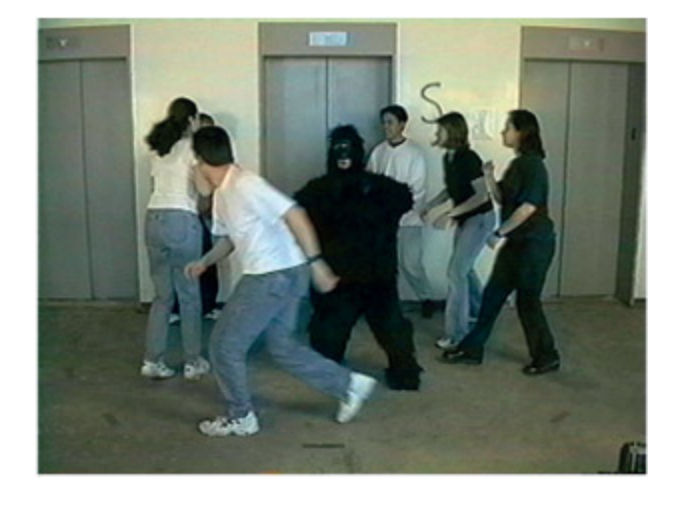
📊 그림 설명
농구 경기에서 패스 횟수를 세는 과제에 집중하는 동안 고릴라 복장을 한 사람이 등장하는 장면을 보여주는 실험 장면이다. 이 실험은 부주의 맹시(inattentional blindness)를 입증하며, 주의가 특정 과제에 집중될 때 눈에 띄는 자극도 인지하지 못할 수 있음을 보여준다. Simons와 Chabris(1999)의 고전적 실험으로, 참가자의 약 50%가 고릴라를 인지하지 못했다.
When concentrating on counting the passes in a basketball game, many people fail to notice the arrival of the gorilla! is study shows that our awareness of the details of a visual scene can be very limited, particularly if our aention is focused on a demanding task.
Whereas perception is very mu concerned with making sense of the external environment, aentional processes lie at the interface between the external environment and our internal states (goals, expectations, and so on). e extent to whi aention is driven by the environment (our aention being grabbed, so-called boom-up) or our goals (our aention being sustained, so called top-down) can vary according to the circumstances. In most cases both forces are in operation and aention can be construed as a cascade of boom-up and top-down influences in whi selection takes place.
주의
Inattentional blindness와 change blindness를 혼동하지 말 것. Inattentional blindness는 주의가 다른 곳에 집중되어 새로운 자극의 존재 자체를 놓치는 것(예: 고릴라 실험)이고, change blindness는 두 이미지 사이의 변화를 감지하지 못하는 것이다. 둘 다 “blindness”라 불리지만 시각 장애가 아닌 주의 용량의 한계를 반영한다.
Spatial and Non-Spatial Attentional Process
Summary
공간적 주의는 스포트라이트 비유로 설명되며, Posner(1980)의 실험에서 큐 후 150ms 이내에는 탐지가 촉진되지만 300ms 이상 지연 시 **억제적 복귀(inhibition of return)**가 나타남을 보여주었다. 주의는 은밀한 지향(눈 움직임 없이)과 명시적 지향(시선 이동 동반)으로 구분되며, 비인접 위치에 분할될 수도 있어 스포트라이트 비유의 한계를 드러낸다.
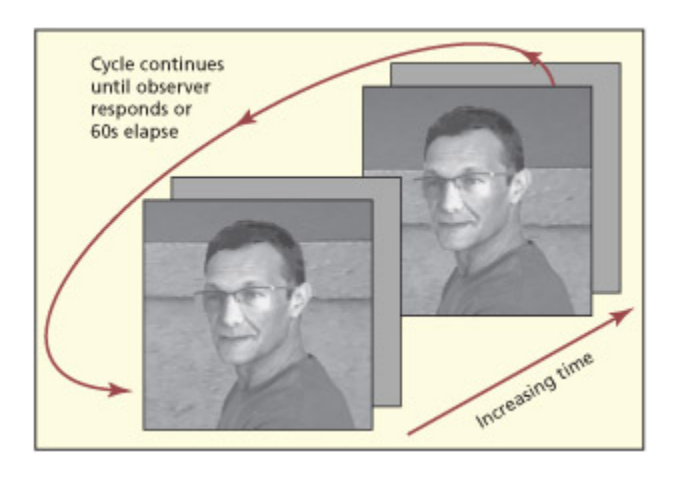
📊 그림 설명
변화 맹시(change blindness) 과제에서 두 이미지가 짧은 빈 화면을 사이에 두고 빠르게 교대하는 장면을 보여준다. 이미지 간의 차이(예: 벽의 높이 변화)를 참가자가 인지하지 못하는 현상을 시각적으로 설명하며, 이는 주의 용량의 한계를 반영하는 대표적 실험 패러다임이다.
In ange detection tasks, two different images alternate quily (with a short blank in between). Participants oen appear “blind” to anges in the image (here, the height of the wall) and this is linked to limitations in aentional capacity.
In terms of visual aention, one of the most pervasive metaphors is to think about aention in terms of a spotlight. e spotlight may highlight a particular location in space (e.g. if that location contains a salient object). It
may move from one location to another (e.g. when searing) and it may even zoom in or out (La Berge, 1983). e locus of the aentional spotlight need not necessarily be the same as the locus of eye fixation. It is possible, for example, to look straight ahead while focusing aention to the le or right when metaphorically “looking out of the corner of one’s eyes.” However, there is a natural tendency for aention and eye fixation to go together because visual acuity (discriminating fine detail) is greatest at the point of fixation. Moving the focus of aention is termed orienting and is conventionally divided into covert orienting (moving aention without moving the eyes or head) and overt orienting (moving the eyes or head along with the focus of aention). It is important not to take the spotlight metaphor too literally. For example, there is evidence to suggest that aention can be split between two non-adjacent locations without incorporating the middle locations (Awh & Pashler, 2000). e most useful aspects of the spotlight metaphor are to emphasize the notion of limited capacity (not everything is illuminated), and to emphasize the typically spatial aracteristics of aention. However, there are non-spatial aentional processes too as described later.

📊 그림 설명
주의를 스포트라이트(spotlight) 또는 정보 처리의 병목(bottleneck)에 비유한 개념도이다. 특정 정보만이 스포트라이트에 의해 조명되어 선택적으로 처리되고, 나머지 정보는 무시되는 과정을 시각적으로 보여준다. 주의의 제한된 용량과 공간적 특성을 강조하는 핵심 비유이다.
Aention has been likened to a spotlight that highlights certain information or a bolene in information processing. But how do we decide whi information to select and whi to ignore?
Posner described a classic study to illustrate that aention operates on a spatial basis (Posner, 1980; Posner & Cohen, 1984). e participants were presented with three boxes on the screen in different positions: le, central, and right. e task of the participant was simply to press a buon when they detected a target in one of the boxes. On “cat trials” no target appeared. At a brief interval before the onset of the target, a cue would also appear in one of the locations su as an increase in luminance (a flash). e purpose of the cue was to summon aention to that location. On some trials the cue would be in the same box as the target and on others it would not. As su, the cue is completely uninformative with regards to the later position of the target. When the cue precedes the target by up to 150 ms, participants are significantly faster at detecting the target at that location. e cue captures the aentional spotlight and this facilitates subsequent perceptual processing at that location. At longer delays (above 300 ms) the
reverse paern is found: participants are slower at detecting a target in the same location as the cue. is can be explained by assuming that the spotlight initially shis to the cued location, but if the target does not appear, aention shis to another location (called “disengagement”). ere is a processing cost in terms of reaction time associated with going ba to the previously aended location. is is called inhibition of return.
Key Terms
Overt orienting
The movement of attention accompanied by movement of the eyes or body.
**명시적 지향(Overt orienting)**은 주의 이동 시 눈 또는 몸의 움직임을 동반하는 과정이다. 은밀한 지향과 대비되며, 시선이 특정 자극 방향으로 이동하는 명시적 주의 재분배를 특징으로 한다.
Inhibition of return
A slowing of reaction time associated with going back to a previously attended location.
**억제적 복귀(Inhibition of return, IOR)**는 이전에 주의가 집중된 위치로 다시 반응할 때 반응 시간이 지연되는 현상이다. 주의가 한 위치에서 이탈(disengagement)한 후 원래 위치로 돌아가는 데 처리 비용이 발생하며, 이는 공간적 주의의 동적 특성을 반영한다.
Exogenous orienting
Attention that is externally guided by a stimulus.
**외생적 지향(Exogenous orienting)**은 외부 자극이 하향식(bottom-up) 방식으로 자동적으로 주의를 끌어당기는 과정이다. 자극의 갑작스러운 변화에 의해 유발되며, 억제적 복귀(IOR) 현상의 발생 원인으로 작용한다.
Endogenous orienting
Attention that is internally guided by the goals of the perceiver.
**내생적 지향(Endogenous orienting)**은 수용자의 **목표(top-down)**에 따라 주의가 조절되는 과정이다. La Berge(1983)의 실험에서 중앙 글자에 집중하면 해당 글자 판단이 빨라지고, 전체 단어에 집중하면 모든 글자 판단이 빨라지는 결과가 이를 입증한다.
시험 팁
Exogenous vs Endogenous orienting을 구분하는 핵심: Exo = Exit(밖에서), **Endo = Inside(안에서)**로 연상하자. Exogenous는 외부 자극이 자동으로 주의를 끄는 것(bottom-up), endogenous는 내부 목표가 주의를 유도하는 것(top-down)이다. Posner 과제에서 밝기 변화 큐 = exogenous, 화살표 큐 = endogenous. **억제적 복귀(IOR)**는 exogenous 조건에서 300ms 이상 지연 시 나타난다.
Attention is guided by the goals of the perceiver
Summary
주의는 외생적 지향(외부 자극 유도)과 내생적 지향(내부 목표 유도)의 두 메커니즘으로 구분된다. Posner 공간 큐잉 과제에서 큐가 표적과 일치하면 촉진 효과가 나타나고, 지연 시간이 길어지면 억제 효과가 발생한다. 이는 주의가 외부 자극과 내부 목표의 상호작용에 의해 동적으로 분배됨을 보여준다.
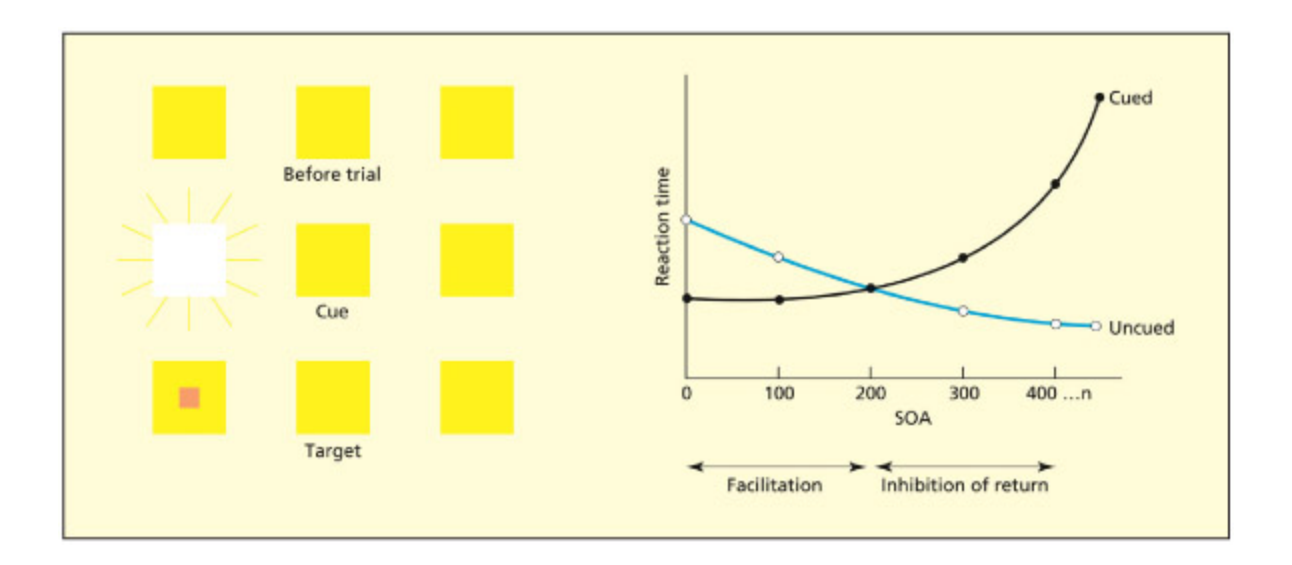
How does the spotlight know where to go? Who controls the spotlight? In the Posner spatial cueing task, the spotlight is aracted by a sudden ange in the periphery. at is, aention is externally guided and boom-up. is is referred to as exogenous orienting. However, it is also possible for aention to be guided, to some degree, by the goals of the perceiver. is is referred to as endogenous orienting. As an example of this, La Berge (1983) presented participants with words and varied the instructions. In one instance, they were asked to aend to the central leer and on another occasion they were asked to aend to the whole word. When aending to the central leer participants were faster at making judgments about that leer but not other leers in the word. In contrast, when asked to aend to the whole word they were faster at making judgments about all the leers. us, the aentional focus can be manipulated by the demands of the task (i.e. top-down). Another commonly used paradigm that uses endogenous aention is called visual sear (Treisman, 1988). In visual sear experiments, participants are asked to detect the presence or absence of a specified target object (e.g. the leer “F”) in an array of other distracting objects (e.g. the leers “E” and “T”). As discussed in more detail later, visual sear is a good example of a mix of boom-up processing (perceptual identification of objects and features) and top-down processing (holding in mind the target and endogenously driven orienting of aention).

📊 그림 설명
Posner 공간 큐잉 과제의 실험 설계를 보여주는 도식이다. 참가자는 중앙 상자에 시선을 고정하고, 주변 상자 중 하나에 짧은 큐(밝기 변화)가 제시된 후 표적이 나타난다. 큐와 표적의 위치가 일치하면 반응이 촉진되고(150ms 이내), 지연 시간이 길어지면(300ms 이상) 억제적 복귀(inhibition of return)가 나타난다.
Participants initially fixate at the central box. A brief cue then appears as a brightening of one of the peripheral boxes. Aer a delay (called the “stimulus onset asynrony,” or SOA), the target then appears in the cued or uncued box. Participants are faster at detecting the target in the cued location if the target appears soon aer the cue (facilitation) but are slower if the target appears mu later (inhibition).
Key Terms
Visual search
A task of detecting the presence or absence of a specified target object in an array of other distracting objects.
**시각적 탐색(Visual search)**은 방해 자극 배열에서 목표 물체의 존재 여부를 판단하는 과제이다. 객체 기반 주의에서는 주의가 집중된 대상의 뇌 영역에서 높은 활성화가 나타나며, **억제적 복귀(IOR)**는 공간 위치와 객체 모두에 관련된다.
Visual Search
Summary
비공간적 주의의 예시로 객체 기반 주의와 시간 기반 주의가 있다. 동일 위치에 겹쳐진 집과 얼굴 중 한쪽에 주의를 집중하면 해당 뇌 영역(FFA 또는 PPA)의 BOLD 반응이 증가한다. Posner 과제에서 **억제적 복귀(IOR)**는 공간 위치와 그 위치의 객체 모두와 관련되며, 객체 이동 시 억제도 함께 이동한다.

📊 그림 설명
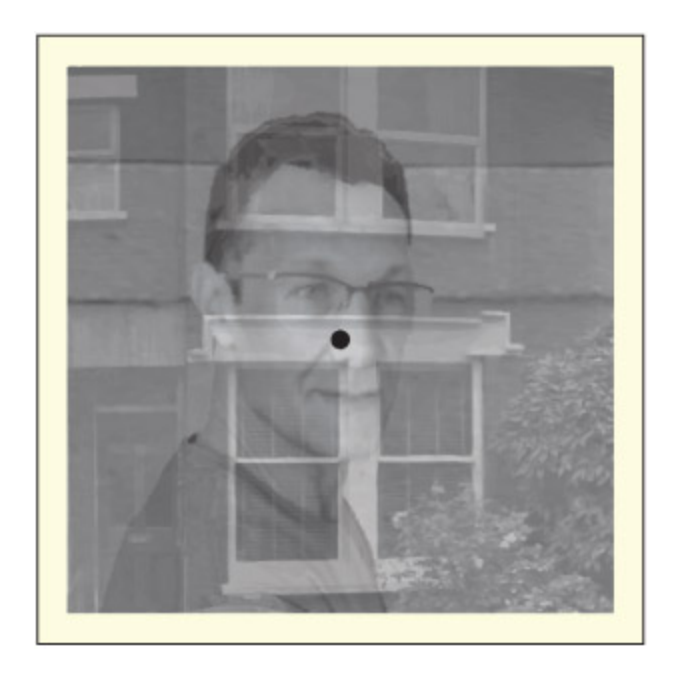
동일한 공간 위치에 투명하게 겹쳐진 얼굴과 집 이미지를 보여준다. 객체 기반 주의(object-based attention)를 설명하는 자극으로, 참가자가 어느 쪽에 주의를 집중하느냐에 따라 해당 뇌 영역(FFA 또는 PPA)의 활성화가 달라진다. Kanwisher와 Wojciulik(2000)의 연구에서 인용되었다.
Do you see a face or a house? e ability to shi between these percepts is an example of object-based aention.
From Kanwisher & Wojciulik, 2000.
Examples of non-spatial aention meanisms include object-based aention and time-based/temporal (not to be confused with temporal lobes) aentional processes. With regards to object-based aention, if two objects (e.g. a house and a face) are transparently superimposed in the same spatial location then participants can still selectively aend to one or the other. is has consequences for neural activity—the aended object is linked to a greater BOLD response in its corresponding brain region given that extrastriate visual cortex contains regions that respond differently to different stimuli (O’Craven et al., 1999). So aending to a face will activate the fusiform face area, and aending to a house will activate the parahippocampal place area even though both objects are in the same spatial location. It also has consequences for cognition: for instance, the unaended object will be responded to more slowly if it now becomes task-relevant (Tipper, 1985). With regards to Posner-style cueing tasks, resear has shown that inhibition of return is partly related to the spatial location itself and partly related to the object that happens to occupy that location (Tipper et
al., 1991). If the object moves, then the inhibition can also move with the object rather than remaining entirely at the initial location.
Key Terms
Attentional blink
An inability to report a target stimulus if it appears soon after another target stimulus.
**주의 깜빡임(Attentional blink)**은 빠르게 연속된 자극에서 첫 번째 표적(T1) 이후 2~3개 항목 내에 등장하는 두 번째 표적(T2)을 인지하지 못하는 현상이다. T1에 대한 주의가 자원을 집중적으로 소모하여 T2 인식이 방해받으며, T1을 무시하도록 지시하면 이 효과는 사라진다.

📊 그림 설명
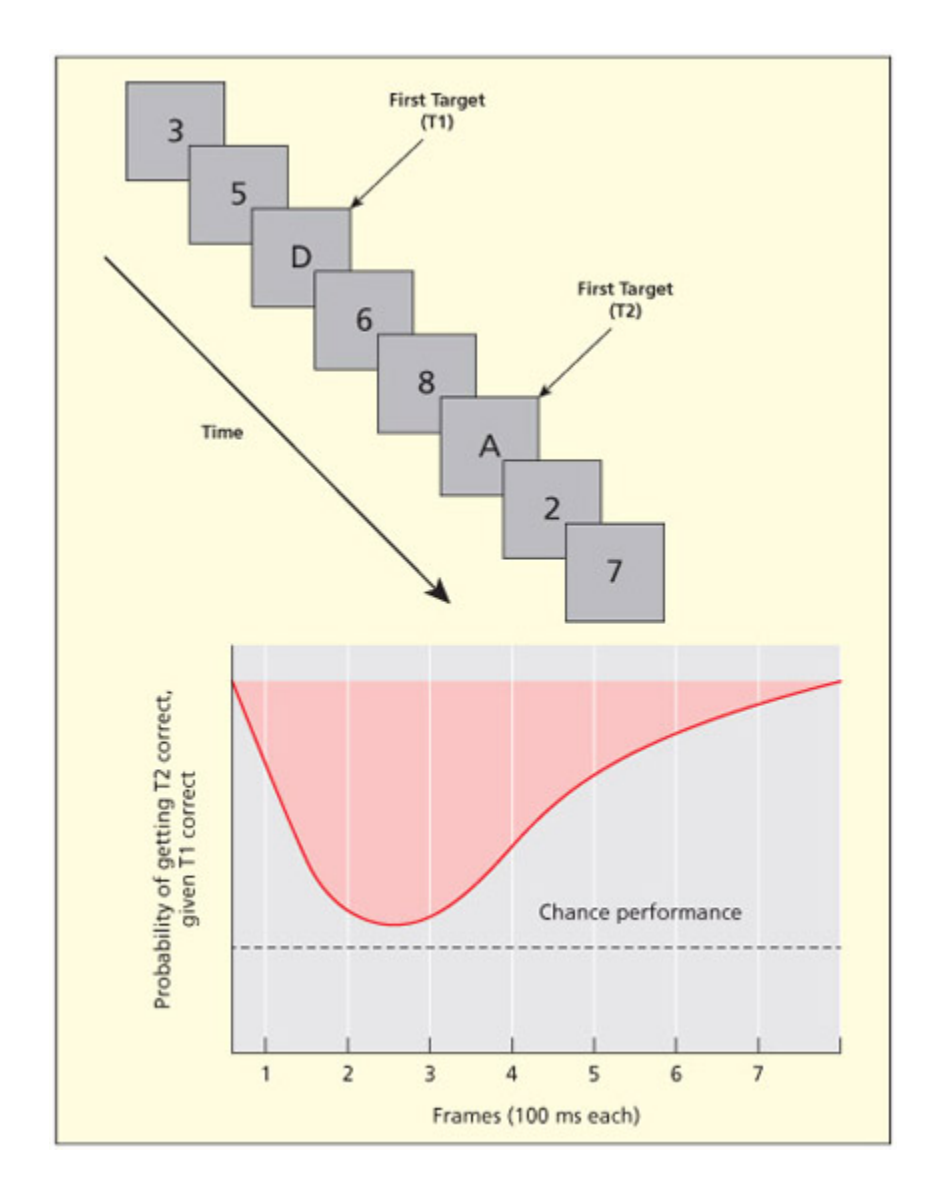
주의 깜빡임(attentional blink) 패러다임의 실험 절차를 보여준다. 동일한 위치에 자극이 빠르게 연속 제시되며(초당 약 10개), 참가자는 두 개의 표적(T1, T2)을 보고해야 한다. T1 직후 2~3개 항목 이내에 나타난 T2는 약 50% 이상 인지되지 못하며, 이는 주의의 시간적 용량 한계를 입증한다.
In the aentional blink paradigm, there is a fast presentation of stimuli and participants are asked to report whi targets they saw (e.g. reporting leers among digits; “D and A” being the correct answer in this example). Participants fail to report the second target when it appears soon aer an initial target. e initial target (T1) may take over our limited aentional capacity leading to an apparent “blindness” of a subsequent target (T2).
e best example of aention also operating in a temporal domain comes from the attentional blink (Dux & Marois, 2009; Raymond et al., 1992). In the aentional blink paradigm, a series of objects (e.g. leers) are presented in rapid succession (~10 per second) and in the same spatial location. e typical task is to report two targets that may appear anywhere within the
stream whi are referred to as T1 and T2 (e.g. white leers among bla; or leers among digits). What is found is that participants are “blind” to the second target, T2, when it occurs soon aer the first target, T1 (typically 2–3 items later). is is believed to reflect aention rather than perception because it is strongly modulated by the task. e effect is found when participants are instructed to aend to the first target but not when instructed to ignore it (Raymond et al., 1992).
Key Terms
Lateral intraparietal area (LIP)
Contains neurons that respond to salient stimuli in the environment and are used to plan eye movements.
**외측 두정엽내구역(LIP)**의 신경세포는 현저한 자극에 반응하고 시선 운동 계획에 관여한다. 이 영역은 외생적/내생적 주의 모두에 관여하며, salience map 기능을 수행하여 행동적으로 가장 중요한 자극의 위치만을 인코딩한다.
Saccade
A fast, ballistic movement of the eyes.
**사케이드(Saccade)**는 빠르고 탄도적인 눈의 움직임으로, **명시적 지향(overt orienting)**의 대표적 예이다. LIP와 FEF 영역의 활성화와 관련이 깊으며, 외생적/내생적 지향 메커니즘의 상호작용을 통해 발생한다.
임상 사례
Attentional blink의 일상적 예: 운전 중 도로 표지판(T1)을 읽는 순간 바로 직후에 나타나는 보행자(T2)를 놓칠 수 있다. T1 처리에 주의 자원이 집중되면 200-500ms 동안 T2에 대한 “주의 깜빡임”이 발생한다. 이 현상은 주의가 시간적으로도 제한된 자원임을 보여주며, 무시증(neglect) 환자에서 더 길게 지속된다(Husain et al., 1997).
The Role of the Parietal Lobes in Attention
Summary
두정엽은 공간적 주의를 조절하는 핵심 구조로, **“where” 경로(dorsal stream)**와 연결되어 자극의 위치 정보를 처리한다. 반구 비대칭성에서 우반구는 공간적 주의에 우세하고, 좌반구는 비공간적 주의에 더 관여한다. 또한 주의, 인식, 의식 간의 상호작용을 조절하는 역할을 수행한다.
PARIETAL_PLACEHOLDER, 특히 공간적 주의(spatial attention)와 “where” 경로(경로)의 관계를 설명한다. 또한, 반구 비대칭성(hemispheric asymmetries)이 공간적 및 비공간적 주의(spatial and non-spatial attention) 과정에 미치는 영향을 분석하고, 인식(perception), 주의(attention), 의식(awareness) 간의 상호작용을 논의한다. 두정엽은 공간적 주의를 조절하는 핵심 구조로, “where” 경로와 연결되어 자극의 위치 정보를 처리하는 데 중요한 역할을 수행하며, 이는 **Lateral intraparietal area (LIP)**와 같은 영역의 활성화와 직접적으로 관련된다. 반면, 전두엽(frontal lobes)은 이 섹션에서는 간략히 언급되며, 행동 선택(action selection), 작업 기억(working memory), 집행 기능(executive functions)과의 관계는 다른 장에서 자세히 다루어진다. 또한, 반구 비대칭성은 공간적 주의의 경우 우반구가 우세한 반면, 비공간적 주의(예: 객체 기반 주의)는 좌반구가 더 많은 영향을 받는 것으로 나타나며, 이는 주의 기전의 생물학적 기초를 이해하는 데 중요한 단서를 제공한다. 마지막으로, 인식, 주의, 의식 간의 관계는 의식의 부재(change blindness), 주의 블링크(attentional blink)와 같은 현상이 주의의 선택적 처리와 인식의 한계를 반영함을 강조하며, 두정엽의 역할이 이 과정에서 어떻게 조절되는지를 설명한다.
is section considers the role of the parietal lobes (and to a lesser degree the frontal lobes) in aention. e frontal lobes are considered in more detail elsewhere with regards to action selection (Chapter 8), working memory (Chapter 9), and executive functions (Chapter 14). e first part of this section considers meanisms of spatial aention and how this relates to the
notion of a “where” pathway. e second part of the section considers hemispheric asymmetries in function considering both spatial and nonspatial aention processes. e final part considers the interplay between perception, aention, and awareness.
The “where” pathway, salience maps, and orienting of attention
Summary
이 섹션에서는 시각 정보 처리 과정에서 “what” pathway(ventral stream)와 “where” pathway(dorsal stream)의 구분을 설명하며, 특히 “where” pathway가 공간적 주의 및 행동 지향에 중요한 역할을 수행함을 강조한다. **Lateral intraparietal area (LIP)**는 외부 자극에 반응하고 시선 움직임(saccade)을 유발하는 sensorimotor association region으로 간주되지만, 실제 기능은 task-relevant 또는 unexpected 자극에 특화된 salience map을 형성함으로써 공간적 주의의 중심 역할을 수행한다. 예를 들어, 목표 물체(예: 빨간 삼각형)가 시야에 등장할 때 LIP 신경세포는 방해물(예: 파란 정사각형)보다 더 강하게 반응하며, 갑작스러운 밝기 변화와 같은 salient 자극에도 민감하게 반응한다. 이는 Posner cueing task에서의 주의 이동 메커니즘과 유사한 특성으로, LIP는 exogenous 및 endogenous 주의 모두에 관여하는 복합적인 역할을 수행함을 시사한다. 또한, LIP는 행동적으로 중요한 자극의 위치만을 인코딩하는 salience map을 포함하며, 이는 주의의 필터 역할을 수행하는 cognitive model에서의 spotlight metaphor와 유사한 메커니즘을 반영한다. 이러한 연구는 “where” pathway가 단순한 위치 인식을 넘어, 주의의 동적 재분배와 행동 지향에 깊이 연관되어 있음을 보여준다.
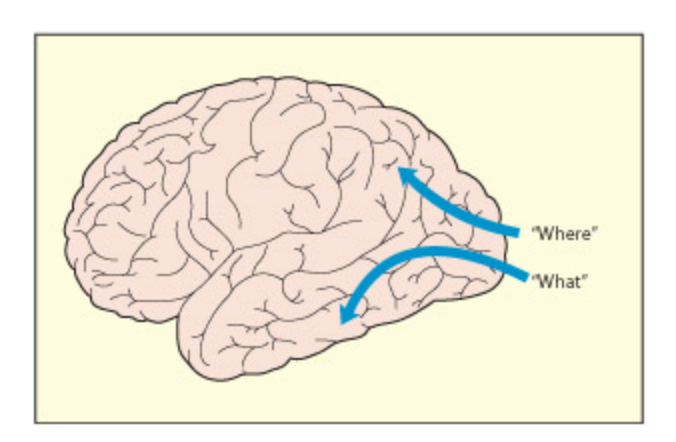
From early visual processing in the occipital cortex, two important pathways can be distinguished that may be specialized for different types of information (Ungerleider & Mishkin, 1982). A ventral route (or “what” pathway) leading into the temporal lobes may be concerned with identifying objects. In contrast, a dorsal route (or “where” pathway) leading in to the parietal lobes may be specialized for locating objects in space. e dorsal route also has an important role to play in aention, spatial or otherwise. e dorsal route also guides action toward objects and some researers also consider it a “how” pathway as well as a “where” pathway (Goodale & Milner, 1992).

📊 그림 설명
시각 처리의 두 경로를 보여주는 뇌 해부도이다. 복측 경로(“what” pathway, ventral stream)는 측두엽으로 이어져 객체 인식과 기억에 관여하고, 배측 경로(“where” pathway, dorsal stream)는 두정엽으로 이어져 공간적 주의와 행동 지향에 관여한다. 이 두 경로의 구분은 Ungerleider와 Mishkin(1982)의 연구에 기반한다.
Later stages of visual processing are broadly divided into two routes: a “what” pathway (or ventral stream) is involved in object perception and memory, whereas a “where” pathway (or dorsal stream) is involved in aending to and acting upon objects.
Single-cell recordings from the monkey parietal lobe provide important insights into the neural meanisms of spatial aention. Bisley and
Goldberg (2010) summarize evidence that a region in the posterior parietal lobe, termed LIP (lateral intraparietal area), is involved in aention. is region responds to external sensory stimuli (vision, sound) and is important for eliciting a particular kind of motor response (eye movements, termed saccades). Superficially then, it could be labeled as a sensorimotor association region. However, a closer inspection of its response properties reveals how it may play an important role in aention. First, this region does not respond to most visual stimuli, but rather has a sparse response profile su that it tends to respond to stimuli that are unexpected (e.g. abrupt, unpredictable onsets) or relevant to the task. When searing for a target in an array of objects (e.g. a red triangle), LIP neurons tend to respond more strongly when the target lands in its receptive field than when a distractor (e.g. a blue square) does (Golieb et al., 1998). So it isn’t related to sensory stimulation per se. Moreover, sudden anges in luminance are a salient stimulus to these neurons (Balan & Golieb, 2009), analogous to how luminance anges drive aention in the Posner cueing task. As su, neurons in this region have aracteristics associated with both exogenous and endogenous aention. It has been suggested that area LIP contains a salience map of space in whi only the locations of the most behaviorally relevant stimuli are encoded (e.g.Ii & Ko, 2001). is is clearly reminiscent of the filter or spotlight metaphor of aention in cognitive models that selects only a subset of information in the environment.
Key Terms
Salience map
A spatial layout that emphasizes the most behaviorally relevant stimuli in the environment.
Salience map(중요성 맵)은 환경 내에서 행동적으로 가장 중요한 자극을 강조하는 공간적 배치로, LIP와 같은 두정엽 영역에서 형성되어 공간적 주의의 방향을 결정한다.
Remapping
Adjusting one set of spatial coordinates to be aligned with a different coordinate system.
**재매핑(Remapping)**은 LIP가 청각 자극의 위치를 눈 중심 좌표(eye-centered coordinates)로 변환하여, 시각과 청각 정보를 통합적인 salience map에 연결하는 기능을 수행한다.
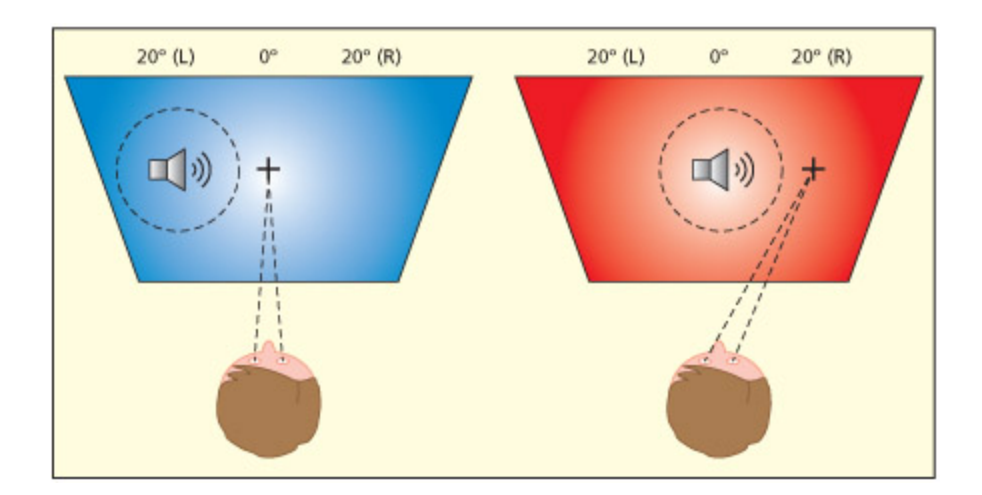
In addition to representing the saliency of visual stimuli, neurons in LIP also respond to the current position of the eye (in fact, its responsiveness depends on the two sources of information being multiplied together). is information can be used to plan a saccade—i.e. overt orienting of aention. ere is also evidence that they may support covert orienting. Lesioning LIP in one hemisphere leads to slower visual sear in the contralateral (not ipsilateral) visual field even in the absence of saccades (Wardak et al., 2004).
Spatial aention to sounds is also associated with activity in LIP neurons and this can also be used to plan saccades (Stricanne et al., 1996). us, this part of the brain is multi-sensory. In order to link sound and vision together on the same salience map it requires the different senses to be spatially aligned or remapped. is is because the location of sound is coded relative to the angle of the head/ears, but the location of vision is coded (at least initially) relative to the angle of the eyes. Some neurons in LIP transform sound locations to be relative to the eyes so they can be used to plan saccades, instead of relative to the head/ears (Stricanne et al., 1996).

📊 그림 설명
청각 자극의 위치를 눈 중심 좌표(eye-centered coordinates)로 재매핑하는 청각 신경세포의 반응 특성을 보여준다. LIP 및 상구(superior colliculus)에서 발견되는 이 신경세포는 소리 원천의 실제 위치와 무관하게 시선 고정점 기준 약 20도 왼쪽의 소리에 반응하며, 이는 청각-시각 통합 및 사케이드 유도를 지원한다. Stein과 Stanford(2008)에서 인용되었다.
An example of an auditory neuron that responds to sounds that have been “remapped” into eyecentered coordinates. ese neurons are found in brain regions su as LIP and the superior colliculus. is neuron responds to sounds about 20 degrees to the le of fixation irrespective of whether the sound source itself comes from the le (le figure) or centre of space (right figure). is enables orienting of the eyes to sounds.
From Stein & Stanford, 2008.
In humans, using fMRI, presenting an arrow (an endogenous cue for spatial orienting) is associated with brief activity in visual cortical regions followed by sustained activity in posterior parietal lobes (including the likely homologue of area LIP) and a frontal region called the frontal eye field, FEF (Corbea et al., 2000). is activity occurs irrespective of whether the required response is one of covert orienting of aention, a saccade, or a pointing response (Astafiev et al., 2003). at is, it reflects a general orienting of aention. It may also not be spatially specific as a similar region is implicated in orienting aention between spatially superimposed objects (Serences et al., 2004). Bressler et al. (2008) examined the functional connectivity among this network during presentation of a preparatory orienting stimulus (the spoken words “le” or “right”) prior to a visual stimulus and concluded that, in this situation, the directionality of activation was top-down: that is, from frontal regions, to parietal regions, to visual occipital cortex. Of course, in other situations (an exogenous cue) it may operate in reverse.
Key Terms
Frontal eye field (FEF)
Part of the frontal lobes responsible for voluntary movement of the eyes.
**전두안장(Frontal Eye Field, FEF)**는 시선의 자발적 움직임을 조절하는 전두엽의 일부로, LIP와 함께 salience map 내에서 주의의 지향을 담당하는 dorso-dorsal branch를 구성한다.
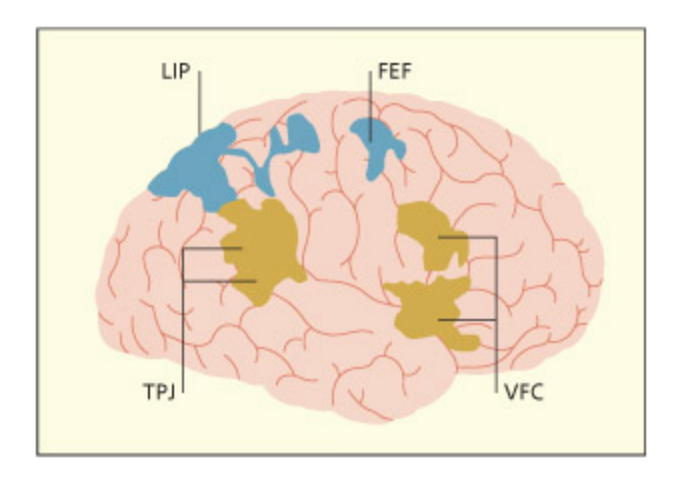
According to Corbea and Shulman (2002), this is only one of two major aentional networks involving the parietal lobes. ey suggest that the dorsal stream should be reconsidered as split into two: a dorso-dorsal bran and a ventro-dorsal bran (for a related proposal see Rizzolai & Matelli, 2003). ey conceptualize the role of the dorso-dorsal stream in aention as one of orienting within a salience map (as described above) and involving the LIP and FEF. By contrast, they regard the more ventro-dorsal bran as a “circuit breaker” that interrupts ongoing cognitive activity to direct aention outside of the current focus of processing. is aentional disengagement meanism is assumed to involve the temporoparietal region (and ventral prefrontal cortex) and is considered to be more strongly right lateralized. For instance, activity in this region is found when detecting a target (but not when processing a spatial cue) whereas activity in the LIP region shows a strong response to the cue (Corbea et al., 2000). Activity in the right temporoparietal region is enhanced when detecting an infrequent target particularly if it is presented at an unaended location (Arrington et al., 2000). Downar et al. (2000) found that several frontal areas as well as the temporoparietal junction (TPJ) were activated when participants were monitoring for a stimulus ange, independently of whether the ange occurred in auditory, visual or tactile stimuli.
Hemispheric differences in parietal lobe contributions to attention

📊 그림 설명
Corbetta와 Shulman(2002)이 제안한 두정엽의 두 가지 주의 관련 회로를 도식화한 그림이다. 배배측 회로(dorso-dorsal circuit)는 LIP와 FEF를 포함하며 salience map 내에서의 주의 지향을 담당하고, 복측 회로(ventral circuit)는 우측 TPJ(temporoparietal junction)를 중심으로 현재 주의 초점을 중단시키는 “회로 차단기” 역할을 수행한다.
Corbea and Sulman (2002) have suggested that there are two main aention-related circuits involving the parietal lobes: a dorso-dorsal circuit (involving LIP) that is involved in aentional orienting within a salience map; and a more ventral circuit (involving right TPJ) that diverts aention away from its current focus.
e parietal lobes of the right and le hemispheres represent the full visual field (unlike early parts of visual cortex) but do so in a graded fashion that favors the contralateral side of space (Pouget & Driver, 2000). So the right parietal lobe shows a maximal responsiveness to stimuli on the far le side, a moderate responsiveness to the middle, and a weaker response to the far right side. e le parietal lobe shows the reverse profile. One consequence of this is that damage to the parietal lobes in one hemisphere leads to le right spatially graded deficits in aention. For instance, damage to the right parietal lobe would lead to less aentional resources allocated to the far le side, moderate aentional resources to the midline, and near-normal aentional abilities on the right. is disorder is called hemispatial neglect, in whi patients fail to aend to stimuli on the opposite side of space to the lesion. Neglect is normally far more severe following right hemisphere lesions, resulting in failure to aend to the le. is suggests that, in humans, there is likely to be a hemispheric asymmetry su that the right parietal lobe is more specialized for spatial aention than the le. Another possible way of conceptualising this is that the right parietal lobe makes a larger contribution to the construction of a salience map than the le side: resulting in a normal bias for the le side of space to be salient (a
phenomenon termed pseudo-neglect, see BOX) and for the le side of space to be, therefore, particularly vulnerable to the effects of brain damage (neglect)
Why Do Actors Make a Hidden Entrance from Stage Right?
Summary
이 섹션에서는 인간의 우두정엽(right parietal lobes)이 공간적 주의(spatial attention)에 비중이 더 큰 역할을 수행함으로써 발생하는 좌측 편향(leftward attentional bias) 현상을 설명한다. 우두정엽 손상 시 좌측 공간에 대한 주의 결여(neglect)가 나타나는 반면, 건강한 뇌에서는 좌측 공간에 대한 과도한 주의(pseudoneglect)가 관찰되며, 이는 예를 들어 직선의 중앙을 기준으로 왼쪽으로 더 많이 나누는 경향(Bowers & Heilman, 1980)이나 배우가 무대 오른쪽에서 등장할 때 출입이 덜 눈에 띄는 현상(Dean, 1946)과 연결된다. 또한, 그림 제목이 왼쪽 물체에 더 자주 언급되거나, 그림을 뒤집었을 때 왼쪽이 더 가까워 보이는 인식(Nelson & MacDonald, 1971), 그림의 빛이 왼쪽에서 비치는 경향(Sun & Perona, 1998), 왼쪽으로 부딪히는 사고가 덜 발생하는 경향(Niolls et al., 2007) 등 다양한 심리적·예술적 현상이 이 편향을 반영한다. 특히, 같은 명암도의 수직 막대 이미지(top과 bottom)에서 하단 막대가 더 어둡게 인식되는 경향은 우두정엽의 공간/주의 우위성에 기인하는 주의 편향(attentional bias)의 예시로, 이는 인간의 인지적 특성과 예술적 표현 방식에 깊은 영향을 미친다.
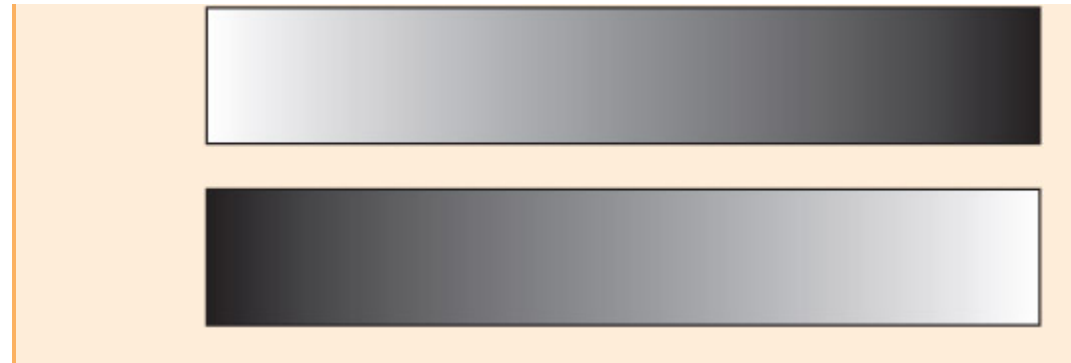
e right parietal lobes of humans are generally considered to have a more dominant role in spatial aention than its le hemisphere equivalent. One consequence of this is that right-hemisphere lesions have severe consequences for spatial aention, particularly for the le space (as in the condition of “neglect”). Another consequence of righthemisphere spatial dominance is that, in a non-lesioned brain, there is over-attention to the le side of space (termed pseudoneglect). For example, there is a general tendency for everyone to bisect lines more to the le of center (Bowers & Heilman, 1980). is phenomenon may explain why actors enter from stage right when they do not wish their entrance to be noticed (Dean, 1946). It may also explain why pictures are more likely to be given titles referring to objects on the le, and why the le side of pictures feels nearer than the right side of the same picture when flipped (Nelson & MacDonald, 1971). e light in paintings is more likely to come from the le side and people are faster at judging the direction of illumination when the source of light appears to come from the le (Sun & Perona, 1998). Moreover, we are less likely to bump into objects on the le than the right (Niolls et al., 2007). us, there is a general lewards aentional bias in us all.

📊 그림 설명
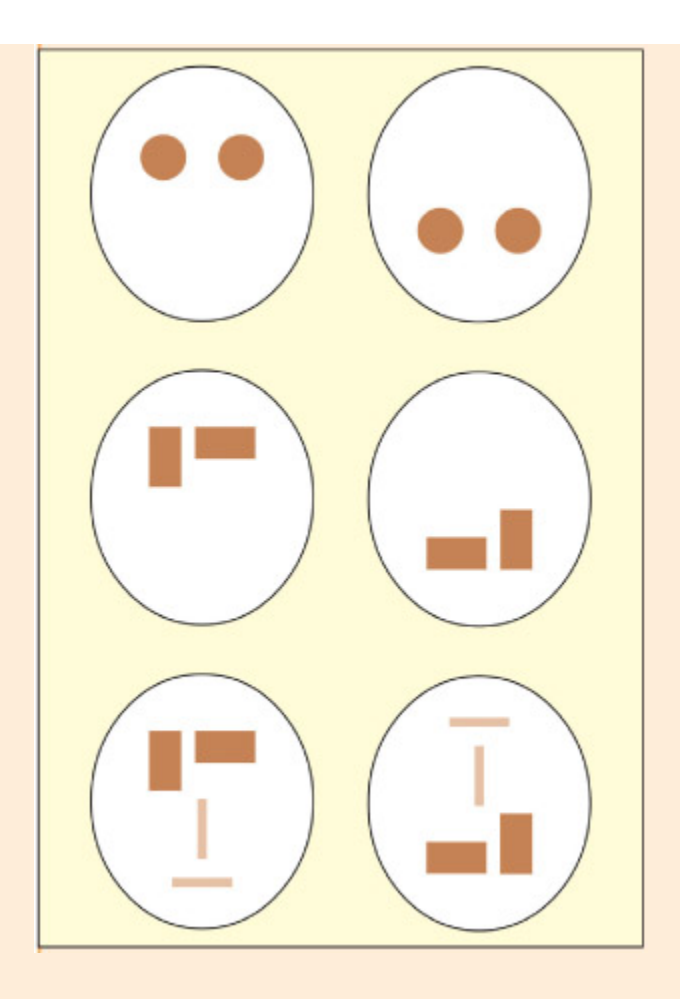
좌측 편향(pseudo-neglect) 현상을 시연하는 두 개의 수평 막대 이미지이다. 위쪽과 아래쪽 막대는 동일한 거울 이미지임에도 불구하고, 대부분의 사람들은 아래쪽 막대가 더 어둡다고 인식한다. 이는 우반구의 공간/주의 우세성으로 인한 왼쪽 공간에 대한 주의 편향을 반영한다.
Whi bar appears darker: the one on the top or the boom? Most people perceive the boom bar as being darker because of an aentional bias to the le caused by a right-hemisphere dominance for space/aention, even though the two images are identical mirror images.
Key Terms
Hemispatial neglect
A failure to attend to stimuli on the opposite side of space to a brain lesion.
**반공간 무시(Hemispatial neglect)**는 뇌 손상 반대쪽 공간의 자극에 대한 주의 부족을 특징으로 하며, 우두정엽 손상 시 좌측 공간 인식이 결여되는 현상이다.
Pseudo-neglect
In a non-lesioned brain there is over-attention to the left side of space.
Pseudo-neglect는 정상적인 뇌에서 우반구의 공간적 주의 우세로 인해 좌측 공간에 대한 과도한 주의가 발생하는 현상이다.
Parietal lobe lesions can also result in non-spatial deficits of aention. Husain et al. (1997) found that neglect patients had an unusually long “blind” period in the aentional blink task in whi stimuli were presented centrally. Again, this can be construed in terms of both hemispheres making
a contribution to the normal detection of salient stimuli (in this task, the second target in a rapidly anging stream). When one hemisphere is damaged then the aentional resource is depleted.

📊 그림 설명
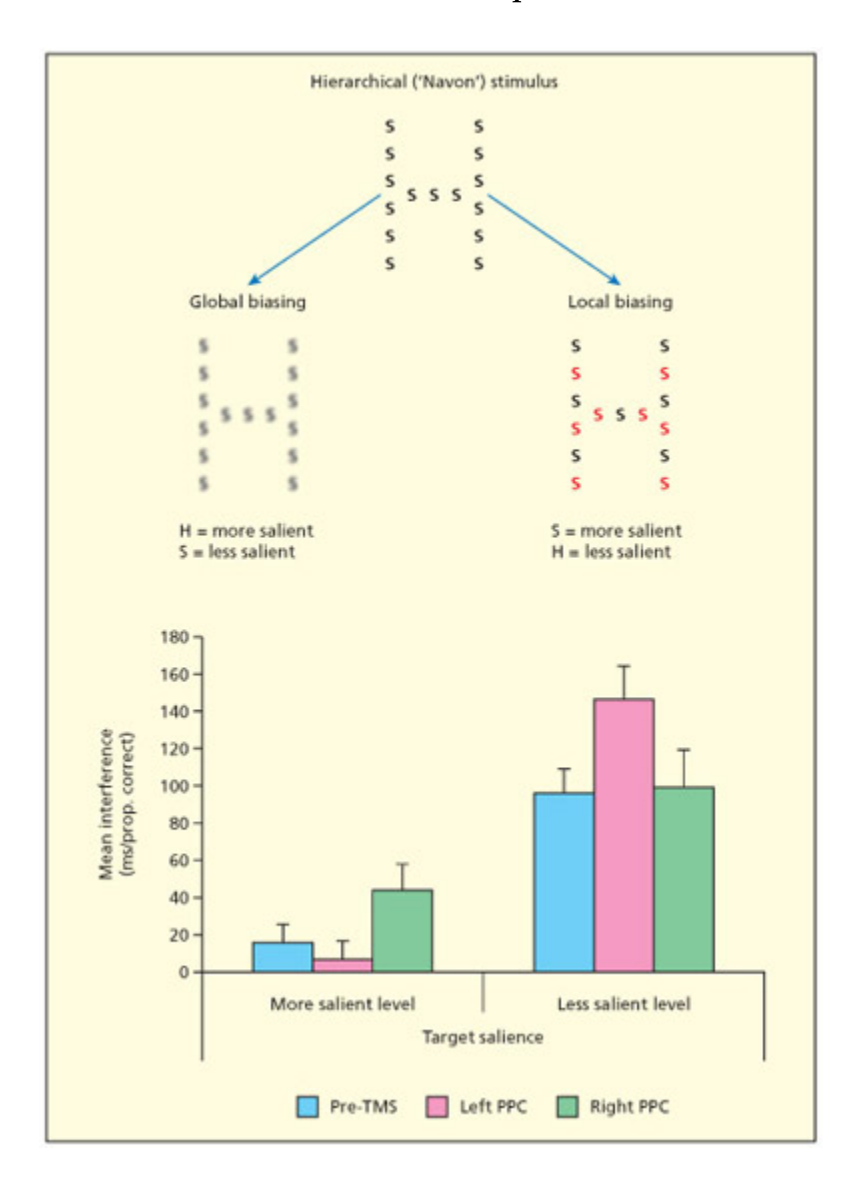
비공간적 주의에서 좌우 두정엽의 역할 차이를 보여주는 TMS 실험 결과이다. 교대하는 색상은 로컬 요소(예: 작은 S)를 현저하게 만들고, 블러링은 글로벌 형상(예: 큰 H)을 현저하게 만든다. 우측 후두정엽 TMS는 현저한 요소 탐지를 방해하고, 좌측 후두정엽 TMS는 비현저한 요소 탐지를 방해한다. Mevorach 등(2006)의 연구 결과이다.
Having alternating colors makes local elements salient, but blurring the local elements makes the global shape more salient. TMS over the right posterior parietal cortex disrupts the ability to detect the more salient element (e.g. the local S in the right example, and the global “H” in the le example). TMS over the le posterior parietal cortex disrupts the ability to detect the less salient element (e.g. the global “H” in the right example, and the local S in the le example). Graph from Mevora et al., 2006.
Spatial Attention Across the Senses— Ventriloquist and Rubber Hand Illusions
Summary
이 섹션에서는 공간적 주의(spatial attention)가 다양한 감각 모드(청각, 시각, 촉각) 간의 상호작용을 통해 어떻게 형성되는지를 다룬다. 특히, 위트로이스트(ventriloquist) 현상에서 시각적 자극이 청각적 자극의 위치를 지배하는 메커니즘을 설명하며, 이는 시각이 청각보다 공간 위치를 더 정확하게 인식하기 때문에 발생한다고 분석한다. Witkin 등(1952)의 연구에 따르면, 시각적 자극이 청각 위치와 충돌할 경우 청각 위치 인식이 약화되는 경향이 관찰되었으며, Driver와 Spence(1994)는 시각과 청각 자극이 동일한 공간 위치에 있을 때 음성 흉내(speech shadowing)의 정확도가 높아진다는 실험 결과를 제시했다. 또한, 고무 손 환상(rubber hand illusion)을 통해 촉각 자극이 시각적 자극에 의해 재지정되는 현상을 설명하며, 이는 시각-촉각 간의 공간적 불일치가 뇌에서 인간의 몸 인식(body ownership)을 왜곡하는 데 기여함을 강조한다. 두정엽(parietal lobes)의 역할에 대해 설명할 때, 좌두정엽(right parietal lobe)은 중요한 자극(salient stimulus)에 대한 주의 집중에, 우두정엽(left parietal lobe)은 비중요 자극(non-salient stimulus)의 억제에 특화되어 있으며, fMRI 및 TMS 실험을 통해 이들의 기능적 차이가 입증되었다. 예를 들어, 좌측 인두두정엽(left intraparietal sulcus)은 비중요 특징에 집중하는 작업에서 활성화되며, 우측 인두두정엽(right intraparietal sulcus)은 중요한 특징을 탐색하는 작업에서 활성화된다고 보고되었다. 이와 같은 비공간적 주의(non-spatial attention)의 분화 메커니즘은 무시증(neglect)의 다양한 공간적 및 비공간적 결손 증상과 연결될 수 있다는 점에서 흥미로운 연구 주제로 제기된다.
In ventriloquism, there is a conflict between the actual source of a sound (the ventriloquist him or herself) and the apparent source of the sound (the dummy). In this instance, the sound appears to come from the dummy the dummy has associated lip movements whereas the lip movements of the ventriloquist are suppressed. In other words, the spatial location of the visual cue “captures” the location of the sound.
Why is it that sound tends to be captured by the visual stimulus but not vice versa? One explanation is that the ability to locate things in space is more accurate with vision than audition, so when there is a mismat between them, the brain may default to the visual location. Witkin et al. (1952) found that sound localization was impaired in the presence of a visual cue in a conflicting location. Driver and Spence (1994) found that people are able to repeat ba a spee stream (or “shadow”) more accurately when lip movements and the loudspeaker are on the same side of space than when they are on opposite sides.
In the brain, there are multi-sensory regions su as in the superior temporal sulcus and intraparietal sulcus that respond selectively to sound and vision when both occur at the same time or in the same location (Calvert, 2001). For instance, the superior temporal sulcus shows greater activity to synronous audio-visual spee than asynronous spee (Macaluso et al., 2004). However, when there is a spatial mismat between the auditory and visual locations of synronous spee then the right inferior parietal lobe is activated (Macaluso et al., 2004). is audio-visual spatial mismat is found in the ventriloquist illusion and may involve the shiing or suppression of the heard location or, conversely, “grabbing” of spatial aention by the visual modality.
More bizarrely, there is an analogue of the ventriloquist effect in the tactile modality. Botvini and Cohen (1998) placed participants’ hand behind a hidden screen and placed a rubber hand on the visible side of the screen. Wating the rubber hand stroked with a paintbrush while their own (unseen) hand was stroked with a paintbrush could induce a kind of “out of body” experience. Participants report curious sensations su as, “I felt as if the rubber hands were my hands.” In this instance, there is a conflict between the seen location of the (rubber) hand and felt bodily location of the real hand: the conflict is resolved by visual capture of the tactile sensation.
Mevora and colleagues have proposed that the le and right parietal lobes have different roles in non-spatial aention: specifically the right hemisphere is considered important for aending to a salient stimulus, and the le hemisphere is important for suppressing a non-salient stimulus or “ignoring the elephant in the room” (Mevora et al., 2010; Mevora et al., 2006). eir non-spatial manipulation of saliency involved making certain elements of the display easier to perceive. For instance, a figure comprised of an “H” made up of small S’s can be altered so that either the “H” is more salient (blurring the S’s) or the S is more salient (using alternating colors). fMRI shows that the left intraparietal sulcus is involved when the task is to focus on non-salient features (and ignore salient ones)—su as finding the local S’s in a blurred global “H” (Mevora et al., 2006). Disruption of this region using TMS (but not the right hemisphere region) interferes with the ability to do this task and disrupts the connectivity between this region and those in the occipital lobe that are presumably engaged in shape processing. By contrast, the right intraparietal cortex responds more when the task is to identify the salient features (and ignore the non-salient ones) and TMS to this region disrupts that task (Mevora et al., 2006). What is presently unclear is how these sorts of non-spatial selection meanisms relate to the spatially specific deficits seen in neglect. One possibility is that neglect comprises a variety of aention-related deficits, some that are spatially
specific (the defining symptoms of neglect) and some that are not. Whatever the relationship to neglect, there is an emerging consensus that aention itself can be fractionated into different kinds of meanisms (Riddo et al., 2010).
The relationship between attention, perception, and awareness
Summary
이 섹션에서는 attention(주의), perception(인식), awareness(의식) 간의 관계를 탐구하며, attention이 정보 선택의 핵심 메커니즘으로 작동하고, awareness는 이 과정의 결과로 나타나는 의식 상태라고 정의한다. perception은 attention에 의해 선택된 정보로 구성되며, 이는 외부 자극(예: 얼굴, 운동)에 집중될 때 visual ventral stream과 같은 뇌 영역에서 fMRI로 측정된 활성화가 증가함을 실험적으로 보여준다. 또한, attention이 top-down 작업 요구에 따라 자원이 제한되어 있을 때, bottom-up 인식 정보의 처리가 감소하는 현상이 관찰되며, 이는 attention이 유한한 자원으로 작동함을 시사한다. visual cortex(시각피질)에서의 활성화는 attention이 특정 위치에 집중될 때 증가하며, modalities(모달리티)에 따라 예상된 자극이 있을 때 해당 영역의 BOLD 반응이 증가하고, 예상되지 않은 자극 영역에서는 감소하는 경향이 있다. Dehaene et al.(2006)의 모델에 따르면, awareness는 강한 감각 자극에 대한 top-down attention에 의해 유발되며, 이는 frontal-parietal network(전두-두정엽 네트워크)의 활성화와 연관된다. 반면, non-aware 상태에서는 sensory cortex(감각피질) 내에서만 활성화 수준이 달라지는 것으로 나타난다. attentional blink 실험에서는 frontal-parietal 영역의 활성화가 두 번째 목표 자극의 awareness 여부를 구분하는 데 중요한 역할을 하며, 이는 attentional selection이 연속적인 정보에서 all-or-nothing 결과(의식적 또는 무의식적 인식)를 생성함을 시사한다.
e terms “aention,” “perception,” and “awareness” are all common in everyday usage although most of us would be pushed to give a good definition of them in either lay or scientific terms. To begin with, a simple working definition may suffice (although more detailed nuances will be introduced later). Aention is a meanism for the selection of information. Awareness is an outcome (a conscious state) that is, in many theories, linked to that meanism. Perception is the information that is selected from and, ultimately, forms the content of awareness. Needless to say it is possible to be aware of, and aend to, things that are not related to perception (e.g. one’s own thoughts and feelings) and it is assumed that broadly similar meanisms operate here with, possibly, an additional prefrontal gating meanism that swites the focus of aention between the external environment and inner thoughts (Burgess et al., 2007).
Considering first the relationship between perception and aention, a number of studies have explored what happens in brain regions responsible for perception (e.g. in the visual ventral stream) when a stimulus is aended versus unaended. In general, when an object (e.g. a face) or a perceptual feature (e.g. motion) is aended then there is an increased activity, measured with fMRI, in brain regions that are involved in perceiving those stimuli relative to when they are unaended (Kanwisher & Wojciulik, 2000). is, however, also depends on how difficult the aention-demanding task is. For instance, Rees et al. (1997) instructed participants to aend to words (in a language-based task) and ignore visual motion in the periphery. e activity in the motion-sensitive area V5/MT was reduced when the language-based task was difficult compared with when it was easy. is is compatible with
the notion of aention being a limited resource, with less of the resource available for (boom-up) processing of irrelevant perceptual information when (top-down) task demands are high.
ere is evidence that aention can affect activity in visual cortex (including in V1) even in the absence of a visual stimulus (Kastner et al., 1999). is increase appears to be related to aended locations rather than aended features su as color or motion (McMains et al., 2007). It is also related to aended modalities. Increases in BOLD activity are found in visual, auditory or tactile cortices when a stimulus is expected in that modality but is linked to decreases in the non-predicted modalities (Langner et al., 2011). is may reflect increased neural activity prior to the presentation of the stimulus. In monkeys it has been shown that neurons increase the spontaneous firing rate in an aended location even in the absence of a visual stimulus (Lu et al., 1997). In these examples in whi no perceptual stimulation is present, it is clear that aention can sometimes operate in the absence of awareness of perceptual stimuli (Ko & Tsuiya, 2007).

📊 그림 설명
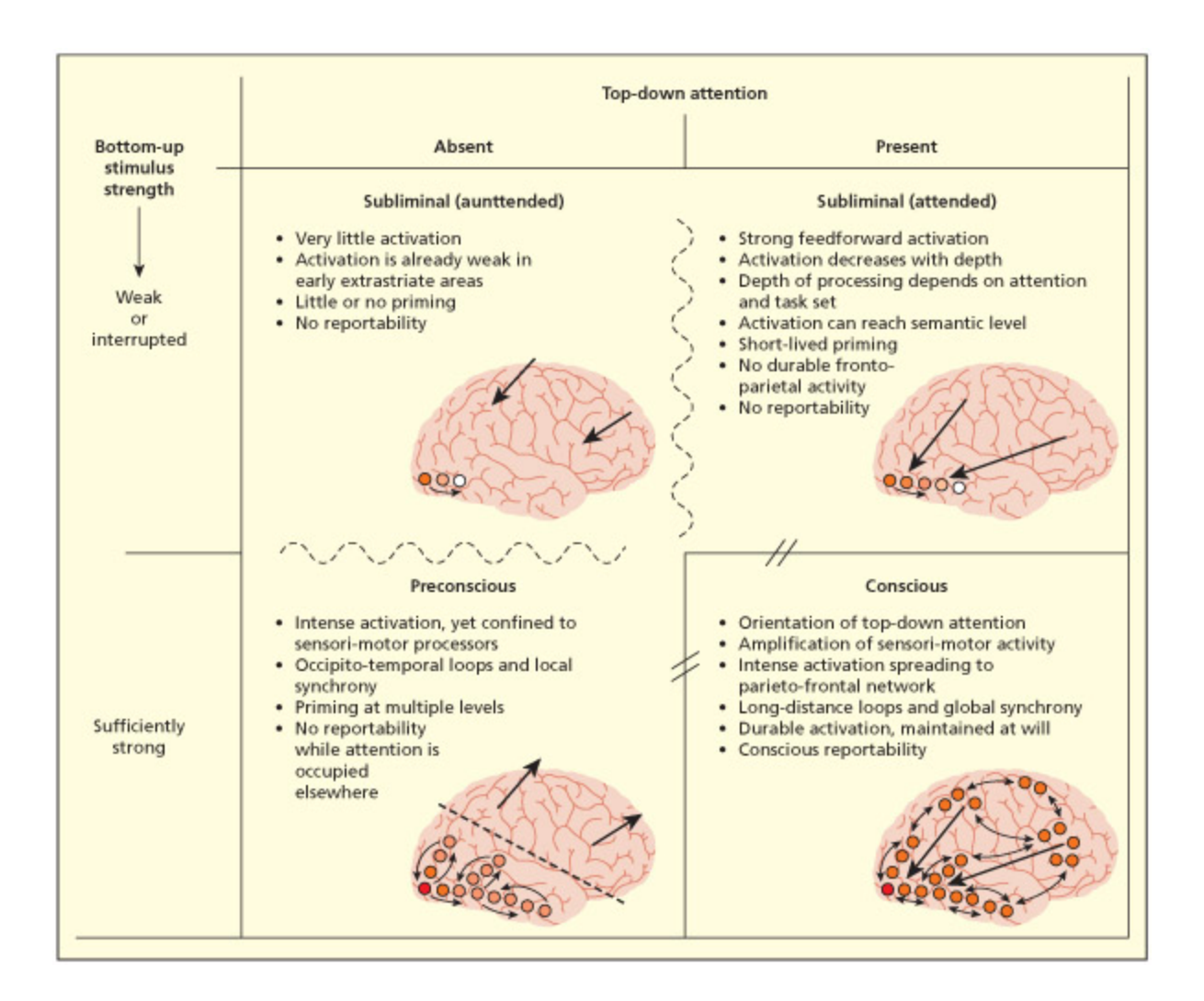
Dehaene 등(2006)의 의식(awareness) 모델을 도식화한 그림이다. 의식적 인식은 충분히 강한 감각 자극에 대한 하향식(top-down) 주의가 전두-두정엽 네트워크로 확산될 때 발생한다. 반면, 비의식 조건(매우 약한 자극에 대한 주의, 강한 자극에 대한 부주의)에서는 감각 피질 내에서만 활성화 수준이 달라진다.
In the model of Dehaene et al. (2006), awareness is linked to top-down aention to a sufficiently strong sensory stimulus. is is associated with activity spreading to a frontal-parietal network. In contrast, non-aware conditions (e.g. aending to a very weak sensory signal, inaention to a strong sensory signal) are linked to varying levels of activity in sensory cortex alone. From Dehaene et al., 2006.
e discussion above has centered on the links between perception and aention. What of the links between perception and awareness? Awareness, as typically defined, depends on participants’ ability to report on the presence of a stimulus. is can be studied by comparing stimuli that are perceived consciously versus those perceived unconsciously (e.g. presented too briefly to be reported). In su studies, conducted with fMRI, a typical paern of brain activity has two main features: firstly, there is greater
activity in regions involved in perception (e.g. ventral visual stream) when participants are aware of a stimulus than unaware and, secondly, that there is a spread of activity to distant brain regions (notably the frontal-parietal network) in the aware state (see Dehaene et al., 2006). It is this broadcasting of information that is oen assumed to enable participants to be able to report on, or act on, the perceived information. Moreover, this network of regions in the frontal and parietal lobes are those typically implicated in studies of aention suggesting (to some researers) that aention is the meanism that gives rise to awareness of perception (Posner, 2012; Rees & Lavie, 2001). To give a concrete example, in the aentional blink paradigm activity in frontal and parietal regions discriminates between awareness versus unawareness of the second target (Kranczio et al., 2005). It has been suggested that, in these circum stances, aentional selection generates an all-or-nothing outcome (some thing that is consciously seen or unseen) from information that is essentially continuous in nature, i.e. perceived to some degree (Vul et al., 2009).
Key Terms
Phenomenal consciousness
The “raw” feeling of a sensation, the content of awareness.
**현상적 의식(Phenomenal consciousness)**은 감각의 “원시적 느낌”과 의식의 내용을 의미하며, 주의(attention)와 인식(perception)의 상호작용을 통해 형성되는 의식 상태이다.
Access consciousness
The ability to report on the content of awareness.
**접근적 의식(Access consciousness)**은 의식 내용의 보고 가능성을 담당하며, 전두-두정엽 네트워크(frontal-parietal network)와 연관된다.
is standard view of perception, aention and awareness is not universally accepted. One alternative viewpoint suggests that perceptual awareness can be sub-divided into two meanisms: one relating to the experience of perceiving itself and one related to the reportability of that experience (Blo, 2005; Lamme, 2010). ese are oen referred to as phenomenal consciousness and access consciousness respectively. In these models, the reportability of an experience is linked to the frontalparietal network, but the actual experience of perceiving is assumed to lie within interactions in the perceptual processing network itself. For instance, there is evidence that the visibility of unaended stimuli is related solely to activity in the occipital lobe (Tse et al., 2005). In this view, aention is still related to awareness, but only to some aspects of awareness (i.e. its reportability).
Evaluation
Summary
두정엽은 **집행기능(top-down)**과 인식 처리(bottom-up) 사이의 인터페이스로서 주의의 핵심 구조이다. 최근 연구는 주의를 분리된 구성 요소 프로세스(지향, 분리 등)로 설명하는 추세이며, 구체적 정의에 대해서는 학계 합의가 부족하다.
is section has taken core ideas relating to the concept of aention (e.g. filtering irrelevant information, the spotlight metaphor, links to eye movements) and explained how these may be implemented in the brain. e parietal lobes has a key role due to it the fact that it interfaces between regions involved in executive control (top-down aspects of aention) and regions involved in perceptual processing (boom-up aspects of aention). One of the emerging trends in the literature on aention, that has been driven largely by neuroscience evidence, is to consider aention in terms of separable but interacting component processes (e.g. orienting aention, disengaging aention, and so on). is is not surprising given that most other cognitive faculties (e.g. vision, memory) are now thought of in this way. However, it would be fair to say that there is less consensus over what the constituent components are (if any) in the aention domain. e next main section considers several specific models of aention that conform to the general principles discussed thus far.
Theories of Attention
Summary
이 섹션에서는 주의(attention) 메커니즘을 설명하는 세 가지 주요 이론인 Feature Integration Theory(Treisman 등), Biased Competition Theory(Desimone, Duncan 등), Premotor Theory(Rizzolai 등)를 다룬다. Feature Integration Theory는 주의가 시각적 특징(예: 색상, 형태)의 통합을 통해 객체 인식을 촉진하는 과정을 강조하며, bottom-up과 top-down 처리의 상호작용을 설명한다. Biased Competition Theory는 주의가 뉴런 간의 경쟁을 통해 특정 자극에 대한 반응을 강화하고, 다른 자극의 반응을 억제하는 메커니즘을 제시하며, 이는 두정엽(parietal lobe)과 전두엽(frontal lobe)의 상호작용과 관련된다. 마지막으로, Premotor Theory는 주의가 운동 계획과 밀접하게 연결되어 있으며, 운동 전구(premotor cortex)가 주의의 방향을 결정하는 핵심 역할을 수행한다고 주장한다. 이들 이론은 주의의 생물학적 기반과 인지적 기능을 이해하는 데 중요한 기초를 제공하며, 특히 공간적 주의(spatial attention)와 비공간적 주의(non-spatial attention)의 차이를 설명하는 데 기여한다.
is section considers in more detail three influential theories in the aention literature: the Feature Integration eory proposed by Treisman and colleagues; Biased Competition eory proposed by Desimone, Duncan, and colleagues; and the Premotor eory of Rizzolai and colleagues.
시험 팁
Early selection vs Late selection 논쟁 정리: Early selection(FIT 등)은 지각 속성(색상, 위치)으로 초기에 걸러낸다는 이론이고, late selection은 모든 자극이 의미 수준까지 처리된 후 선택된다는 이론이다. 정답은 둘 다 맞을 수 있다 — Lavie(1995)에 따르면 지각 부하(perceptual load)가 높으면 early selection, 낮으면 late selection이 작동한다. 이것이 시험에서 가장 균형 잡힌 답이다.
Feature integration theory
Summary
이 섹션에서는 Feature Integration Theory(FIT)를 통해 주의(attention)가 시각적 자극의 기본 특징(예: 색상, 형태)을 선택하고 결합하여 인식 가능한 경험(reportable experience)을 생성하는 메커니즘을 설명한다. 시각적 탐색(visual search) 실험을 예로 들어, 단일 특징(예: 색상)으로만 구별되는 표적이면 즉각적으로 탐지(pop-out)되지만, 두 개 이상의 특징(색상+형태)이 결합된 경우 주의가 필요한 직렬 탐색(serial search)이 요구됨을 보여준다. FIT에 따르면, 기본 특징은 병렬 처리되지만, 특징 결합(conjunction)은 공간적 주의(spatial attention)를 통해 직렬로 탐색해야 하며, 이는 자극 수(distractor number)와 탐색 시간(reaction time) 간 선형 관계를 유도한다. 또한, 주의가 제대로 배치되지 않을 경우 오류 결합(illusory conjunctions)이 발생할 수 있으며, 예를 들어 파란 H와 빨간 E가 동시에 제시될 때 참가자는 빨간 H를 잘못 인식하는 사례를 제시한다. 이는 주의(attention)가 특징 결합을 정확히 수행하는 데 필수적임을 강조하며, 이전 섹션에서 논의된 salience와 공간적 주의의 역할과 직접적으로 연결된다.
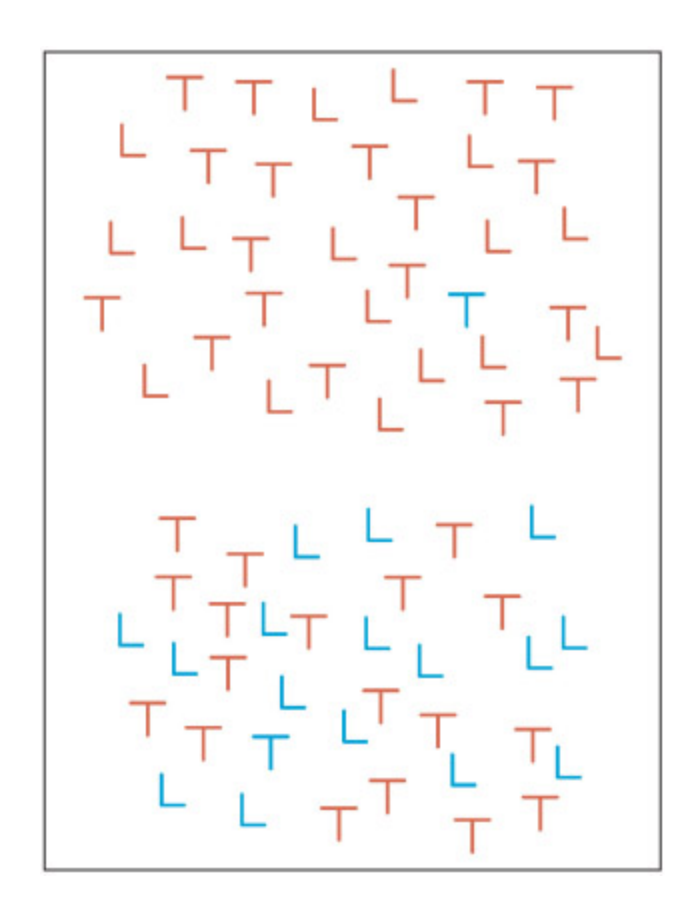
Feature integration theory (FIT) is a model of how aention selects perceptual objects and binds the different features of those objects (e.g. color and shape) into a reportable experience. Most of the evidence for it (and against it) has come from the visual sear paradigm. Look at the two arrays of leers in the next figure. Your task is to try to find the blue “T” as quily as possible.

📊 그림 설명
특징 통합 이론(FIT)을 설명하는 시각적 탐색 과제이다. 첫 번째 배열에서는 파란 T가 단일 특징(색상)으로 구별되어 즉시 탐지(pop-out)되지만, 두 번째 배열에서는 표적이 색상과 형태의 결합으로만 구별되어 직렬 탐색이 필요하다. 이 차이는 주의의 역할과 특징 결합 메커니즘을 입증한다.
Try to find the blue “T” as quily as possible. Why is one condition harder than the other? Feature-Integration eory assumes that basic features are coded in parallel but that focused aention requires serial sear. When the leer differs from others by a single feature, su as color, then it can be identified quily by the initial stage of feature detection. When the leer differs from others by two or more features, then aention is needed to serially sear.
Was the leer relatively easy to find in the first array, but hard to find in the second array? In the second case, did you feel as if you were searing ea location in turn until you found it? In the first array, the target object (the blue “T”) does not share any features with the distractor objects in the array (red Ts and red Ls). e object can therefore be found from a simple inspection of the perceptual meanism that supports color detection.
According to FIT, perceptual features su as color and shape are coded in parallel and prior to aention (Treisman, 1988; Treisman & Gelade, 1980). If an object does not share features with other objects in the array it appears to pop-out. In the second array, the distractors are made up of the same features that define the object. us, the object cannot be detected by inspecting the color module alone (because some distractors are blue) or by inspecting the shape module alone (because some distractors are T-shaped). To detect the target one needs to bring together information about several features (i.e. a conjunction of color and shape). Feature-Integration eory assumes that this occurs by allocating spatial aention to the location of candidate objects. If the object turns out not to be the target, then the “spotlight” inspects the next candidate and so on in a serial fashion.
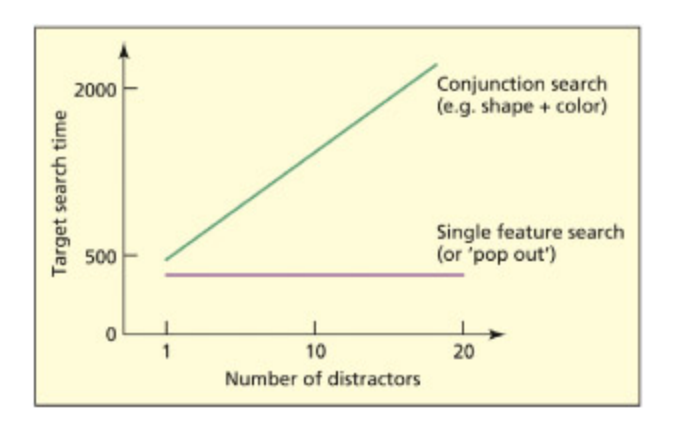
Typical data from a visual sear experiment su as the one conducted by Treisman and Gelade (1980) is presented on p. 150. e dependent measure is the time taken to find the target (some arrays do not contain the target, but these data are not presented here). e variables manipulated were the number of distractors in the array and the type of distractor. When the target can only be found from a conjunction of features, there is a linearly increasing relationship between the number of distractors and time taken to complete the sear. is is consistent with the notion that ea candidate object must be serially inspected in turn. When a target can be
found from only a single feature, it makes very lile difference how many distractors are present, because it “pops out.” If aention is not properly deployed, then individual features may incorrectly combine. ese are referred to as illusory conjunctions. For example, if displays of colored leers are presented briefly so that serial sear with focal aention cannot take place, then participants may incorrectly say that they had seen a red “H” when in fact they had been presented with a blue “H” and a red “E” (Treisman & Smidt, 1982). is supports the conclusion arising from FIT that aention needs to be deployed to combine features of the same object correctly.
Key Terms
Pop-out
The ability to detect an object among distractor objects in situations in which the number of distractors presented is unimportant.
Pop-out은 특정 목표 물체가 단일 시각적 특징(예: 색상)으로 구별될 때 즉각적으로 탐지되는 현상이다.
Illusory conjunctions
A situation in which visual features of two different objects are incorrectly perceived as being associated with a single object.
**환상적 결합(Illusory conjunctions)**은 두 개의 다른 물체의 시각적 특징이 잘못 결합되어 하나의 물체에 속한 것으로 인식되는 현상이다.
📊 그림 설명
FIT 예측에 따른 시각적 탐색 실험의 전형적인 데이터를 보여주는 그래프이다. 결합 탐색(conjunction search) 조건에서는 방해 자극 수가 증가함에 따라 반응 시간이 선형적으로 증가하며(직렬 탐색), 단일 특징 탐색(feature search) 조건에서는 방해 자극 수와 무관하게 반응 시간이 일정하다(pop-out 효과). Treisman과 Gelade(1980)의 연구 결과이다.
According to FIT, when a target is defined by a conjunction of features, sear becomes slower when there are more items, because the items are seared serially. When a target is defined by a single feature it may “pop out”; that is, the time taken to find it is not determined by the number of items in the array.
TMS applied over the parietal lobe slows conjunction seares but not single-feature seares (Ashbridge et al., 1997, 1999) and a functional imaging study has demonstrated parietal involvement in conjunction, but not single-feature seares (Corbea et al., 1995). Patients with parietal lesions oen show a high level of illusory con junction errors with brief presentation (Friedman-Hill et al., 1995).
One difficulty with FIT is that there is no a priori way to define what constitutes a “feature.” Features tend to be defined in a post hoc manner according to whether they elicit pop-out. For instance, it is generally assumed that the features consist of lines (e.g. vertical line, horizontal line) rather than leers (i.e. clusters of lines). However, some evidence does not support this assumption. For example, searing for an “L” among Ts is hard if the “T” is rotated at 180 or 270 degrees, and easier if the “T” is rotated at 0 or 90 degrees (Duncan & Humphreys, 1989). is occurs even though the basic features (horizontal and vertical lines) are equally present in them all. Duncan and Humphreys (1989) suggest that most of the data that FIT aempts to explain can also be explained in terms of how easy it is to perceptually group objects together rather than in terms of parallel feature perception followed by serial aention. ey found that it is not just the similarity between the target and distractor that is important, but also the
similarity between different types of distractor. is implies that there is some feature binding prior to aention and this contradicts a basic assumption of FIT.
Searing for an “L” among “T” is hard if the “T” is rotated 180 degrees or 270 degrees (le), but easier if the “T” is rotated at 0 degrees or 90 degrees (right). It suggests that features in visual sear consist of more than oriented lines, or that some form of feature integration takes place without aention.
Another issue is whether simple feature seares (e.g. a single blue leer among red leers) really occur without aention as assumed by FIT. An alternative position is that all visual sear requires aention even in the case of pop-out stimuli. Wolfe (2003) argues that pop-out is not preaentive but is simply a stimulus driven (exogenous) cue of aention.
Key Terms
Early selection
A theory of attention in which information is selected according to perceptual attributes.
**초기 선택(Early selection)**은 주의가 시각적 특징(perceptual attributes)에 기반하여 초기 단계에서 정보를 선택하는 이론이다.
Late selection
A theory of attention in which all incoming information is processed up to the level of meaning (semantics) before being selected for further processing.
**후기 선택(Late selection)**은 모든 입력 정보가 의미 수준(semantic)까지 처리된 후에만 선택이 이루어진다는 이론이다.
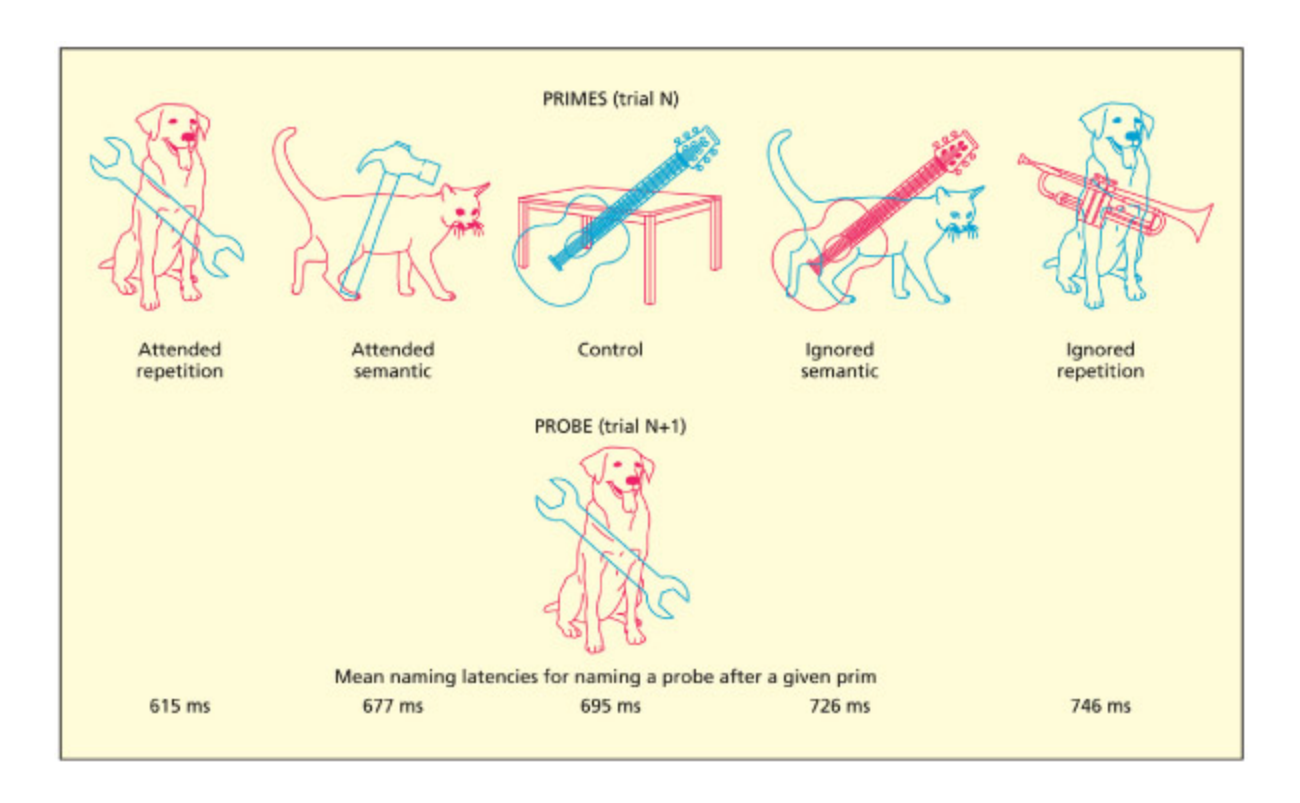
Finally, FIT is an example of what has been termed an early selection model of aention. Recall that the main reason for having aentional meanisms is to select some information for further processing, at the expense of other information. According to early selection theories, information is selected according to perceptual aributes (e.g. color or pit). is can be contrasted with late selection theories that assume that all incoming information is processed up to the level of meaning (semantics) before being selected for further processing. One of the most frequently cited examples of late selection is the negative priming effect (Tipper, 1985). In this figure, participants must name the red object and ignore the blue one. If the ignored object on trial N suddenly becomes the aended object on trial N+1, then participants are slower at naming it (called negative priming). e effect can also be found if the critical object is from the same semantic category. is suggests that the ignored object was, in fact, processed meaningfully rather than being excluded purely on the basis of its color as would be expected by early selection theories su as FIT.

📊 그림 설명
부정적 점화(negative priming) 효과를 설명하는 실험 도식이다. 참가자는 빨간 물체를 명명하고 파란 물체를 무시해야 한다. N번째 시행에서 무시된 파란 물체가 N+1번째 시행에서 주목 대상이 되면 명명 속도가 감소하며, 이는 무시된 자극이 의미 수준까지 처리되었음을 시사하는 후기 선택(late selection)의 증거이다.
In this example, participants must name the red object and ignore the blue one. If an ignored object becomes an aended object on the subsequent trial, then there is cost of processing, whi is termed negative priming.
How can the evidence both for and against FIT be reconciled? e selection of objects for further processing may sometimes be early (i.e. based on perceptual features) and sometimes late (i.e. based on meaning), depending on the demands of the task. Lavie (1995) has shown that, when there is a high perceptual load (e.g. the large arrays typically used for visual sear), then selection may be early, but in conditions of low load in whi few objects are present (as in the negative priming task), then there is a capacity for all objects to be processed meaningfully consistent with late selection. Other findings have suggested that the process of feature binding may also operate at several levels (Humphreys et al., 2000), with some forms of binding occurring prior to aention. is could account for the distractor similarity effects of Duncan and Humphreys (1989).
Biased competition theory
Summary
이 섹션에서는 Biased Competition Theory(편향 경쟁 이론)를 중심으로, 주의가 시각적 자극 간의 신경 활성화 경쟁을 조절하여 선택적 처리를 유도하는 메커니즘을 설명한다. 이 이론에 따르면, 다중 자극이 존재할 때 주의가 집중된 자극에 해당하는 신경세포의 활성화가 강화되고, 반대로 무시되는 자극에 대한 활성화는 억제되며, 이는 경쟁적 억제(competitive inhibition)를 통해 구현된다. 이는 Feature Integration Theory(FIT)와 대비되며, FIT가 특징 통합을 통해 객체 인식을 설명하는 반면, Biased Competition Theory는 주의가 자극 간의 신경 활성화 경쟁에 편향(bias)을 주입함으로써 선택적 처리를 실현하는 과정을 강조한다. 예를 들어, 두 개 이상의 특징이 결합된 표적이 존재할 때, 주의가 특정 자극에 편향되면 해당 자극에 대한 신경 활성화가 우세해지며, 이는 직렬 탐색(serial search)이 필요한 현상을 설명하는 데 기여한다. 이 이론은 Bottom-up과 Top-down 처리의 상호작용을 통합적으로 설명하며, 주의가 경쟁적 신경 활성화를 조절함으로써 정보 선택의 효율성을 높이는 핵심 메커니즘으로 작동함을 강조한다.
Key Terms
Negative priming
If an ignored object suddenly becomes the attended object, then participants are slower at processing it.
**부정적 점화(Negative priming)**는 무시된 자극이 이후 주목 대상이 되었을 때 처리 속도가 감소하는 현상이다.
e biased competition theory of Desimone and Duncan (1995) draws more heavily from neuroscience than from cognitive psyology. It explicitly rejects a spotlight metaphor of aention (inherent, for instance, in Feature Integration eory). Instead “aention is an emergent property of many neural meanisms working to resolve competition for visual processing and control of behavior.” By “emergent property,” Desimone and Duncan imply that aention isn’t a dedicated module, but rather a broad set of meanisms for reducing many inputs to limited outcomes and there is no clear division between aentive and preaentive stages. e Biased Competition eory has been extended and updated by others in light of more recent evidence (Be & Kastner, 2009; Knudsen, 2007).
One assumption of the model is that competition occurs at multiple stages rather than at some fixed bolene—i.e. neither early nor late selection but something more dynamic. is competition occurs first within the visual ventral stream itself in terms of the processing of visual features (colors, motion, etc.) and objects. For instance, single cell electrophysiology suggests that when two stimuli are presented in a single receptive field (e.g. two color pates presented in the receptive field of a neuron in V4) then the responsiveness of the neuron is less than the sum of its responsiveness to
ea stimulus in isolation (Lu et al., 1997). is is one way in whi “competition” may be realized at the neural level.
In humans, the BOLD response in areas of the visual ventral stream to multiple stimuli presented together is less than the sum of its parts as determined by a control condition involving sequential presentation. is also depends on how spatially close together the different stimuli are (Kastner et al., 2001). Brain regions containing neurons with small receptive fields (e.g. V1) are only disrupted by competitors that are close by, but regions that have larger receptive fields (e.g. V4) are also disrupted by more distant competitors. As well as spatial proximity, the degree of competition depends on perceptual similarity of multiple stimuli within the field (Be & Kastner, 2009). is may be the neural basis of early grouping effects and also pop-out. Certain perceptual representations may also tend to dominate in the competitive process by virtue of being familiar (e.g. spoing your partner in a crowd), or by virtue of being recently seen, and so on. Again, this does not require a special meanism as su: it just requires that there is bias in the way these stimuli are represented that facilitates their selection (e.g. neurons fire more when expected or frequently encountered). Selection may also be biased by top-down signals. When a receptive field contains an experimentally defined target and an irrelevant distractor then the neural response resembles that to the target alone suggesting some filtering out of the distractor (Moran & Desimone, 1985).
Another key assumption of this theory is that aention is not deployed serially, but rather perceptual competition occurs in parallel. Serial processing, by contrast, is assumed to arise from competition at the response level rather than perceptual processing (e.g. from the fact that it is only possible to fixate one location at a time). (is idea is linked closely to the Premotor eory of Aention discussed in the next section). Neurons recorded in monkey V4 during visual sear tasks are activated in parallel (i.e. irrespective of whether it is being currently aended/fixated) whenever a target feature (e.g. color) falls in the receptive field (Biot et al., 2005). is occurs for both simple feature (i.e. pop-out) and conjunction seares. However, there is also an enhanced response when the target is selected for
a saccade suggesting serial processing linked to motor responses. Whereas Feature-Integration eory assumes either parallel or serial sear (depending on the nature of the targets), the Biased Competition eory suggests both kinds of meanisms act together.
e Biased Competition Model also accounts for spatial and non-spatial aention within the same model. e differences between spatial and nonspatial aention was originally assumed to be due to different anatomical origins of the biasing signals rather than reflecting different meanisms per se. e posterior parietal cortex was thought to be the origin of spatial biases (e.g. effects of arrows in orienting aention) and prefrontal cortex may code task-related biases (find the blue X). However, other resear has suggested that the same frontal and parietal regions support both spatial and nonspatial sear cues (Egner et al., 2008).
Key Terms
Extinction
In the context of attention, it refers to unawareness of a stimulus in the presence of competing stimuli.
**소멸(Extinction)**은 경쟁 자극이 존재할 때 특정 자극을 인지하지 못하는 현상으로, 두정엽 손상 환자에서 두 자극이 동시에 제시될 경우 관찰된다.
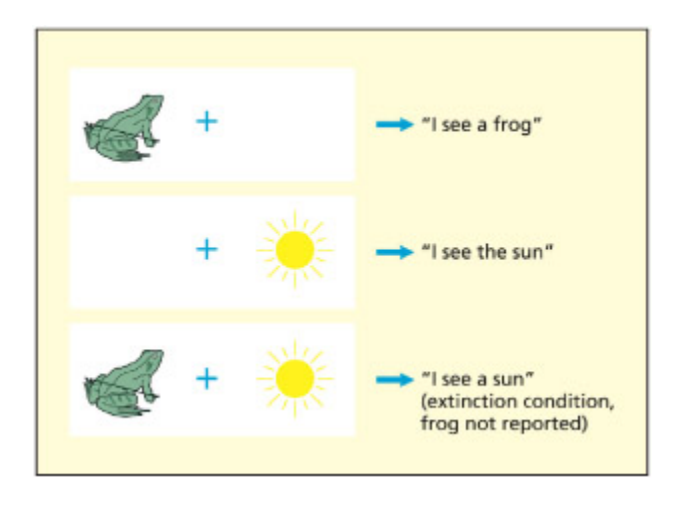
Damage to the parietal lobe not only produces neglect it may also lead to a curious symptom called extinction (Riddo et al., 2010). When a single stimulus is presented briefly to either the le or the right of fixation, patients with parietal lesions tend to accurately report them. But when presented with two stimuli at the same time, the patient may report seeing the object on the right but not the object on the le (in the case of right parietal damage). us the patient has not lost the ability to see the le side of space, nor have they lost the ability to aend to the le side of space per se, but
they have lost the ability to aend to (and be aware of) the le side of space when there is a competitor on the right.
Similar effects are found for the Posner-cueing task as a result of parietal lobe lesions (Posner & Petersen, 1990). For patients with right parietal lobe lesions, they are able to initially orient aention to either the le or right side of space as a result of a prestimulus flash of light on either the le or right. However, while they are able to shi aention from a cue on the le (their neglected side) to a target on the right (their “good” side) they are impaired in the reverse scenario (shiing from the “good” to neglected side). While this could be explained by damage to a special aention meanism relating to disengaging aention (Posner & Petersen, 1990) it could be explained by biased competition: it is easy to orient to the “bad” side of space when competition is low (i.e. to the initial cue), but harder to orient to the “bad” side following a salient visual stimulus on the “good” side.

📊 그림 설명
소멸(extinction) 현상을 보여주는 도식이다. 무시증 환자는 단일 자극이 제시될 때 좌측 자극도 정확히 인지할 수 있으나, 두 자극이 동시에 제시되면 좌측 자극을 인지하지 못한다. 이는 주의가 자극 간 경쟁에 의존하여 작동하며, 편향 경쟁 이론(Biased Competition Theory)의 핵심 증거가 된다.
Neglect patients may fail to notice the stimulus on the le when two stimuli are briefly shown (called extinction), but notice it when it is shown in isolation. It suggests that aention depends on competition between stimuli.
The premotor theory of attention
Summary
이 섹션에서는 Premotor theory of attention(지향의 전운동기 이론)을 설명하며, 주의의 이동이 운동 준비(motor preparation)와 직접적으로 연결되어 있다고 주장한다. 이 이론에 따르면, 공간적 주의(spatial attention)의 지향은 눈의 움직임(saccade)을 준비하는 운동 계획(motor planning)과 동일한 메커니즘을 기반으로 하며, 특히 명시적(overt) 및 은밀한(covert) 주의 이동 모두를 포괄한다. Rizzolai 등(1987)의 실험에서, 참가자는 중앙에 고정된 숫자가 나타난 위치에 목표 자극이 있을 확률(80%)을 나타내었고, 이후 사각형에서 빛이 깜빡이는 자극을 탐지해야 했다. 이때, 예측 위치와 반대편(예: 위치 2에서 1 또는 3으로의 이동)으로 주의를 이동할 때 반응 시간이 증가했으며, 특히 왼쪽으로의 이동(예: 위치 2→1)은 오른쪽으로의 이동(위치 2→3)보다 비용(cost)이 작았다. 이는 눈의 움직임(saccade)을 계획하는 운동 프로그램(motor program)의 특성과 관련이 있으며, 왼쪽으로의 이동은 기존 프로그램을 유지할 수 있지만, 방향 전환은 새로운 프로그램을 생성해야 하기 때문으로 설명된다. 또한, Moore 및 Fallah(2001)의 실험에서 전두눈장(frontal eye field, FEF)의 신경세포를 자극하면 눈의 움직임(saccade) 없이도 주의가 집중된 위치(virtual eye movement)에서 시각적 감별(perceptual discrimination)이 향상되었으며, 이는 은밀한 주의 이동(covert orienting)이 운동 계획(movement plan)과 동일한 신경 기전을 기반으로 한다는 것을 뒷받침한다. 이 이론은 주의(attention)의 신경 기전이 운동 준비(motor preparation)와 동일한 전두엽(frontal lobe) 및 두정엽(parietal lobe) 영역(예: FEF, LIP)에서 발생한다고 예측하며, 단일 세포 기록(single-cell recordings) 및 인간 fMRI(Nobre 등, 2000) 실험을 통해 이와 일치하는 증거가 제시된다. **“Premotor”**라는 용어는 운동 준비(motor preparation)와 관련된 운동 기능(motor function)을 의미하며, 이는 전운동기 피질(premotor cortex)과는 구분되어야 한다.
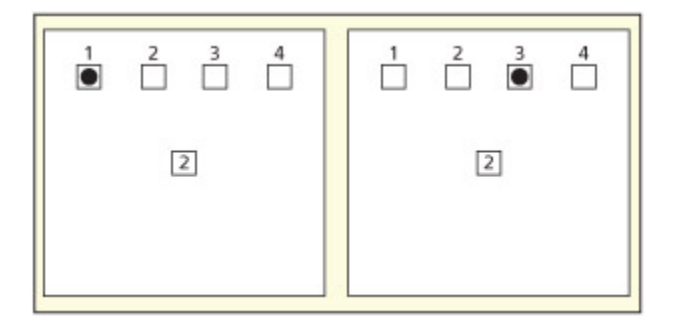
e premotor theory of aention assumes that the orienting of aention is nothing more than preparation of motor actions (Rizzolai et al., 1987, 1994).
As su, it is primarily a theory of spatial aention. e theory encompasses both overt orienting, in whi actual movement occurs, and covert orienting. e laer is assumed to reflect movement that is planned but not executed.
e initial evidence for the theory came from a spatial cueing task (Rizzolai et al., 1987). e set-up used four spatial locations arranged le to right (1, 2, 3 and 4) and a centrally fixated square. Within the central square, a digit would appear that would indicate where a target was likely to appear (with 80 percent certainty). A flash would then appear in one of the four boxes and the participant simply had to press a buon as soon as it was detected. Participants were slower when the cue was misleading, forcing them to shi aention. However, they found that costs in response times were not only related to whether aention had to shi per se, but also whether aention had to reverse in direction. So a shi of aention from position 2 (le) to position 1 (far le) had a small cost whereas a shi from position 2 (le) to a rightward location (position 3) had a larger cost (and similarly a shi from 3 to 4 was less costly than from 3 to 2). e same results were also found for vertical alignments of the four posi tions so the findings do not relate to processing differences across hemispheres. e basic finding is hard to reconcile with a simple “spotlight” account, because the spotlight is moved the same distance in both scenarios. ey suggest instead that the paern reflects the programming of eye movements (but not their execution as overt movements were not allowed). Specifically, a lewards eye movement can be made to go further lewards with minimal additional processing effort, but to ange a lewards movement to a rightwards movement requires a different motor program to be set up and the original one discarded.

📊 그림 설명
Rizzolatti 등(1987)의 전운동 이론 실험 설계를 보여주는 도식이다. 중앙에 제시된 숫자가 표적의 예상 위치를 나타내며(이 경우 위치 2), 표적이 예상과 다른 위치에 나타날 수 있다. 위치 1과 3은 예상 위치에서 같은 거리에 있지만, 같은 방향(위치 1)으로의 주의 이동이 반대 방향(위치 3)보다 빠르며, 이는 안구 운동 프로그래밍과 주의 이동의 관련성을 시사한다.
In the study of Rizzolai et al. (1987), a centrally presented digit indicates where a target stimulus is likely to appear (in this case, position 2), but it may sometimes appear in an unaended location (as shown here, in positions 1 or 3). Although positions 1 and 3 are equidistant from the expected location, participants are faster at shiing aention to position 1 than position 3. Why might this be?

📊 그림 설명
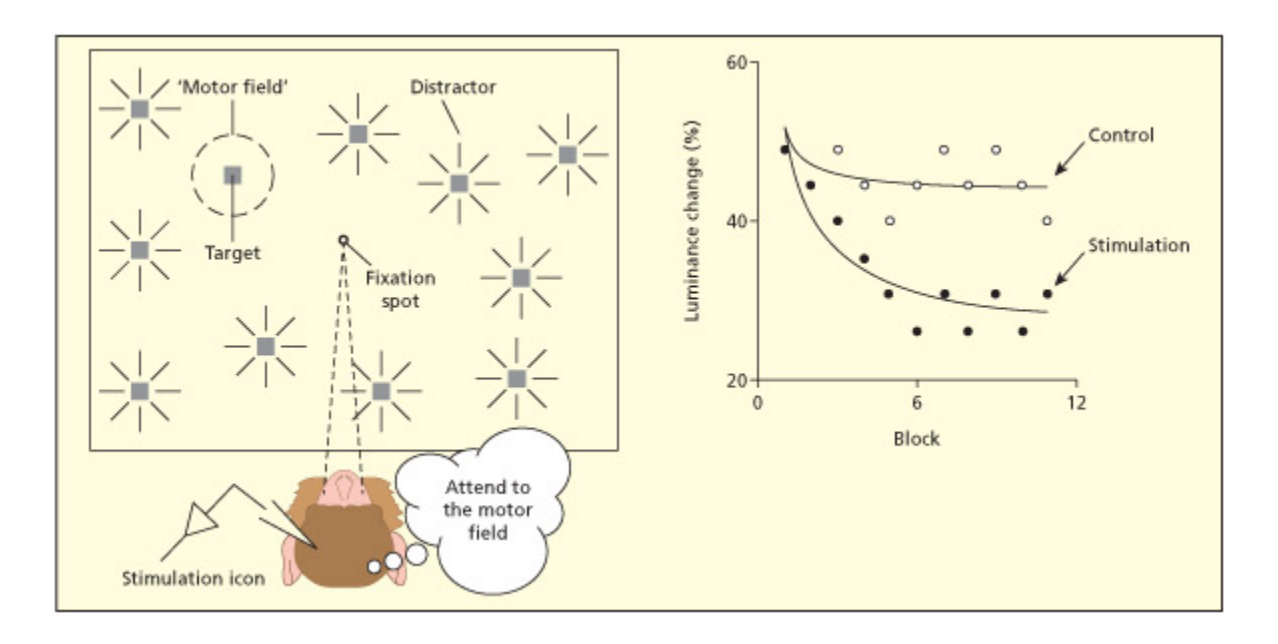
Moore와 Fallah(2001)의 실험을 보여주는 도식이다. 원숭이가 자극의 밝기 변화를 탐지하는 과제에서, 안구 운동을 유발하는 FEF 신경세포를 역치 이하로 자극하면 실제 안구 운동 없이도 해당 수용장 위치의 시각적 변별 능력이 향상되었다. 이는 은밀한 주의 이동이 실행되지 않은 안구 운동 계획과 동일한 메커니즘을 기반으로 함을 뒷받침한다.
In Moore and Fallah (2001) the task of the animal was to press a lever when one of the stimuli “blinked” (a small ange in luminance). ey were beer at doing the task when a part of the brain involved in generating eye movements was stimulated than in a no-stimulation control condition (even though no eye movements occurred), provided the light stimulus fell in the appropriate receptive field. is is consistent with the idea that aending to a region of space is like a virtual movement of the eyes.
Le image from www.nature.com/neuro/journal/v5/n9/fig\_tab/nn0902–819\_F1.html. Right image from Moore and Fallah, 2001.
e term “premotor” refers to the claim that aention is a preparatory motor act and is not referring to the premotor cortical region of the brain (discussed in Chapter 8). e theory does, however, make strong neuroanatomical predic tions: namely that the neural substrates of aention should be the same as the neural substrates for motor preparation (particularly eye movements). As discussed previously, there is evidence to sup port this view from single-cell recordings (Bisley & Goldberg, 2010) and human fMRI (Nobre et al., 2000). ere is also intriguing evidence from brain stimulation studies. Electrical stimulation of neurons in the frontal eye fields (FEF) of monkeys can elicit reliable eye movements to particular locations in space. Moore and Fallah (2001) identified su neurons and then stimulated them at a lower intensity su that no eye movements occurred (the animal continued to fixate centrally). However, the animals did show enhanced perceptual discrimination of a stimulus presented in the location where an eye-movement would have occurred. is suggests that aention was deployed there and is consistent with the idea that covert orienting of aention is a non-executed movement plan.
Key Terms
Balint's syndrome
A severe difficulty in spatial processing normally following bilateral lesions of parietal lobe; symptoms include simultanagnosia, optic ataxia, and optic apraxia.
**발린트 증후군(Balint’s syndrome)**은 두정엽의 양측 손상으로 인해 발생하는 공간적 처리 장애로, 동시실인증, 시각실조, 시각실행증을 특징으로 한다.
Simultanagnosia
Inability to perceive more than one object at a time.
**동시실인증(Simultanagnosia)**은 한 번에 하나 이상의 물체를 인식하지 못하는 현상이다.
The premotor theory of attention has not been without criticism. Smith and Schenk (2012) argue that it fails as a general theory of attention and may only be valid in certain situations (e.g. exogenous orienting of attention to, say, flashes of light). For instance, patients with chronic lesions of the FEF have a saccadic deficit but no deficit of endogenous attention in covert orienting tasks involving, say, arrow cues (Smith et al., 2004).
Seeing One Object at a Time: Simultanagnosia and Balint’s Syndrome
Summary
이 섹션에서는 Balint’s syndrome(발린트 증후군)와 관련된 시뮬타나고니아(simultanagnosia) 현상을 중심으로, 공간적 주의(spatial attention) 및 시각 정보 처리(visual processing)의 병리적 기전을 탐구한다. RM 환자는 양측 두정엽(parietal lobes) 손상으로 인해 공간 관계 인식(spatial relationship perception)에 심각한 장애를 보이며, 물체의 위치를 언어적, 시각적, 신체적 방식으로 인식하는 능력이 상실되었으나, 기본적인 시각 능력(visual acuity, 색상 인식 등)은 정상이었다. Balint’s syndrome 환자는 한 번에 하나의 물체만 인식할 수 있는 시뮬타나고니아를 특징으로 하며, 이는 두 시각 경로(ventral stream, dorsal stream) 이론에서 “공간이 존재하지 않는 것처럼” 인식되는 현상으로 설명된다. Biased Competition Theory(편향 경쟁 이론)에서는 이 현상을 공간 선택 능력의 한계로 인한 극단적인 인식 경쟁(perceptual competition)으로 해석하고, Feature Integration Theory(기능 통합 이론)에서는 특징과 위치의 결합(feature-location binding) 장애로 설명한다. 예를 들어, 정상 참가자는 빠르게 제시된 파란 H와 빨간 E를 혼동하는 환상적 결합(illusory conjunction) 오류를 보일 수 있으나, Balint’s 환자는 오랜 시간 시각 정보를 관찰하더라도 동일한 오류를 보인다. 또한, GK 환자의 사례를 통해 시각적 자극(face parts)의 그룹화(grouping)가 형상(shape), 색상(color), 연결성(connectedness) 및 상향식(top-down) 인식 영향에 따라 달라짐을 보여준다. GK는 눈의 위치를 파악하라는 지시를 받을 때 정상적인 환자(91%)에 가까운 성능을 보이지만, 단순한 원형으로 인식할 때는 55%의 정확도에 그쳤다. 이는 두정엽 손상이 공간적 주의(spatial attention)와 행동 지향(action orientation)의 기초를 형성하는 “where” 경로(dorsal stream)에 중대한 영향을 미친다는 점을 강조한다.
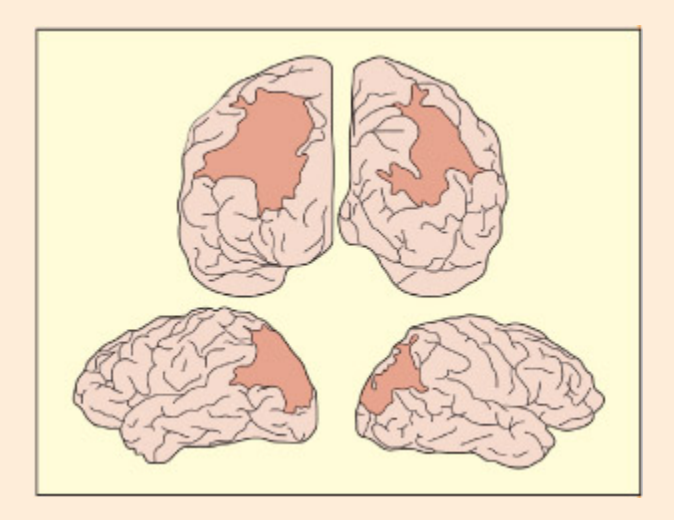
📊 그림 설명
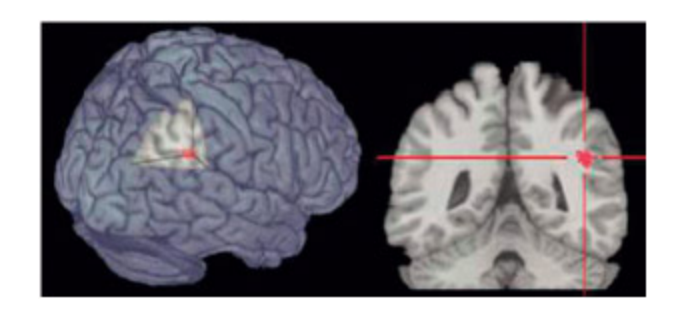
환자 RM의 양측 두정엽 손상 부위를 보여주는 뇌 영상이다. 위쪽 도식은 후방에서, 아래쪽 도식은 측면에서 본 뇌 손상 범위를 나타낸다. RM은 물체의 위치를 언어적, 시각적, 신체적 방식으로 인식하는 능력이 완전히 상실되었으나, 기본적인 시각 능력(시력, 색상 인식 등)은 정상이었다. Robertson 등(1997)의 연구에서 인용되었다.
RM has extensive damage to both the le and right parietal lobes and severe difficulties in perceiving spatial relationships (top diagrams are viewed from the ba of the brain; boom diagrams are viewed from the side). RM was unable to locate objects verbally, or by reaing or pointing (Robertson et al., 1997). In contrast, his basic visual abilities were normal (normal 20/15 visual acuity, normal color vision, contrast sensitivity, etc.). He was impaired at locating sounds, too.
e idea that one could perceive an object but not its location is highly counterintuitive, because it falls outside of the realm of our own
experiences. However, there is no reason why the functioning of the brain should conform to our intuitions. Patients with Balint’s syndrome (Balint, 1909, translated 1995) typically have damage to both the le and the right parietal lobes and have severe spatial disturbances. Patients with Balint’s syndrome may notice only one object at a time: this is termed simultanagnosia. For example, the patient may notice a window, then, all of a sudden, the window disappears and a nelace is seen, although it is unclear who is wearing it. In terms of the two visual streams idea, it is as if there is no “there” there (Robertson, 2004). Within the Biased Competition eory it could be regarded as an extreme form of perceptual competition due to a limited spatial selection capacity. Within Feature Integration eory, it can be construed as an inability to bind features to locations and, hence, to ea other. Recall that if a blue “H” and a red “E” are presented very quily to normal participants, then illusory conjunction errors may be reported (e.g. red “H”). Balint’s patients show these errors even when they are free to view objects for as long as they like (Friedman-Hill et al., 1995). In addition to simultanagnosia, patients typically have problems in using vision to guide hand actions (optic ataxia; considered in Chapter 8) and fail to make appropriate eye movements (optic apraxia).

📊 그림 설명
Balint 증후군 환자 GK에서 얼굴이 전체로 인식되는 조건과 부분의 집합으로 인식되는 조건을 비교하는 자극이다. GK는 타원 안의 원이 “눈”이라고 알려지면 위치 판단을 91% 정확히 수행했으나, 단순한 원으로 인식할 때는 55%에 그쳤다. 이는 하향식(top-down) 인식 영향과 객체 그룹화가 주의에 미치는 효과를 보여준다.
Under what circumstances is a face perceived as a whole or as a collection of parts? Patient GK can identify the location of the ovals when he is told that they are the eyes of a face, but not if he thinks of them just as circles inside an oval. e former judgment may use his intact ventral route for identifying faces/objects, whereas the laer may use the impaired dorsal route for appreciating the location of the circles relative to another. GK was also beer at making location judgments about the rectangles when other face-like features were added.
To say that Balint’s patients can recognize single objects leads to some potential ambiguities. Consider a face. Is a face a single object or a collection of several objects (eyes, nose, mouth, etc.) arranged in a particular spatial configuration? A number of factors appear to determine whether parts are grouped together or not. Humphreys et al. (2000) showed that, in their Balint’s patient, GK, parts are likely to be grouped into wholes if they share shape, if they share color, or if they are connected together. is suggests that some early feature binding is
possible prior to aention. Another factor that determines grouping of parts into wholes is the familiarity of the stimulus and how a given stimulus is interpreted (so-called top-down influences). Shalev & Humphreys (2002) presented GK with the ambiguous stimuli on the le. When asked whether the two circles were at the top or boom of the oval he was at ance (55 percent). He performed the task well (91 percent) when asked whether the eyes were at the top or boom of the face.
Evaluation
Although there are many theories of aention, three prominent ones have been considered here. Feature Integration eory and the Premotor eory are necessarily limited in scope in that they are specifically theories of spatial aention, whereas the Biased Competition eory has the advantage of offering a more general account. Feature Integration eory has been successful in explaining mu human behavioral data in visual sear. Biased Competition eory offers a more neuroscientific account of this data in whi competition arises at multiple levels (e.g. perceptual crowding, and response competition) and aention is syn ony mous with the selection function of this overall system. e Premotor eory offers an interesting explanation as to how aention can be considered as a combination of both “where” (spatial) and “how” (motor) functions of the dorsal stream.
Key Terms
Line bisection
A task involving judging the central point of a line.
**선분 이등분(Line bisection)**은 선분의 중앙 지점을 판단하는 과제로, 무시증 평가에 핵심적으로 활용된다.
Cancellation task
A variant of the visual search paradigm in which the patient must search for targets in an array, normally striking them through as they are found.
**소거 과제(Cancellation task)**는 배열된 자극 중 목표물을 탐색하고 발견 즉시 제거하는 실험으로, 공간적 주의 메커니즘을 평가하는 데 사용된다.
임상 사례
Hemispatial neglect의 일상적 증상: 우측 두정엽 손상 환자는 접시의 오른쪽 반만 먹고, 얼굴의 오른쪽 반만 면도하며, 시계를 그리면 숫자 1-12를 모두 오른쪽 반원에 몰아 넣는다. 중요한 점은 환자가 자신의 결함을 인식하지 못한다(anosognosia)는 것이다. 무시증은 시력 문제가 아니므로, 주의를 좌측으로 유도하면 자극을 인식할 수 있다.
주의
Neglect와 hemianopia(Ch6)를 혼동하면 안 된다. Hemianopia는 V1 손상으로 인한 실제 시각 상실이고, neglect는 두정엽 손상으로 인한 주의 결함이다. Hemianopia 환자는 맹시야를 인식하지만, neglect 환자는 결함 자체를 인식하지 못한다. 또한 neglect는 주의를 유도하면 개선되지만, hemianopia는 주의 유도로 개선되지 않는다.
Neglect as a Disorder of Spatial Attention and Awareness
Summary
이 섹션에서는 Neglect(무시증)가 공간적 주의(spatial attention) 및 의식(awareness) 장애로 나타나는 질환으로, 일반적으로 우두정엽(right parietal lobe) 손상으로 인해 좌측 공간(left side of space)에 대한 자극 인식이 결여되는 현상을 설명한다. 무시증 환자는 선 분할(line bisection) 작업에서 선의 중심을 오른쪽으로 편향시키는 경향이 있으며, 이 편향은 선의 길이에 비례하여 나타난다(Marshall & Halligan, 1990). 평가 방법으로는 도면 복사(copying), 기억에 의한 그림(drawing from memory), 타겟 제거(cancellation) 등이 사용되며, 환자는 좌측 공간의 자극을 간과하는 경향이 있다. Mort et al.(2003)은 35명의 환자를 대상으로 하여 우측 인두두정엽(right angular gyrus)과 두정두정 접합부(temporoparietal junction, TPJ)가 무시증 발생에 핵심적인 역할을 수행함을 밝혔고, 기능적 영상 연구 및 TMS(transcranial magnetic stimulation) 실험(Fierro et al., 2000)도 이 영역의 관여를 지지한다. 또한, 우측 후두정엽(right posterior parietal cortex)은 구조적 손상이 없더라도 TPJ와의 연결성으로 인해 기능적으로 비활성화될 수 있으며, 무시증은 다양한 공간 처리 메커니즘(spatial processes)과 관련된 신경 기질(neural substrates)의 차이로 분화될 수 있음이 제시된다.
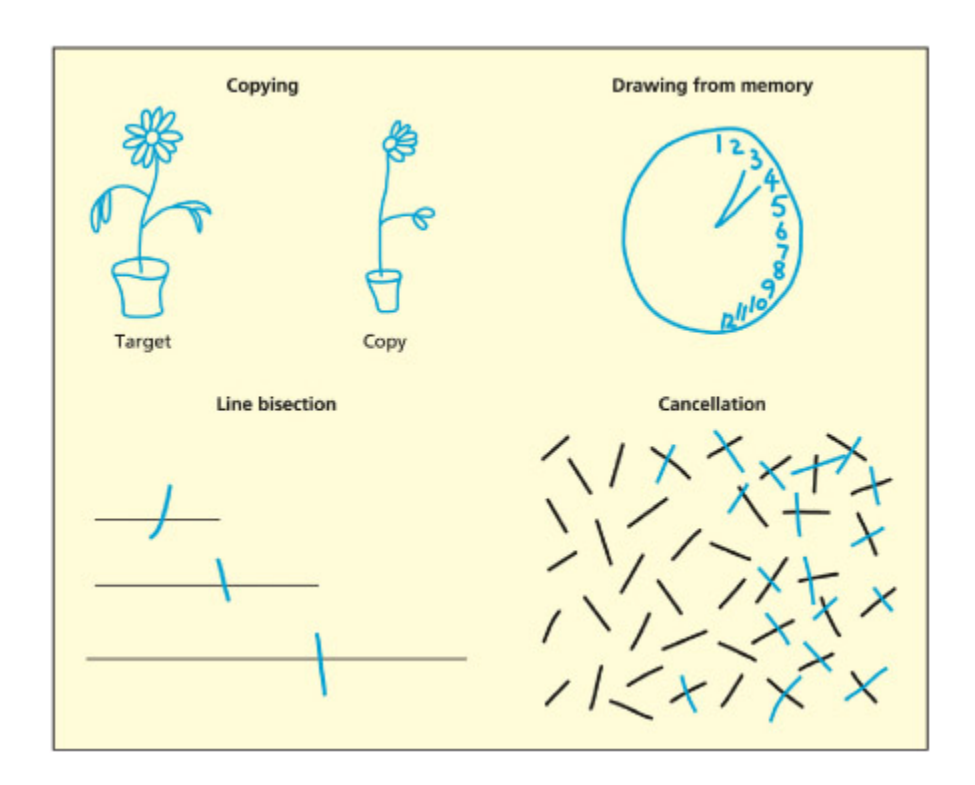
Patients with neglect (also called hemispatial neglect, visuospatial neglect or visual neglect) fail to aend to stimuli on the opposite side of space to their lesion— normally a right-sided lesion resulting in inaention to the le side of space.
Characteristics of neglect

📊 그림 설명
무시증(neglect)을 평가하는 다양한 방법을 보여주는 환자 수행 예시이다. 도면 복사(copying), 기억에서 그리기(drawing from memory), 선분 이등분(line bisection), 소거 과제(cancellation) 등이 포함된다. 환자는 일관되게 좌측 공간의 정보를 무시하거나 왜곡하는 특징적인 패턴을 보인다.
Different ways of assessing neglect include copying, drawing from memory, finding the center of a line (line bisection), and crossing out targets in an array (cancellation).
ere are a number of common ways of testing for neglect. Patients may omit features from the le side when drawing or copying. In tests of line bisection, patients tend to misplace the center of the line toward the right (because they underestimate the extent of the le side). e bias in bisection is proportional to the length of the line (Marshall & Halligan, 1990). Cancellation tasks are a variant of the visual sear paradigms already discussed, in whi the patients must sear for targets in an array (normally striking them through as they are found). ey will typically not find ones on the right. Some of these tasks may be passed by some neglect patients but failed by others, the reasons for whi have only recently started to become clear (Halligan & Marshall, 1992; Wojciulik et al., 2001). In extreme cases, neglect patients may shave only half of their face or eat half of their food on the plate.

📊 그림 설명
무시증과 관련된 우측 하두정엽(right inferior parietal lobe) 병변 부위를 보여주는 뇌 영상이다. 14명의 환자 병변이 가장 많이 겹치는 영역을 표시하며, 우측 각회(angular gyrus)와 측두두정엽 접합부(TPJ) 영역이 무시증 발생에 핵심적으로 관여함을 보여준다. Mort 등(2003)의 연구 결과이다.
Neglect is associated with lesions to the right inferior parietal lobe. is photo shows the region of highest overlap of the lesions of 14 patients.
Mort et al. (2003) examined the brain regions critical for producing neglect in 35 patients and concluded that the critical region was the right angular gyrus of the inferior parietal lobe, including the right temporoparietal junction (TPJ). Functional imaging studies of healthy participants performing line bisection also point to an involvement of this area in that particular task (Fink et al., 2000); as do the results from a TMS study (Fierro et al., 2000). While there is good consensus over the role of this region in neglect, it is not the only region that is implicated. For instance, Corbea and Sulman (2011) argue that the right posterior parietal cortex, containing salience maps, may tend to be functionally deactivated (due to its connectivity with the damage right TPJ) despite not being structurally damaged. Others have argued that neglect itself can be fractionated into different kinds of spatial processes with differing neural substrates, as considered later.
Neglect and the relationship between attention, perception, and awareness
Summary
이 섹션에서는 무시증(neglect)이 저수준 시각 인식(low-level visual perception) 장애가 아니라 주의(attention)와 의식(awareness)의 결함으로 인해 발생하는 질환임을 강조한다. 기능적 영상(functional imaging) 결과에 따르면, 무시되는 시각 영역의 자극은 두정엽(parietal lobes)과 시상(thalamus) 등에 활성화를 유발하며, 주의가 특정 공간에 유도될 경우 무시된 자극도 인지될 수 있음을 보여준다. 또한, 무시증은 시각 외 감각(예: 청각, 촉각)에도 영향을 미치며, Pavani 등(2002)의 연구에 따르면 무시증 환자는 왼쪽 공간의 소리 위치 인식에 오른쪽 편향을 보인다. 객체 인식(object recognition) 수준까지 정보가 처리될 수 있음을 보여주는 실험 결과(예: Vuilleumier 등(2002b)의 연구)와 Marshall 및 Halligan(1988)의 집 이미지 실험을 통해, 무시된 자극은 의식 없이도 의미 있는 판단(예: 화재가 있는 집을 피하는 선택)을 유도할 수 있음을 강조한다. 무시증(neglect)과 블라인드사이트(blindsight)의 차이점은 의식 결여(lack of awareness)의 범위, 주의 유도 가능성, 공간 참조 시스템(egocentric vs. retinocentric) 등에서 명확히 구분되며, 이는 의식(awareness)과 주의(attention)의 복잡한 상호작용을 반영한다.
It is important to stress that neglect is not a disorder of low-level visual perception. A number of lines of evidence support this conclusion. Functional imaging reveals that objects in the neglected visual field still activate visual regions in the occipital cortex (Rees et al., 2000). Stimuli presented in the neglected field can oen be detected if aention is first cued
to that side of space (Riddo & Humphreys, 1983). is also argues against a low-level perceptual deficit. e situations in whi neglect patients oen fare worse are those requiring voluntary orienting to the neglected side and those situations in whi there are several stimuli competing for aention. Although the primary deficit in neglect is related to aention, not perception, it does lead to deficits in awareness of the perceptual world.
Neglect is not just restricted to vision, but can apply to other senses as well. is is consistent with evidence presented earlier that the parietal lobes have multi-sensory aracteristics. Pavani et al. (2002) have shown that neglect patients show a right-skewed bias in identifying the location of a sound (but note that they are not “deaf” to sounds on the le). Extinction can also cross sensory modalities. A tactile (or visual) sensation on the right will not be reported if accompanied by a visual (or tactile) stimulus on the le, but will be reported when presented in isolation (Maingley et al., 1997).
Patients with neglect can be shown to process information in the neglected field to at least the level of object recognition. e ventral “what” route seems able to process information “silently” without entering awareness, whereas the dorsal “where” route to the parietal lobe is important for creating conscious experiences of the world around us. Vuilleumier et al. (2002b) presented brief pictures of objects in le, right, or both fields. When two pictures were presented simultaneously the patients extinguished the one on the le and only reported the one on the right and when later shown the neglected stimuli they claimed not to remember seeing them (a test of explicit memory). However, when later asked to identify a degraded picture of the object, their performance was facilitated, whi suggests that the extinguished object was processed unconsciously. Other lines of evidence support this view. Marshall and Halligan (1988) presented a neglect patient with two depictions of a house that were identical on the non-neglected (right) side, but differed on the le side su that one of the two houses had flames coming from a le window. Although the patients claimed not to be able to perceive the difference between them, they did, when forced to oose, state that they would rather live in the
house without the flames! is, again, points to the fact that the neglected information is implicitly coded to a level that supports meaningful judgments being made.
| ”LaAwareness”DifferentLaHowIsAOfInNeglectFromOfAwarenessInBlindsight? | |
|---|---|
| Neglect | Blindsight |
| • La of awareness is notrestricted to vision and may befound for other sensory modalities | • La of awareness is restricted to thevisual modality |
| • Whole objects may be processedimplicitly | • Implicit knowledge is restricted tobasic visual discriminations (directionof motion; but see Marcel, 1998) |
| • La of awareness can oen beovercome by directing aention toneglected region | • La of awareness not overcome bydirecting aention to”blind” region |
| • Neglected patients oen fail tovoluntarily move their eyes intoneglected region | • Blindsight patients do move their eyes”blind” regioninto |
| • Neglected region is egocentric | • Blind region is retinocentric |
Different types of neglect and different types of space
Summary
이 섹션에서는 공간(space)을 뇌가 단일한 연속체가 아니라 **다양한 종류의 “지도”(maps)**로 생성하고 저장한다고 설명하며, 인지 신경과학자들이 이를 설명하기 위해 다양한 공간 기준 프레임(spatial reference frames)을 사용한다고 강조한다. 각 프레임은 독자적인 중심점(origin)과 좌표계를 가지며, 이들 사이의 연결 방식인 재지도(remapping) 메커니즘을 통해 서로 연계될 수 있다. 예를 들어, 머리 중심(head-centered) 프레임에서의 소리 위치를 눈 중심(eye-centered, retinocentric space) 프레임으로 재지도하여 시선 움직임을 유발하는 과정이 설명되며, 이는 손 중심(hand-centered) 시각 수용 영역으로의 재지도가 수동적 행동 시 손-눈 조율(hand-eye coordination)을 지원할 수 있음을 보여준다. 두정엽(parietal lobes)은 이러한 재지도 기능을 수행할 수 있는 뇌 구조로, 몸의 자세 정보와 소리, 시각, 촉각과 관련된 감각 정보를 동시에 수신받는 점에서 그 역할을 강조한다. 이는 이전 섹션에서 논의된 공간적 주의(spatial attention)와 두정엽의 기능을 확장한 설명으로, 뇌가 다양한 공간 프레임 간의 유연한 정보 처리를 통해 환경에 적응하는 메커니즘을 드러낸다.
Space, as far as the brain goes, is not a single continuous entity. A more helpful analogy is to think of the brain creating (and perhaps storing) different kinds of “maps.” Cognitive neuroscientists refer to different spatial reference frames to capture this notion. Ea reference frame (“map”) may have its own center point (origin) and set of coordinates. Similarly there may be ways of linking one map to another—so-called remapping. It has already been described how neurons may remap the spatial position of
sounds from a head-centered reference frame to an eye-centered reference frame (so-called retinocentric space). is enables sounds to trigger eye movements. e same can happen for other combinations: for instance, visual receptive fields may be remapped so that they are centered on the position of the hands rather than the position of the eyes (facilitating handeye coordination during manual actions). e parietal lobes can perform remapping because they receive postural information about the body as well as sensory information relating to sound, vision and tou (Pouget & Driver, 2000).
Key Terms
Egocentric space
A map of space coded relative to the position of the body.
**자기 중심 공간(Egocentric space)**은 신체의 위치를 기준으로 공간을 인코딩하는 맵이다.
Allocentric space
A map of space coding the locations of objects and places relative to each other.
**환경 중심 공간(Allocentric space)**은 물체 간 상대적 위치를 기준으로 공간을 표현하는 맵이다.
e main clinical features of neglect tend to relate to egocentric space (reference frames centered on the body midline) and it is these kinds of spatial aentional disorders that are linked to brain damage to the right temporoparietal region (Hillis et al., 2005). However, neglect is also linked to other kinds of spatial reference frames, as outlined below. Although this could be conceptualized as losing particular kinds of spatial representations,
another way of thinking about it is in terms of aention deficits created by disrupting competition at different levels of processing.
Perceptual versus representational neglect
Summary
이 섹션에서는 무시증(neglect)이 단순한 시각 인식 장애가 아니라 공간적 주의(spatial attention)의 결함에서 비롯된다는 점을 강조하며, representational neglect(표현적 무시)와 perceptual neglect(인식적 무시)의 구분을 제시한다. Bisia와 Luzzai(1978)의 연구에 따르면, 환자들에게 익숙한 밀라노 대성당 광장(Piazza del Duomo)의 특정 위치에서 건물을 상상하도록 요청했을 때, 환자는 대성당의 왼쪽에 있는 건물을 보지 못하는 경향을 보였다. 이후 환자가 광장의 반대편에서 상상하도록 유도했을 때, 이전에 무시되었던 왼쪽 건물이 이제는 오른쪽에 위치해 보고되었으나, 이전에 보고되었던 오른쪽 건물이 이제는 왼쪽에 위치해 무시되었음을 확인했다. 이는 공간 지식 자체가 손상된 것이 아니라 특정 공간에 대한 주의 집중 실패를 의미함을 시사한다. 이후 연구에 따르면, 이 representational neglect는 perceptual neglect와 double dissociation(이중 분리) 관계에 있으며, 뇌는 정신 이미지(mental imagery)와 자기 중심적 시각 공간(egocentric perceptual space)에 대해 다른 공간 기준 프레임(spatial reference frames)을 별도로 유지한다고 분석된다. 특히, 해마(hippocampus)는 비자기 중심적(allocentric) 공간 관계(지표물 간 상대적 위치)를 저장하는 것으로 알려져 있으나, 두정엽(parietal lobes)은 특정 시점에서 공간을 상상하는 데 필수적인 역할을 수행한다고 설명된다. 이는 무시증이 공간 기억의 결손이 아니라 공간 주의의 실패에서 비롯된다는 것을 강조한다.
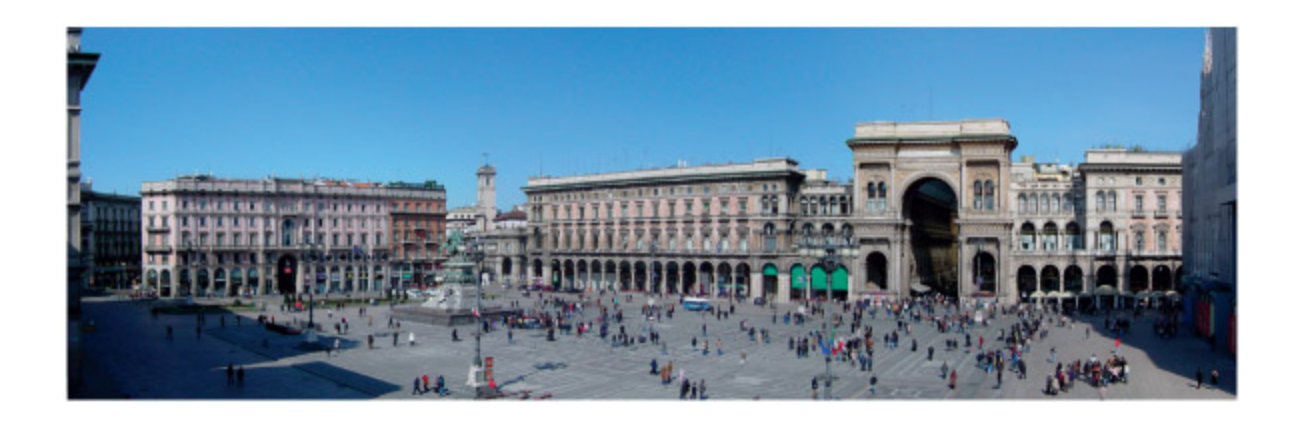
Bisia and Luzzai (1978) established that neglect can occur for spatial mental images and not just for spatial representations derived directly from perception. Patients were asked to imagine standing in and facing a particular location in a town square that was familiar to them (the Piazza del Duomo, in Milan). ey were then asked to describe the buildings that they saw in their “mind’s eye.” e patients oen failed to mention buildings in the square to the le of the Duomo. Was this because of loss of spatial knowledge of the square or a failure to aend to it? To establish this, the patients were then asked to imagine themselves at the opposite end of the square, facing in, and describe the buildings. In this condition, the buildings that were on the le (and neglected) are now on the right and are reported, whereas the buildings that were on the right (and reported previously) are now on the le and get neglected. us, spatial knowledge of the square is not lost but is unavailable for report. Subsequent resear has established that this so-called representational neglect forms a double dissociation with neglect of perceptual space (Bartolomeo, 2002; Denis et al., 2002). e brain appears to contain different spatial reference frames for mental imagery and for egocentric perceptual space. e hippocampus is oen considered to store an allocentric map of space (the spatial relationship of different landmarks to ea other, rather than relative to the observer), but the parietal lobes may be required for imagining it from a given viewpoint (Burgess, 2002).

📊 그림 설명
밀라노의 두오모 광장(Piazza del Duomo) 사진으로, 표현적 무시(representational neglect)를 입증한 Bisiach와 Luzzatti(1978)의 고전적 연구에 사용된 장소이다. 환자가 한쪽 끝에서 광장을 상상하면 좌측 건물을 보고하지 못하고, 반대편에서 상상하면 이전에 무시했던 건물이 보고되는 현상을 통해, 공간 기억이 아닌 공간 주의의 결함임을 입증했다.
e Piazza del Duomo in Milan featured in a classic neuropsyological study. When asked to imagine the square from one viewpoint, patients with neglect failed to report buildings on the le. When asked to imagine the square from the opposing viewpoint they still failed to report buildings on the le, even though these had been correctly reported on the previous occasion. It suggests a deficit in spatial aention rather than memory.
Image from hp://en.wikipedia.org.
Near versus far space
Summary
이 섹션에서는 근거리 공간(near space)과 원거리 공간(far space)의 무시증(neglect) 간 이중 분리(double dissociation) 현상을 다루며, 선분 중앙 판단(line bisection) 실험을 통해 레이저 펜과 근거리/원거리 자극을 사용해 시각각을 동일하게 유지한 상태에서 평가할 수 있음을 설명한다. 근거리 공간은 “손이 닿는 범위 내”로 정의되나, 도구 사용 시 공간 인식이 확장되는 현상이 관찰되며, 예를 들어 Berti와 Frassinei(2000)의 환자 사례에서는 근거리 공간 무시가 존재하지만 원거리 공간 무시는 없었고, 긴 막대 대신 레이저 포인터를 사용했을 때 근거리 공간의 무시 범위가 확장된 것으로 나타났다. 이는 도구가 뇌에서 신체와 융합되어 공간을 인식하는 방식을 시사하며, Iriki 등(1996)의 동물 실험에서 팔의 시각 수용장(visual-receptive fields)이 도구 사용 훈련으로 인해 공간적으로 확장되는 결과와 일관된다.
Double dissociations exist between neglect of near space (Halligan & Marshall, 1991) versus neglect of far space (Vuilleumier et al., 1998). is can be assessed by line bisection using a laser pen and stimuli in either near or far space, even equating for visual angles. Near space appears to be defined as “within rea,” but it can get streted! Berti and Frassinei (2000) report a patient with a neglect deficit in near space but not far space. When a long sti was used instead of a laser pointer, the “near” deficit was extended. is suggests that tools quite literally become fused with the body in terms of the way that the brain represents the space around us. is is consistent with single-cell recordings from animals suggesting that visual-receptive fields for the arm get spatially streted when the animal has been trained to use a rake tool (Iriki et al., 1996).
Personal and peripersonal space
Summary
이 섹션에서는 개인 공간(personal space, 신체와 직접적으로 관련된 공간)과 주변 공간(peripersonal space, 신체 외부의 공간)에서 나타나는 무시증(neglect)의 차이를 분석한다. 환자는 신체의 왼쪽 부분(예: 얼굴, 팔)을 관리하지 못하거나 왼쪽 신체 부위의 위치를 인지하지 못하는 신체 관련 무시(body-related neglect)를 보일 수 있으며, 이는 시각적 탐색(visual search) 작업에서 외부 공간의 왼쪽 부분만 무시하는 주변 공간 무시(peripersonal neglect)와 구분된다. Calvanio 등(1987)의 연구에 따르면, 환자가 직립 자세(upright posture)일 때는 왼쪽 공간에 대한 무시가 명확히 나타났으나, 측면 누워 있는 자세(lying on the side, 90도 기울기)에서는 방의 좌우 방향(room’s left-right dimension)과 신체의 좌우 방향(body’s left-right dimension)에 따라 무시의 패턴이 복잡하게 변화하는 것으로 나타났다. 또한, 환자는 물체의 공간 위치와 관계없이 항상 물체의 왼쪽 부분(left side of objects)을 놓치는 생략 오류(omission errors)를 보이는 것으로 확인되었다. 이는 무시증이 단순한 시각 인식 장애가 아니라 공간 지향(spatial orientation)과 신체 위치(body position)의 복합적 상호작용에 기반한 인지적 결함(cognitive deficit)임을 시사한다.
Patients might show neglect of their bodily space. is might manifest itself as a failure to groom the le of the body or failure to notice the position of the le limbs (Cocini et al., 2001). is can be contrasted with patients who show neglect of the space outside their body, as shown in visual sear type tasks, but not the body itself (Guariglia & Antonucci, 1992).
e orientation of the body and the orientation of the world can have independent effects on neglect, suggesting that these are also coded separately. Calvanio et al. (1987) displayed words in four quadrants of a computer screen for the patients to identify. When seated upright, patients showed le neglect. However, when lying down on their side (i.e. 90 degrees to upright), the situ ation was more complex. Performance was deter mined both relative to the le–right dimension of the room and the le–right dimension of the body.

📊 그림 설명
객체 기반 무시(object-based neglect)를 보여주는 환자의 수행 예시이다. 환자는 물체의 공간적 위치와 무관하게 각 물체의 왼쪽 부분에서 일관되게 생략 오류를 보인다. 이는 무시가 환경 공간이 아닌 물체 내부의 참조 틀(object-centered reference frame)에 따라 발생할 수 있음을 시사한다.
e patient makes omission errors on the le side of objects irrespective of the object’s position in space.
Within objects versus between objects (or object-based versus space-based)
Summary
이 섹션에서는 객체 기반 무시(object-based neglect)와 공간 기반 무시(space-based neglect)의 차이를 중심으로, 무시증의 두 가지 주요 유형을 설명한다. 객체 기반 무시는 특정 물체 내부의 일부분(예: 물체의 왼쪽 부분)을 인식하지 못하는 반면, 공간 기반 무시는 환경 내 특정 위치(예: 페이지의 왼쪽)에 있는 물체 전체를 무시하는 특징을 보인다. 예를 들어, 환자가 방 안의 물체를 그릴 때 물체의 왼쪽 부분이 왜곡되거나 누락되는 경우나, 두 개의 글자 열에서 왼쪽 열의 왼쪽 부분에 있는 ‘A’를 인식하지 못하는 경우는 객체 기반 무시의 예시로, 이는 물체의 내부 구조에 대한 주의 결손을 반영한다. 반대로, 페이지 왼쪽에 있는 전체 단어를 인식하지 못하는 경우는 공간 기반 무시에 해당한다. 객체 기반 무시는 물체 중심 공간(allocentric space)과 관련된 전두두정엽(ventral stream) 손상, 특히 백질(white matter) 손상과 연결되어 있으며, 이는 물체 기반 인식과 주의 메커니즘 간의 연결이 손상되었음을 시사한다. 특히, 환자 NG의 사례에서 일반적으로 인쇄된 단어를 읽는 데 오류가 있었고, 수직으로 인쇄되거나 거울 반사된 형태로 제공된 단어에서도 동일한 오류가 발생했으며, 심지어 단어의 글자를 하나씩 말해줄 때도 오류가 나타났는데, 이는 물체 내부의 인식 구조(object-based perceptual representations)가 결손되었음을 강조한다. 이는 객체 기반 무시가 공간 기반 주의(space-based attention)와 구분되는 별도의 신경 기전을 기반으로 작동함을 보여준다.
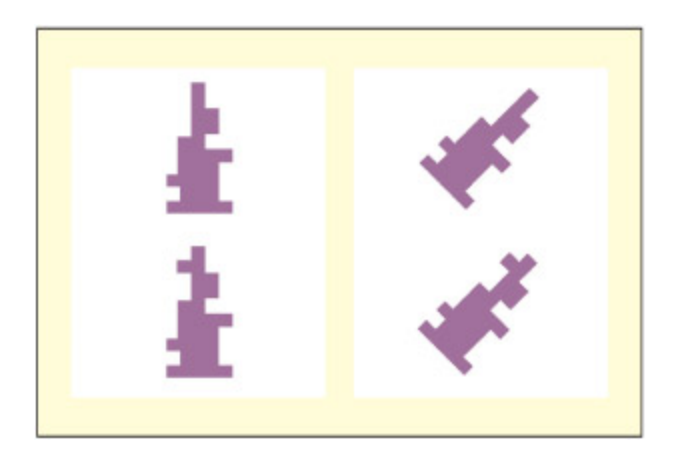
Look at the figures to the right (from Robertson, 2004). Note how the patient has aempted to draw all of the objects in the room (including those on the le) but has distorted or omied the le parts of the objects. Similarly, the patient has failed to find the As on the le side of the two columns of leers
even though the right side of the le column is further lewards than the le side of the right column. is patient would probably be classed as having object-based neglect.

📊 그림 설명
객체 기반 좌표와 환경 기반 좌표가 대립하는 실험 자극을 보여준다. Driver와 Halligan(1991)의 과제에서 두 무의미 물체의 차이가 물체의 왼쪽에 있지만 공간적으로는 오른쪽에 위치하는 기울어진 조건을 사용한다. 환자가 이 차이를 발견하지 못하는 것은 무시가 물체 중심 좌표에서 작동함을 보여준다.
Are these objects the same or different? e critical difference lies on the le side of the object but, in the slanted condition, on the right side of space.
e object in question may be more dynamically defined according to the current spatial reference frame being aended. Driver and Halligan (1991) devised a task that pied object-based coordinates with environmentally based ones. e task was to judge whether two meaningless objects were the same or not. On some occasions, the critical difference was on the le side of the object but on the right side of space, and the patient did indeed fail to spot su differences.
Wrien words are an interesting class of object, because they have an inherent le to right order of leers. Patients with le object-based neglect may make leer substitution errors in reading words and nonwords (e.g. reading “home” as “come”), whereas patients with space-based (or between object) neglect may read individual words correctly but fail to read whole words on the le of a page. In one unusual case, NG, the patient made neglect errors in reading words that were printed normally but also made identical errors when the words were printed vertically, printed in mirror image (so that the neglected part of the word was on the opposite side of space) and even when the leers were dictated aloud, one by one
(Caramazza & Hillis, 1990a). is strongly suggests that it is the internal object frame that is neglected.
Neglect within objects is linked to brain damage in different regions than that associated with neglect of egocentric space; in particular, it seems to be linked to ventral stream lesions including to the white maer (Chelacz et al., 2012). is raises the interesting possibility that this form of neglect represents a disconnection between object-based perceptual representations and more general meanisms of aention.
Evaluation
Although the cardinal symptom of neglect is a la of awareness of perceptual stimuli, neglect is best aracterized as a disorder of aention rather than perception. is is because it tends to be multi-sensory in nature, the deficit is more pronounced when demands on aention are high (e.g. voluntary orienting, presence of competing stimuli), and there is evidence that neglected stimuli are perceived (albeit unconsciously and perhaps less detailed). However, neglect is a heterogeneous disorder and this may reflect the different ways in whi space is represented in the brain. Basic aention processes (involving competition and selection) may operate across different spatial reference frames giving rise to the different aracteristics of neglect.
Summary and Key Points of the Chapter
Summary
이 섹션에서는 주의(attention)가 정보 선택을 통해 감각 과부하를 방지하는 동적인 시스템으로, 상향식(top-down, 작업 관련)과 하향식(bottom-up, 감각 기반)의 상호작용을 통해 여러 수준(인식, 의미, 반응 기반)에서 선택이 이루어진다는 핵심 개념을 정리한다. 두정엽(parietal lobes)은 감각 기반의 공간 맵(예: 망막 중심 좌표)을 자기 중심(egocentric) 공간 맵으로 변환하며, 이 맵은 하향식 또는 상향식 제약에 따라 주요 특징(salient features)을 강조하는 희소 코드로 구성된다. 하향식 외부 자극(exogenous cues)에 따른 주의 지향은 시선 움직임 준비와 관련된 메커니즘과 연결되며, 집중된 자극(attended)은 해당 자극을 인식하는 뇌 영역(예: 시각 하부 유도 경로)과 전두-두정엽 네트워크(frontoparietal network)에서 더 높은 활성화를 유발한다. 이 네트워크는 일반적으로 의식적 인식(conscious awareness)과 관련된다. 두정엽 내부의 다양한 메커니즘(예: 후두두정엽 vs. 두정엽, 좌우 반구 차이)이 존재하지만, 이들이 어떻게 상호작용하는지는 명확하지 않다. 또한, 무시증(neglect) 연구는 공간이 뇌 내 여러 수준에서 표현됨을 입증하며, 이는 주의와 인식, 의식 간의 복잡한 관계를 반영한다.
-
Aention is the process by whi certain information is selected for further processing and optimizes efficiency by preventing sensory overload.
-
is is a dynamic system in whi there is an interaction between top-down (task relevant) and boom-up (sensory driven) influences, and in whi selection can operate at multiple levels (perceptual, semantic, response-based).
-
e parietal lobes may transform sensory-based maps of space (e.g. retinocentric coordinates) into various egocentric (viewercentered) maps of space. ese maps contain a sparse code of the perceptual environment in whi salient features predominate (either due to boom-up or top-down constraints).
-
e orienting of aention (at least from boom-up, exogenous cues) taps meanisms involved in preparing eye movements.
-
Aended relative to unaended stimuli are associated with greater activity in the neural system involved in perceiving that stimulus (e.g. visual ventral stream) and with activity in a frontoparietal network. e laer is normally linked to conscious awareness of perceptual stimuli.
-
ere is evidence for different aention-related meanisms in the parietal lobes (e.g. contrasting posterior parietal versus temporoparietal; or le and right hemispheres) although it is less clear how these different meanisms normally operate together.
-
Studies of neglect have been important for establishing that space is represented at several different levels within the brain.
Example Essay Questions
Summary
이 섹션에서는 신경과학의 증거가 인지과학의 주의(attention) 이해에 미친 영향을 중심으로 논의하며, 두정엽(parietal lobes)의 공간적 주의(spatial attention) 기능, salience map(중요성 맵)의 역할, Frontal Eye Field(FEF)와 Lateral Intraparietal Area(LIP)의 신경생리학적 기전 등이 주의의 필터 역할과 의식(awareness) 형성에 기여함을 강조한다. 주의의 공간적 및 비공간적 측면(spatial and non-spatial aspects)을 설명하는 이론으로는 Premotor Theory(전운동기 이론), Biased Competition Theory(편향 경쟁 이론), Feature Integration Theory(특징 통합 이론)가 제시되나, Balint’s syndrome(발린트 증후군)나 무시증(neglect)과 같은 뇌 손상 사례를 통해 이론의 한계가 드러난다. 주의(attention)와 인식(perception), 의식(awareness)의 관계는 bottom-up(하향식) 및 top-down(상향식) 처리의 상호작용을 통해 설명되며, 명시적 주의 이동(overt orienting)과 사케이드(saccade)의 연관성은 FEF와 LIP의 활성화를 통해 구현된다. 뇌 손상 연구는 공간적 주의(spatial attention)의 “where” 경로(dorsal stream)와 두정엽(parietal lobes)의 손상이 시뮬타나고니아(simultanagnosia)나 무시증(neglect)과 같은 인지 장애를 유발함을 밝혀내며, 주의의 신경 기초(neural basis)를 이해하는 데 핵심적인 기여를 했다.
- How has evidence from neuroscience anged the way that cognitive science thinks about aention?
- Can any theory account for spatial and non-spatial aspects of aention?
- What is the relationship between aention, perception, and awareness?
- What is the relationship between orienting aention and moving the eyes?
What have studies of human brain damage contributed to our understanding of aention and its neural basis?

📊 그림 설명
이 장의 핵심 개념을 요약하는 시각적 참고 자료 또는 교재 관련 안내 이미지이다. 주의(attention)의 공간적/비공간적 메커니즘, 두정엽의 역할, 주의 이론(FIT, 편향 경쟁 이론, 전운동 이론), 무시증의 다양한 유형 등 본 장에서 다룬 주요 주제들의 연결 관계를 개괄한다.
Visit the companion website at www.psypress/cw/ward for:
- References to key papers, readings and useful websites
- Videos including interviews with key psyologists Geoff Boynton and Marlene Behrmann, examples and accounts of ange blindness and hemispatial neglect, and a lecture with author Jamie Ward on The Spatial Brain
- Multiple oice questions and interactive flashcards to test your knowledge
Recommended Further Reading
Summary
이 섹션에서는 주의(attention) 관련 주요 참고 자료로 Mangun(2012)의 The neuroscience of attention를 소개하며, 이 책은 분야의 선도 전문가들이 기여한 내용을 담고 있다고 설명한다. 또한 Posner(2011)의 The cognitive neuroscience of attention은 최신 연구 동향을 다루고 있어 고급 주제를 탐구하고자 하는 학생에게 추천되며, Styles(2006)의 The psychology of attention은 주의의 기초 개념을 직설적으로 설명하는 교재로, 무시증(neglect)을 포함하지만 인지 신경과학의 심층적 내용은 다루지 않는다고 강조한다. 이들 참고서는 주의의 이론적 틀과 실증적 연구를 이해하는 데 기초 자료로 활용될 수 있다.
- Mangun, G. R. (2012). The neuroscience of attention. Oxford, UK: Oxford University Press. An excellent set of apters wrien by leading experts in the field.
- Posner, M. I. (2011). The cognitive neuroscience of attention (2nd edition). New York: e Guilford Press. An edited book with apters at the cuing edge of resear. Recommended for students who want to find out about more advanced topics.
- Styles, E. A. (2006). The psychology of attention (2nd edition). Hove, UK: Psyology Press. is book is a good introduction to aention that explains difficult ideas in a straightforward way.
It covers neglect, but otherwise does not focus on cognitive neuroscience findings.