Overview
- 연구 배경: 학습과 기억은 경험을 통해 미래 결과를 예측하고 새로운 상황에 적응하게 하는 진화적 이점을 갖는다. 신경 수준에서 기억은 시냅스 연결의 변화(가소성, plasticity)로 구현되며, 전 뇌가 학습에 기여하지만 영역마다 기여 방식이 다르다. 단어 기억, 시각 객체 기억, 일화 회상 등은 서로 다른 뇌 영역에 의존한다.
- 핵심 방법론:
- **단기 기억(STM)**과 **장기 기억(LTM)**의 구분: STM은 “마음 속에 보유”하는 제한된 용량의 기억, LTM은 저장된 본질적으로 무제한 용량의 기억이다.
- Baddeley & Hitch(1974) 작업 기억 모델: 음운 루프(phonological loop), 시공간 스케치패드(visuospatial sketchpad), 중앙 집행기(central executive), 그리고 후속으로 추가된 일화적 버퍼(episodic buffer)로 구성된다.
- HM 사례 및 기타 기억상실증 환자 연구: 내측 측두엽(MTL) 손상이 선언적 기억에 미치는 영향을 분석한다.
- 단일 세포 기록(O’Keefe, 1976): 해마의 장소 세포(place cells), 내후각 피질의 격자 세포(grid cells)를 발견했다.
- fMRI 연구: 부호화-인출 분석, 친숙성/회상 분리, 출처 모니터링 등을 신경학적으로 규명한다.
- 주요 기여:
- 다중 기억 시스템 관점(Nyberg & Tulving, 1996): 선언적/비선언적, 의미/일화, 절차적 등 LTM의 하위 구분이 신경학적으로 분리될 수 있음을 입증한다.
- 표준 응고화 모델(Squire, 1992): 해마가 시간 제한적 역할을 하며, 응고된 기억은 신피질로 점진적으로 이전된다.
- 다중 흔적 이론(Nadel & Moscovitch, 1997): 해마가 맥락화된 기억의 영구 저장에 관여하며, 의미적 기억으로 변환되는 과정을 설명한다.
- 친숙성-회상 이중 처리 모델(Mandler, 1980; Eichenbaum et al., 2007): 인지 기억이 맥락 의존 회상과 맥락 자유 친숙성으로 분리된다.
- 실험 결과:
- Miller(1956): 인간의 음운 단기 기억 폭은 7±2 항목, 다만 Cowan(2001)은 실제 용량을 약 4개로 추정한다.
- HM 환자(Scoville & Milner, 1957): 양측 MTL 절제 후 심각한 순행성 기억상실, 역행성 손상은 수술 11년 전(16세)까지 거슬러 올라간다.
- PZ 사례(Butters & Cermak, 1986): 자서전 집필 2년 후 기억상실증 발병, 역행성 기억의 시간 기울기(Ribot’s law)를 보여준다.
- London 택시 운전사 연구(Maguire et al., 2000): 우측 해마 부피가 IQ 통제 일반인보다 크며, 근무 기간과 상관관계를 보인다.
- Roediger & McDermott(1995) DRM 패러다임: 의미적으로 관련된 단어 목록 학습 후 제시되지 않은 “수면” 같은 임계 단어를 높은 신뢰도로 잘못 회상한다.
- 의의 및 한계:
- 기억은 단일 시스템이 아니라 여러 하위 시스템의 협력으로 작동하며, 해마-MTL-PFC의 상호작용이 핵심임을 보여준다.
- 다만 응고화의 정확한 기전, 친숙성/회상의 신경 분리 정도, 해마의 역할이 시간 제한적인지에 대한 논쟁이 지속된다.
- 동물 모델에서 발견된 장소 세포가 인간에서는 “정신적 위치”에도 반응하는 등 종간 차이가 존재하며, 인간 적용에 신중함이 요구된다.
📋 목차
대단원 구조
- Chapter 9 The remembering brain — 도입: 가소성(plasticity), 학습과 기억의 진화적 이점
- Short-Term and Working Memory — 단기 기억과 작업 기억
- 2.1 Phonological short-term memory — 음운 단기 기억
- 2.2 Visuo-spatial short-term memory — 시공간 단기 기억
- 2.3 The concept of working memory — 작업 기억 개념
- 2.4 Working memory and the frontal lobes — 작업 기억과 전두엽
- Different Types of Long-Term Memory — 장기 기억의 유형
- Amnesia — 기억상실증
- 4.1 Preserved and impaired memory in amnesia — 기억상실증에서 보존된 기억과 손상된 기억
- 4.2 Accounting for the memory deficits in amnesia — 기억상실증 결손 설명
- Functions of the Hippocampus and Medial Temporal Lobes in Memory — 해마와 내측 측두엽 기능
- 5.1 Consolidation — 응고화
- 5.2 Multiple trace theory — 다중 흔적 이론
- 5.3 Cognitive map theory — 인지 지도 이론
- Theories of Remembering, Knowing, and Forgetting — 회상, 앎, 망각의 이론
- 6.1 Recall versus recognition and familiarity versus recollection — 회상-인지, 친숙성-기억의 구분
- 6.2 Why do we forget things? — 왜 망각하는가
- 6.3 Memory distortions and false memories — 기억 왜곡과 거짓 기억
- The Role of the Prefrontal Cortex in Long-Term Memory — 장기 기억에서 전전두피질의 역할
- 7.1 Memory encoding — 기억 부호화
- 7.2 Monitoring and memory retrieval — 모니터링과 기억 인출
- 7.3 Experiential states — 경험적 상태
- 7.4 Source monitoring — 출처 모니터링
- 7.5 Memory for temporal context — 시간 맥락 기억
Chapter 9 The remembering brain
Summary
학습과 기억은 경험을 통한 예측·적응 능력을 제공하며, 뇌의 가소성(plasticity)에 기반한 시냅스 연결 변화로 구현된다. 전 뇌가 학습에 기여하지만 영역마다 기여 방식이 달라, 단어·시각 객체·일화에 특화된 영역이 존재한다. 본 장은 단기/작업 기억, 장기 기억의 유형, 기억상실증, 해마 기능, 회상·앎·망각 이론, 전전두피질의 역할 순으로 다룬다.
The ability to learn and remember has several evolutionary advantages. It enables one to predict future outcomes on the basis of experience and adapt to new situations. One can learn to avoid situations previously associated with threat, or to return to locations where food has previously been found. Plasticity refers to the brain’s ability to change as a result of experience and, while greatest during childhood, plasticity persists throughout life. At a neural level, plasticity occurs by changing the pattern of synaptic connectivity between neurons. Given that the whole brain is capable of such changes, one could regard learning and memory to be a feature of the brain as a whole rather than a specialized module or faculty. Indeed there are no instances in which memory is completely lost or abolished. Even amnesic patients can learn and remember certain things. Although the whole brain may make contributions to learning and memory, it is crucial to recognize that different regions contribute in different ways.
Key Terms
Plasticity
The brain’s ability to change as a result of experience.
**가소성(Plasticity)**은 경험의 결과로 뇌가 변화하는 능력을 의미한다. 신경 수준에서는 시냅스 연결 패턴이 변화하는 형태로 나타나며, 아동기에 가장 크고 일생에 걸쳐 지속된다. 학습과 기억의 신경학적 기반이 된다.
Short-term memory
Memory for information currently held “in mind”; it has limited capacity.
**단기 기억(Short-term memory, STM)**은 현재 “마음 속에” 보유 중인 정보의 기억으로, 용량이 제한적이다. 음운 단기 기억과 시공간 단기 기억 등 하위 시스템으로 나뉘며, 본 장 후반에서 자세히 다룬다.
Long-term memory
Memory for information that is stored but need not be consciously accessible; it has an essentially unlimited capacity.
**장기 기억(Long-term memory, LTM)**은 저장된 정보로, 현재 의식적으로 접근하지 않아도 되는 기억이다. 뇌의 내재적 한계 안에서 본질적으로 무제한 용량을 갖는다. 시간 지속성이 아니라 저장 여부가 STM과의 구분 기준이다.
주의
STM과 LTM은 시간(몇 시간/며칠/몇 년)이 아닌 저장 여부와 의식적 접근성으로 구분된다. 단기 기억은 “지금 마음 속에 떠올린” 정보이고, 장기 기억은 “저장되어 있으나 의식적으로 접근하지 않을 수도 있는” 정보다. 몇 시간 전, 며칠 전, 수년 전 일은 모두 LTM에 속한다.
Short-Term and Working Memory
Summary
**단기 기억(STM)**과 **장기 기억(LTM)**의 핵심 구분은 시간이 아닌 저장 여부와 의식적 접근성이다. STM은 마음 속에 보유 중인 제한된 용량의 정보를 가리키며, LTM은 본질적으로 무제한 용량을 갖는다. 음운/시공간 STM, 작업 기억(working memory) 개념, 그리고 전전두피질의 유지·조작 기능을 다룬다.
The labels “short-term” and “long-term” appear to suggest that there could be different types of memory evoked for different periods of time with, perhaps, separate stores for things that happened a few days ago relative to several years ago. This is a popular misconception. It is not how psychologists distinguish between short- and long-term memory. Short-term memory (STM) is defined as memory for information currently held “in mind” and has limited capacity. Long-term memory (LTM) refers to information that is stored; it need not be presently accessed or even consciously accessible. The long-term store is considered to have essentially unlimited capacity within the inherent confounds of the brain.
Phonological short-term memory
Summary
음운 단기 기억의 용량 한계는 숫자 폭(digit span) 과제로 측정되며, **Miller(1956)**는 7±2 항목(5~9개)의 폭을 제시했고 **Cowan(2001)**은 실제 한계를 약 4개로 추정했다. 폭은 단어가 다음절일 때, 음운적으로 유사할 때, 그리고 조음 억제(articulatory suppression) 조건에서 감소한다. Baddeley는 이를 음운 저장소와 하위 발성 리허설 메커니즘의 두 구성요소로 설명하며, 둘을 합쳐 음운 루프(phonological loop)라 부른다.
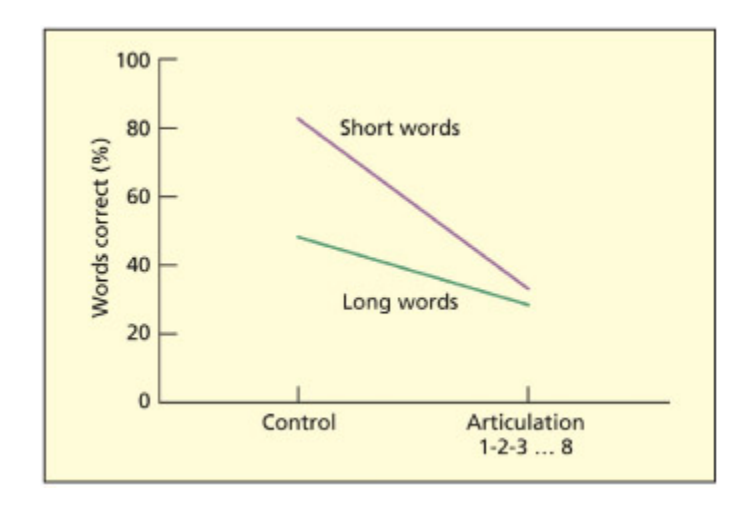
Short-term memory is often used as an abbreviated term for phonological short-term memory or verbal working memory. The capacity limitation of phonological short-term memory is typically investigated with span tasks, in which participants are read a sequence of, say, digits, and must repeat them back immediately or after brief retention. Miller (1956) argued that humans have a span of seven items plus or minus two (i.e. between five and nine items). He argued that the seven items are meaningful “chunks” of information rather than words or syllables. However, others have argued that chunking is relying on long-term memory to recode information and that the true capacity limitation is lower, around four (Cowan, 2001). Span length is lower when lists of words are polysyllabic (Baddeley et al., 1975) or when they are phonologically similar (Baddeley, 1966).
📊 그림 설명
짧은 단어(short words)와 긴 단어(long words)에 대한 단어 목록 회상률을 보여주는 그래프이다(Baddeley et al., 1975). 통제 조건에서는 짧은 단어가 약 80%로 가장 잘 회상되고 긴 단어는 약 50% 수준이다. 조음 억제(articulation 1-2-3 … 8) 조건에서는 양쪽 모두 약 30%로 떨어지며, 단어 길이 효과도 소멸된다. 이는 음운 루프의 하위 발성 리허설 메커니즘이 단기 기억 유지에 결정적임을 시사한다.
Key Terms
Articulatory suppression
Silently mouthing words while performing some other task (typically a memory task).
**조음 억제(Articulatory suppression)**는 다른 과제를 수행하는 동안 단어를 무성으로 입모양만 내는 조작이다. 예를 들어 목록 부호화 중 “the, the, the…”를 반복하면 폭이 감소한다(Baddeley et al., 1984). 음운 루프의 리허설 메커니즘을 방해하여 저장된 표상의 활성화 유지를 차단한다.
Visuo-spatial short-term memory
Summary
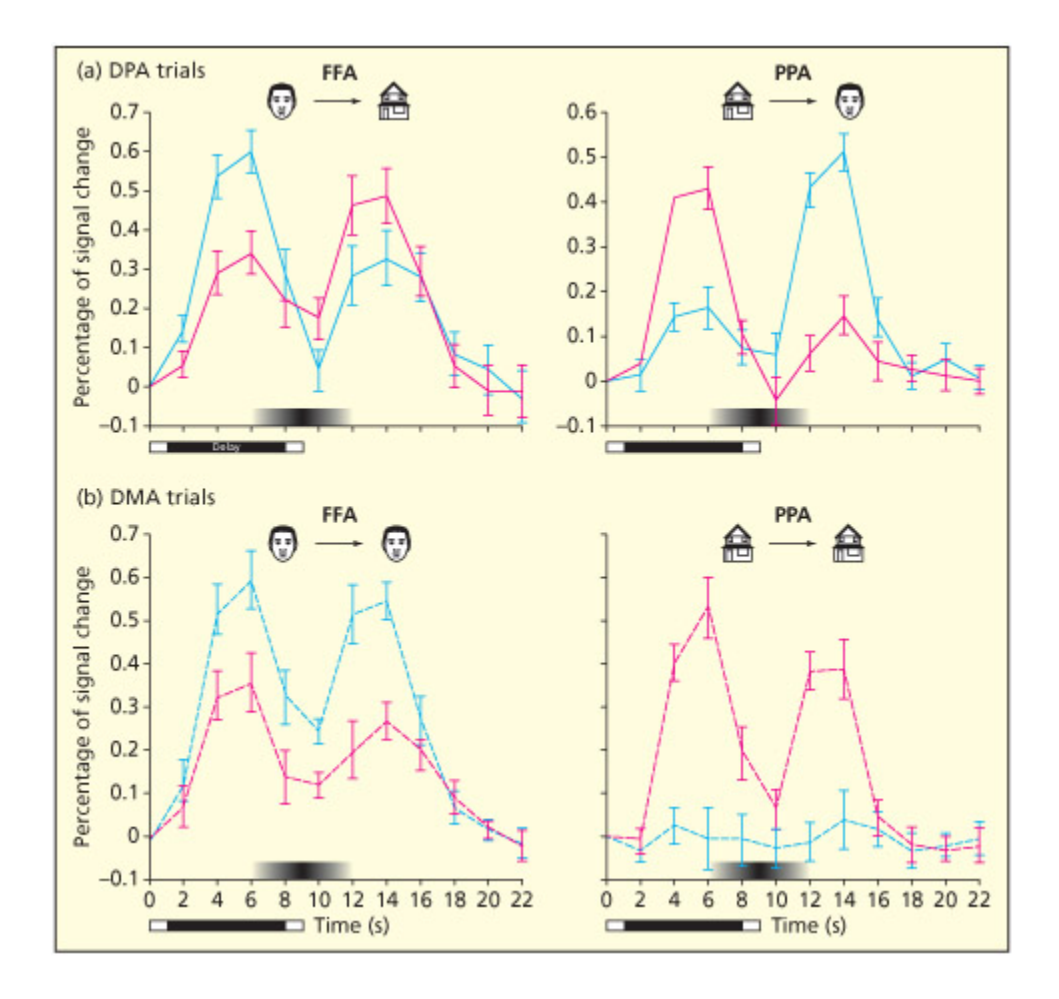
시공간 단기 기억은 시공간 정보에 대한 제한된 용량의 시스템으로(Logie, 1995), Corsi blocks 과제에서 일반적으로 약 5개의 시퀀스가 유지된다(Della Sala et al., 1999). **Luck & Vogel(1997)**은 색상·선 방향 배열에서 약 4개 객체가 한계이며, 객체 내 특징 결합(예: 색+방향)을 늘려도 용량은 유지되어 한계가 시각적 특징이 아니라 객체/위치에 있음을 보였다. fMRI 연구는 객체 보유 중 복측 시각 영역(FFA, PPA)의 활동이 지속됨을 확인했다(Ranganath et al., 2004).
It has been proposed that there is a limited-capacity short-term memory system for visuo-spatial information that is analogous to the one involving phonological information described above (Logie, 1995). One simple test, often termed the “Corsi blocks,” involves tapping a sequence of squares/blocks that the participant must then reproduce. Typical performance on such a task is to accurately maintain sequences of up to five (Della Sala et al., 1999). Luck and Vogel (1997) displayed arrays of different colored squares or arrays of different line orientations. In both cases, memory deteriorates when holding in mind more than four items. Even though conjunctions involve holding twice as many features in mind, memory performance was not halved but remained constant; that is, around four feature conjunctions could be remembered.
📊 그림 설명
Ranganath et al.(2004)의 fMRI 실험 결과로, 시각 자극(얼굴 또는 집)을 1초간 본 뒤 8초 지연 후 재인식하거나(DMS, 지연된 표본 일치) 연합된 항목을 떠올리는(DPA, 지연된 쌍 연합) 동안의 신호 변화를 보여준다. **FFA(방추형 얼굴 영역)**는 얼굴을 마음 속에 보유할 때, **PPA(해마방회 장소 영역)**는 장소를 보유할 때 더 큰 BOLD 반응을 나타낸다. 지연 기간(1
8초) 동안의 활동이 612초 사이에 BOLD 신호로 발현된다.
The concept of working memory
Summary
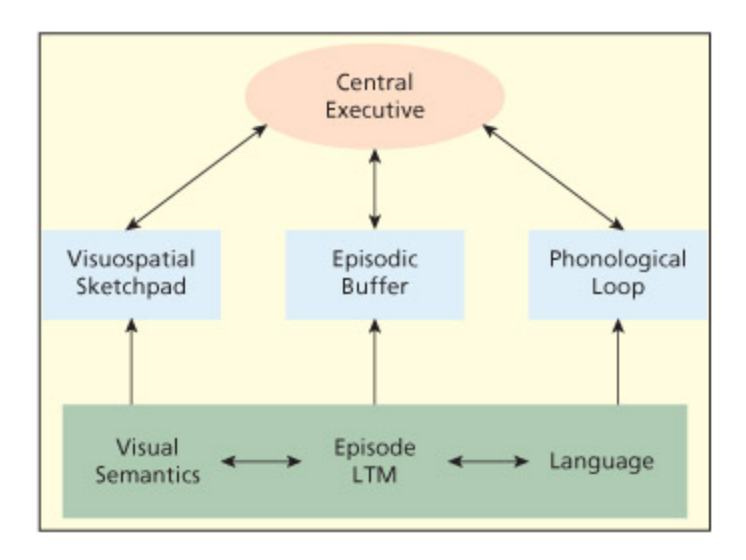
**작업 기억(Working memory)**은 단기 기억의 확장 개념으로, 정보의 단순 보유뿐 아니라 추론·이해 등 인지 전반에서의 활용을 강조한다. Baddeley & Hitch(1974) 모델은 음운 루프, 시공간 스케치패드, 중앙 집행기 세 요소로 구성되며, 후속으로 일화 LTM과 인터페이스하는 일화적 버퍼(episodic buffer)가 추가되었다(Baddeley, 2000). 대안 관점(Cowan, 2001; D’Esposito, 2007)은 별도 STM 저장소를 가정하지 않고 LTM의 일시적 활성화로 작업 기억을 설명한다.
The concept of working memory is essentially an extension of the one already described for short-term memory. The key difference is that working memory emphasizes a wider role in cognition (reasoning, comprehension, etc.), whereas short-term memory is often taken to imply a more passive retention of material. One of the most influential models is that proposed by Baddeley and Hitch (1974; Baddeley, 1986). This original model consists of three components. The phonological consists of a limited-capacity phonological store, together with a mechanism for refreshing it (based on subvocal rehearsal). A comparable system is postulated in the visual domain and termed the visuospatial sketchpad. Collectively, the phonological loop and visuospatial sketchpad are considered to be “slave systems.” They can be contrasted with the third component: the central executive. The central executive coordinates the slave systems, and cognition in general, specifying task goals, initiating and terminating cognitive routines and so on.
📊 그림 설명
Baddeley(2000)의 개정된 작업 기억 모델 도식이다. 상단의 **중앙 집행기(Central Executive)**가 세 개의 단기 시스템(파란색)인 시공간 스케치패드(Visuospatial Sketchpad), 일화적 버퍼(Episodic Buffer), **음운 루프(Phonological Loop)**를 조율한다. 하단에는 이들이 인터페이스하는 장기 기억(녹색)인 시각 의미(Visual Semantics), 일화 LTM(Episode LTM), **언어(Language)**가 있다.
Key Terms
Working memory
A system for the temporary storage and manipulation of information.
**작업 기억(Working memory)**은 정보의 일시적 저장과 조작을 위한 시스템이다. 단순 보유에 그치는 단기 기억과 달리 추론·이해 등 인지 전반과 결합되며, 전전두피질의 역할과 밀접한 관련이 있다. Baddeley 모델에서는 중앙 집행기가 음운 루프, 시공간 스케치패드, 일화적 버퍼를 조율한다.
Working memory and the frontal lobes
Summary
전전두피질(PFC)은 작업 기억의 유지와 조작에 결정적 역할을 하며, 정보 저장 자체는 주로 후방 피질에 위치한다. **Funahashi et al.(1989)**의 원숭이 단일 세포 기록은 배외측 PFC 뉴런이 지연 기간 동안 선택적으로 발화하여 위치 정보를 보유함을 보여주었다. **Goldman-Rakic(1996)**은 배측/복측 PFC가 공간/객체 작업 기억으로 분화된다고 주장한 반면, **Petrides(1996, 2000, 2005)**는 처리 유형(유지 vs. 조작)에 따라 분화되는 위계적 모델을 제안한다. 자기 순서 가리키기 과제(self-ordered pointing task; Petrides & Milner, 1982)에서 전전두엽 손상 환자는 손상을 보인다.
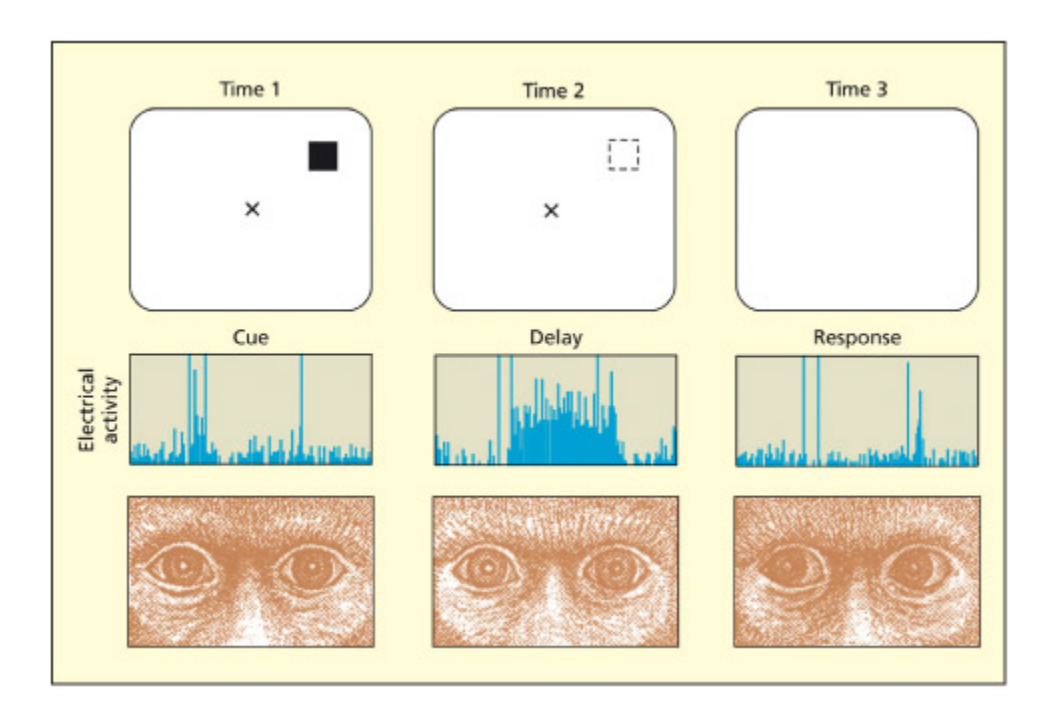
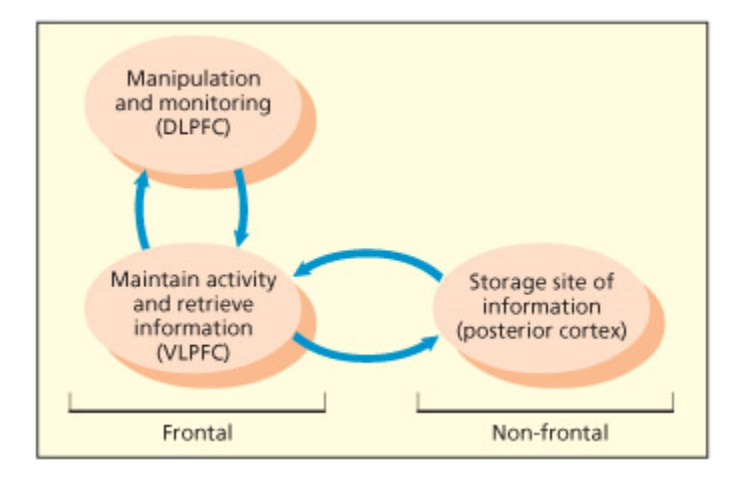
The prefrontal cortex within the frontal lobes is widely recognized as playing a crucial role in working memory. Most models tend to assume that the main storage site of information is not within the frontal lobes themselves but in the posterior cortex, and that the function of the prefrontal cortex is to keep this information active and/or manipulate the active information according to current goals. Single-cell recordings from monkeys show that some dorsolateral prefrontal neurons respond selectively during the delay period, suggesting that this is the neural mechanism for holding locations in mind (Funahashi et al., 1989).
📊 그림 설명
원숭이의 배외측 전전두피질에서 단일 세포 기록 결과를 보여주는 도식이다(Goldman-Rakic, 1992). 세 시점(Time 1: 큐 표적, Time 2: 지연, Time 3: 반응)에서 (a) 표적 위치 공부, (b) 지연 중 “마음 속” 보유, (c) 큐 제거 후 해당 위치로 시선 이동에 서로 다른 뉴런이 반응한다. 지연 기간 동안 지속되는 전기적 활동이 작업 기억의 신경 기전임을 시사한다.
📊 그림 설명
작업 기억의 위계적 모델 도식이다. **복외측 전전두피질(VLPFC)**은 정보 활성화·유지·인출을 담당하고, **배외측 전전두피질(DLPFC)**은 정보 조작·모니터링을 담당하며, 정보 저장은 후방 피질(Non-frontal)에 위치한다. Petrides의 위계 모델을 시각화한다.
Key Terms
Self-ordered pointing task
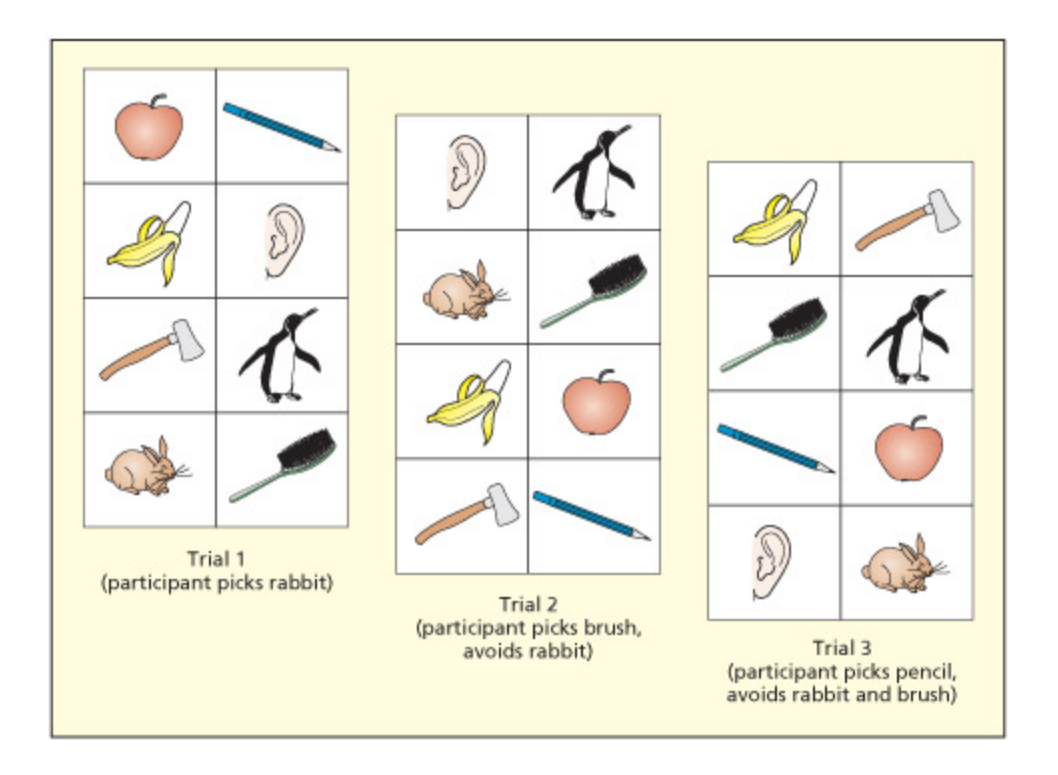
A task in which participants must point to a new object on each trial and thus maintain a working memory for previously selected items.
**자기 순서 가리키기 과제(Self-ordered pointing task)**는 매 시행마다 새로운 객체를 가리켜야 하며, 이를 위해 이전에 선택한 항목을 작업 기억에 유지해야 하는 과제다. **Petrides & Milner(1982)**가 도입했으며, 전전두엽 손상 환자가 손상을 보인다. 동물 연구에서 핵심 영역은 배외측 전전두피질임이 밝혀졌다(Petrides, 1995).
📊 그림 설명
Petrides & Milner(1982) 자기 순서 가리키기 과제의 예시이다. 시행 1에서 참가자는 토끼를 선택하고, 시행 2에서는 토끼를 피해 솔을 선택하며, 시행 3에서는 토끼와 솔을 모두 피해 연필을 선택한다. 매 시행마다 이전 선택의 온라인 기록을 유지해야 한다.
시험 팁
Goldman-Rakic vs. Petrides 모델을 구분하자. Goldman-Rakic: 배외측 = 공간 작업 기억, 복외측 = 객체 작업 기억(내용 기반 분화). Petrides: 복외측 = 유지·인출, 배외측 = 조작·모니터링(처리 기반 위계). Rao et al.(1997)의 신경세포가 과제에 따라 객체→위치로 반응 변화한다는 결과는 Petrides 모델을 지지한다.
Different Types of Long-Term Memory
Summary
장기 기억은 단기 기억과 마찬가지로 여러 하위 구성요소로 나뉜다(다중 기억 시스템 접근; Nyberg & Tulving, 1996). 가장 기본적 구분은 선언적/비선언적(Squire et al., 1993) 또는 명시적/암묵적이며, 의식적 접근 가능성에 따라 나뉜다. **Tulving(1972)**은 선언적 기억을 의미 기억(개념·사실 지식)과 일화 기억(자신 삶의 특정 사건)으로 구분했다. 비선언적 기억에는 절차적 기억(기저핵), 지각 표상 시스템(점화), 고전적 조건화, 비연합 학습이 포함된다.
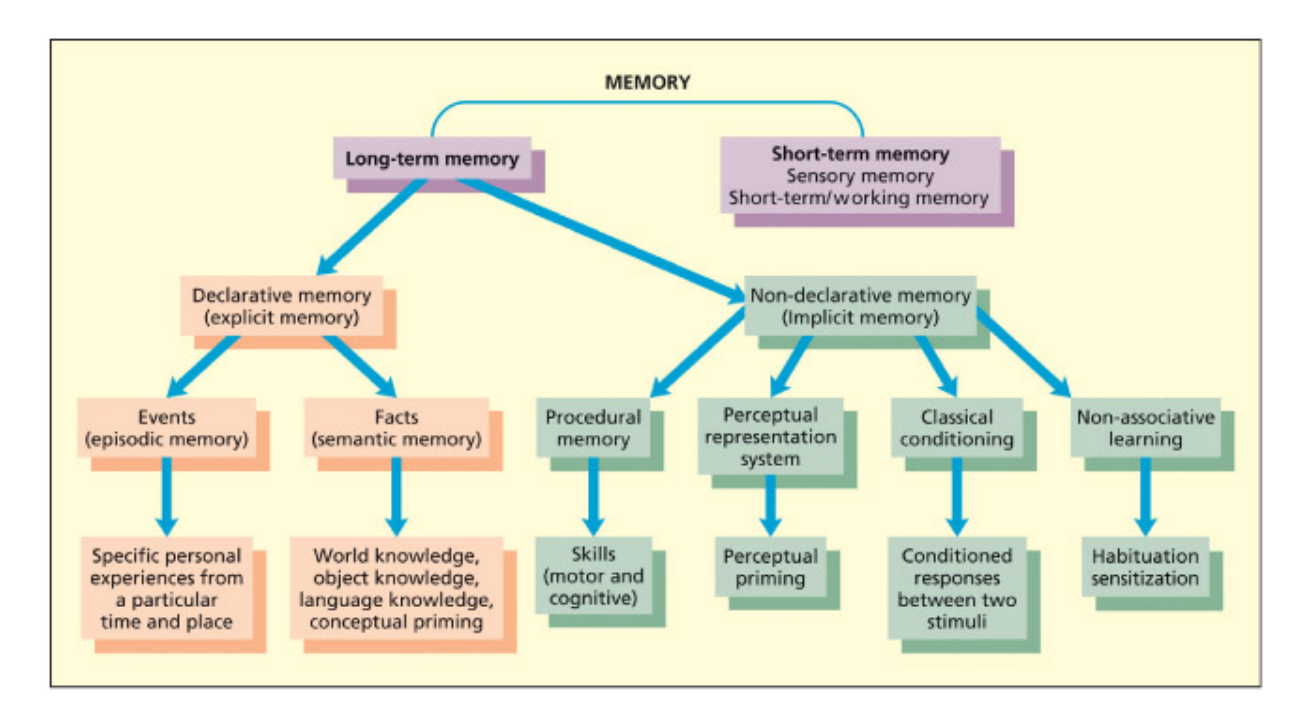
Just as short-term memory may have several components (e.g. visuo-spatial, phonological), long-term memory may be further subdivided into different components. This has been termed the multiple memory systems approach (Nyberg & Tulving, 1996). One distinction that can be made is whether the memories are consciously accessible or not; termed declarative memory and non-declarative memory, respectively (Squire et al., 1993) or, alternatively, explicit memory and implicit memory, respectively.
Procedural memory refers to memory for skills such as riding a bike. It is not consciously accessible in the sense that the contents of the memory are not amenable to verbal report. Evidence suggests that the basal ganglia are important for the learning of procedural skills and habits (Packard & Knowlton, 2002). Perceptual representation systems are those used for perceiving sounds, words, objects, and so on (Schacter, 1987). Evidence for perceptual learning comes from priming studies.
Within declarative or explicit memory, Tulving (1972) has proposed the influential distinction between episodic and semantic memory. Semantic memory is conceptually based knowledge about the world, including knowledge of people, places, the meaning of objects and words. By contrast, episodic memory refers to memory of specific events in one’s own life. For example, knowing that Paris is the capital of France is semantic memory, but remembering a visit to Paris or remembering being taught this fact is episodic memory.
Key Terms
Declarative memory
Memories that can be consciously accessed and, hence, can typically be declared.
**선언적 기억(Declarative memory)**은 의식적으로 접근 가능하여 언어로 진술할 수 있는 기억이다. 명시적 기억(Explicit memory)과 동의어로 사용되며, 의미 기억과 일화 기억을 포함한다. 기억상실증에서 손상되는 주요 시스템이다.
Non-declarative memory
Memories that cannot be consciously accessed (e.g. procedural memory).
**비선언적 기억(Non-declarative memory)**은 의식적으로 접근할 수 없는 기억이다. 암묵적 기억(Implicit memory)이라고도 하며, 절차적 기억, 지각 표상 시스템(점화), 고전적 조건화, 비연합 학습(습관화·민감화)을 포함한다.
Explicit memory
See declarative memory.
**명시적 기억(Explicit memory)**은 선언적 기억의 다른 이름으로, 의식적으로 인출 가능한 기억을 가리킨다.
Implicit memory
See non-declarative memory.
**암묵적 기억(Implicit memory)**은 비선언적 기억의 다른 이름으로, 무의식적으로 작용하는 기억을 가리킨다.
Procedural memory
Memory for skills such as riding a bike.
**절차적 기억(Procedural memory)**은 자전거 타기와 같은 기술에 대한 기억이다. 언어로 보고할 수 없다는 점에서 비선언적이며, 기저핵(basal ganglia)이 학습에 중요한 역할을 한다(Packard & Knowlton, 2002).
Semantic memory
Conceptually based knowledge about the world, including knowledge of people, places, the meaning of objects and words.
**의미 기억(Semantic memory)**은 사람·장소·객체·단어 의미 등 세계에 대한 개념적 지식이다. 문화적으로 공유되는 지식이며, “파리가 프랑스의 수도”라는 사실 같은 일반 지식이 이에 해당한다. 본인에 관한 사실(주소, 배우자 이름 등)은 개인 의미 기억으로 분류된다.
Episodic memory
Memory of specific events in one’s own life.
**일화 기억(Episodic memory)**은 자신 삶의 특정 사건에 대한 기억으로, 시간과 장소가 명시 가능하다. 1인칭 관점(관찰자/참여자로서의 자신)이 포함되며, 자전적 기억(autobiographical memory)으로도 불린다. Tulving(1972)이 도입한 의미/일화 구분은 매우 영향력 있다.
📊 그림 설명
장기 기억의 분류 체계를 보여주는 도식이다(Gazzaniga et al., 2002). 상위에 **장기 기억(Long-term memory)**과 **단기 기억(감각·작업 기억)**이 있고, 장기 기억은 다시 선언적/명시적(사건=일화 기억, 사실=의미 기억)과 비선언적/암묵적(절차적 기억, 지각 표상 시스템, 고전적 조건화, 비연합 학습)으로 나뉜다. 각 하위 시스템의 대표 사례가 함께 표시된다.
주의
의미 기억 vs. 일화 기억을 혼동하지 말 것. 의미는 시공간 맥락이 없는 개념적·사실적 지식(예: “파리는 프랑스의 수도”)이고, 일화는 시공간이 특정된 개인적 사건의 회상(예: “지난 여름 파리 방문”)이다. 본인 관련 사실(주소, 배우자 이름 등)은 의미 기억의 하위인 개인 의미 기억이다.
Amnesia
Summary
**기억상실증(Amnesia)**의 가장 유명한 사례는 HM(Henry Molaison, 1926-2008)으로, 1953년 간질 발작 치료를 위해 양측 내측 측두엽(medial temporal lobes, MTL), 해마 포함 절제 수술을 받았다(Scoville & Milner, 1957). 그 결과 심각한 순행성 기억상실과 수술 11년 전(16세)까지 거슬러 올라가는 역행성 손상을 보였다(Sagar et al., 1985). HM의 IQ, 단기 기억, 절차적 기억은 보존되었다. 기억상실증은 뇌졸중, 두부 손상, 바이러스 감염(특히 단순포진 뇌염), 장기 알코올중독에 의한 Korsakoff 증후군 등으로도 발생한다.
One of the most famous patients in the neuropsychological literature is HM (Corkin, 2002). HM began to experience epileptic seizures at the age of ten and, by the time of leaving high school, his quality of life had deteriorated to a point where surgeons and family decided to intervene surgically. The procedure involved removing the medial temporal lobes, including the hippocampus, bilaterally (Scoville & Milner, 1957). What the surgeons did not foresee was that HM would develop one of the most profound amnesias on record. Several decades after the operation, it was observed that HM “does not know where he lives, who cares for him, or where he ate his last meal. His guesses as to the current year may be off by as much as 43 years… . In 1982 he did not recognize a picture of himself that had been taken on his fortieth birthday in 1966” (Corkin, 1984, p. 255). On his death, HM was identified as Henry Molaison (1926-2008) and his brain has been preserved in histological sections.
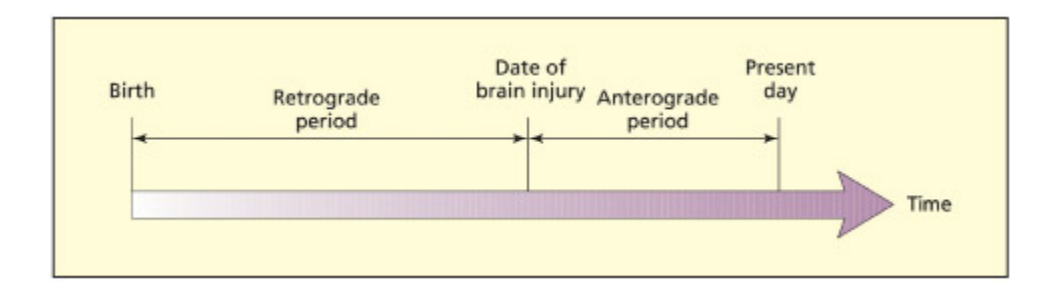
Global amnesics have memory problems both in terms of learning new information (anterograde memory impairment) and remembering information prior to their brain damage (retrograde memory impairment). HM’s retrograde deficit extends back to age 16 (11 years before his surgery) and his anterograde deficit is extremely severe (Sagar et al., 1985).
Key Terms
Anterograde memory
Memory for events that have occurred after brain damage.
**순행성 기억(Anterograde memory)**은 뇌 손상 이후 발생한 사건에 대한 기억을 가리킨다. 기억상실증에서 가장 심하게 손상되는 영역으로, HM은 수술 이후 새로운 사실·일화를 거의 학습하지 못했다. 새로운 정보 학습 능력의 손상을 의미한다.
Retrograde memory
Memory for events that occurred before brain damage.
**역행성 기억(Retrograde memory)**은 뇌 손상 이전의 사건에 대한 기억이다. 손상 정도는 환자마다 다양하며, HM의 경우 수술 11년 전(16세)까지 거슬러 올라간다. 일반적으로 시간 기울기(Ribot’s law)에 따라 오래된 기억일수록 더 잘 보존된다.
Korsakoff's syndrome
Amnesia arising from long-term alcoholism.
Korsakoff 증후군은 장기 알코올중독으로 인한 기억상실증으로, 티아민 결핍과 관련될 수 있다. 중앙선 간뇌(midline diencephalon), 특히 배내측 시상과 유두체(mammillary bodies)의 병리와 관련된다(Parkin & Leng, 1993).
📊 그림 설명
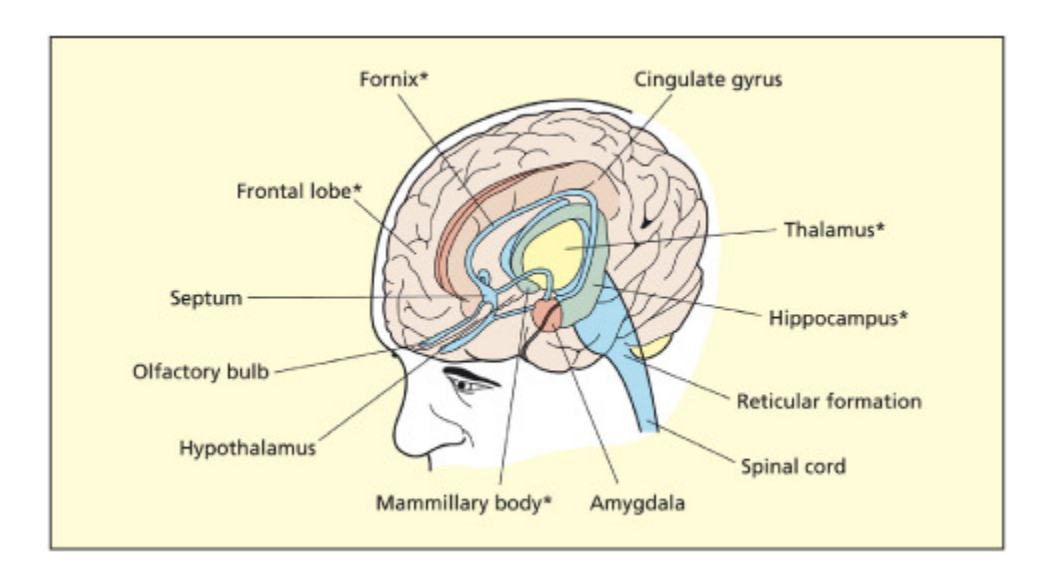
내측 측두엽과 주변 구조의 해부도이다(Parkin, 2001). 별표(*)로 표시된 영역(원개=fornix, 전두엽=frontal lobe, 시상=thalamus, 해마=hippocampus, 유두체=mammillary body)의 손상이 기억상실증 증후군을 일으킬 수 있다. 그 외 대상회(cingulate gyrus), 후각망울(olfactory bulb), 시상하부(hypothalamus), 편도체(amygdala) 등이 함께 표시된다.
📊 그림 설명
기억상실증의 시간적 구조를 보여주는 도식이다. 출생부터 뇌 손상 시점까지의 역행성 기간(Retrograde period), 손상 시점부터 현재까지의 **순행성 기간(Anterograde period)**으로 구분된다. 일반적으로 순행성 손상이 심각하고 역행성 손상은 변동성이 더 크다(음영의 진하기가 손상 정도를 표시).
Preserved and impaired memory in amnesia
Summary
기억상실증은 일화 기억과 의미 기억 모두 손상되며, 단기 기억과 절차적·지각적 암묵 기억은 보존된다. HM은 거울 그림(mirror drawing) 학습 같은 절차적 기술을 유지했고(Milner, 1966), **Knowlton et al.(1994, 1996)**의 날씨 예측 게임에서 기억상실 환자는 정상 암묵 학습을 보였지만 파킨슨 환자는 학습에 실패해 이중 해리를 보였다. 의미 기억은 새 어휘 학습이 일반적으로 손상되지만, 일부 환자(Hirst et al., 1988)는 새로운 언어(이탈리아어)를 배운 사례도 보고된다.
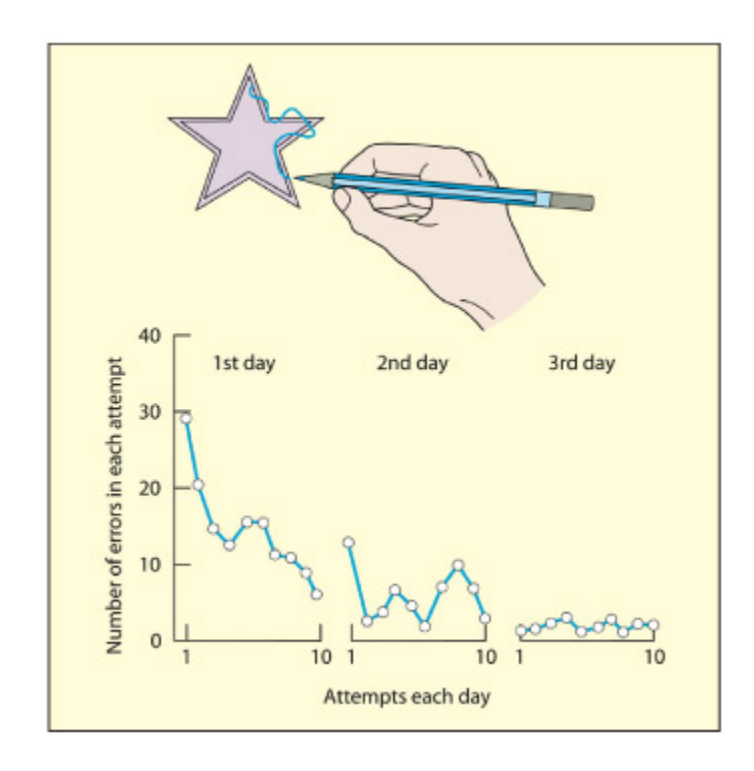
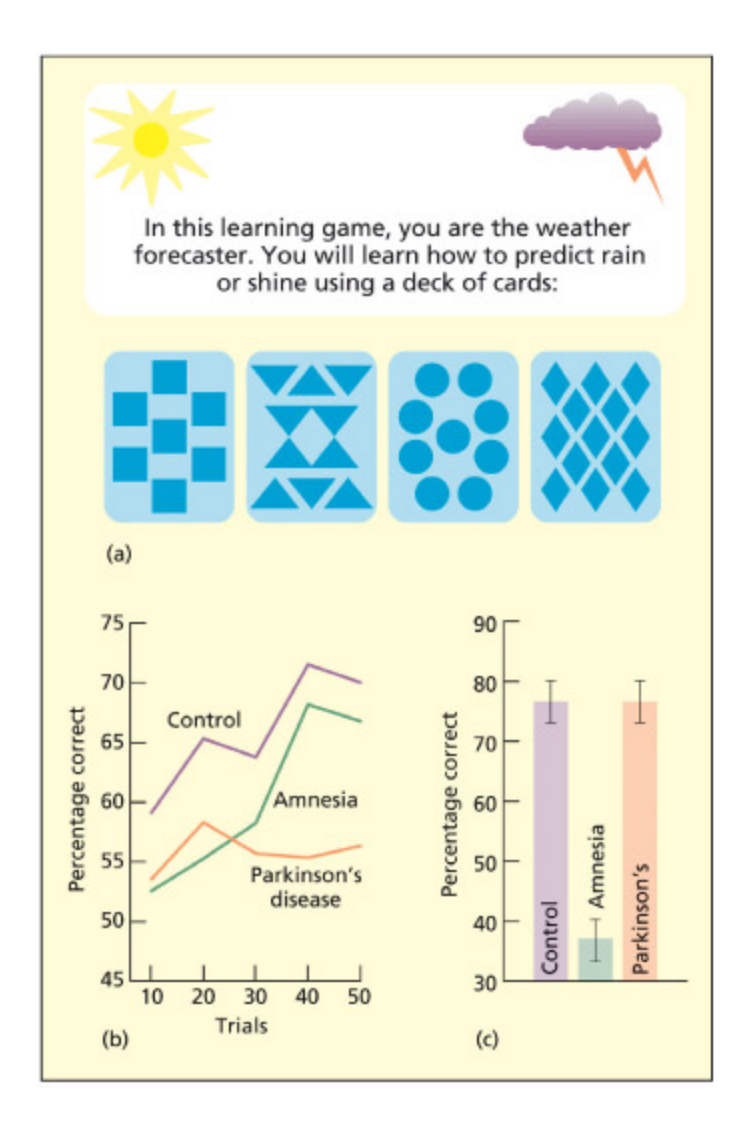
When given new tasks requiring visuomotor coordination, such as drawing around a shape when the hand is viewed in a mirror, then performance is initially poor but improves with practice. The same is true of amnesic patients (Milner, 1966). Thus, procedural knowledge appears to be spared. The same is true of other implicit memory tasks that do not have a strong motor component. Knowlton et al. (1994) devised a weather prediction game in which geometric shapes predict weather patterns with a partial degree of certainty (60-85 percent predictive). Participants often feel that they are guessing although they exhibit learning over 50-100 trials. Amnesic patients also show normal learning despite poor declarative memory for the stimuli, whereas patients with Parkinson’s disease show the reverse dissociation consistent with a role of the basal ganglia in learning of habitual responses (Knowlton et al., 1996).

📊 그림 설명
HM의 거울 그림 학습 데이터를 보여준다(Blakemore, 1977). 3일간(1st-3rd day)의 시행에서 오류 수가 1일차 약 30회에서 3일차 약 5회 이하로 점진적으로 감소한다. HM은 이전에 과제를 수행한 기억이 없음에도 절차적 기술 학습은 정상적으로 이루어졌다.
📊 그림 설명
Knowlton et al.(1996)의 날씨 예측 게임 결과이다. (a) 네 종류의 큐 카드가 다양한 조합으로 제시되고 참가자는 비 또는 맑음을 예측한다. (b) 50회 반복 노출 후 통제군과 기억상실 환자는 학습하지만, 파킨슨 환자는 학습하지 못한다. (c) 명시적 기억 검사에서는 기억상실 환자가 부진하나 파킨슨 환자는 정상 수행을 보여 이중 해리가 나타난다.
📊 그림 설명
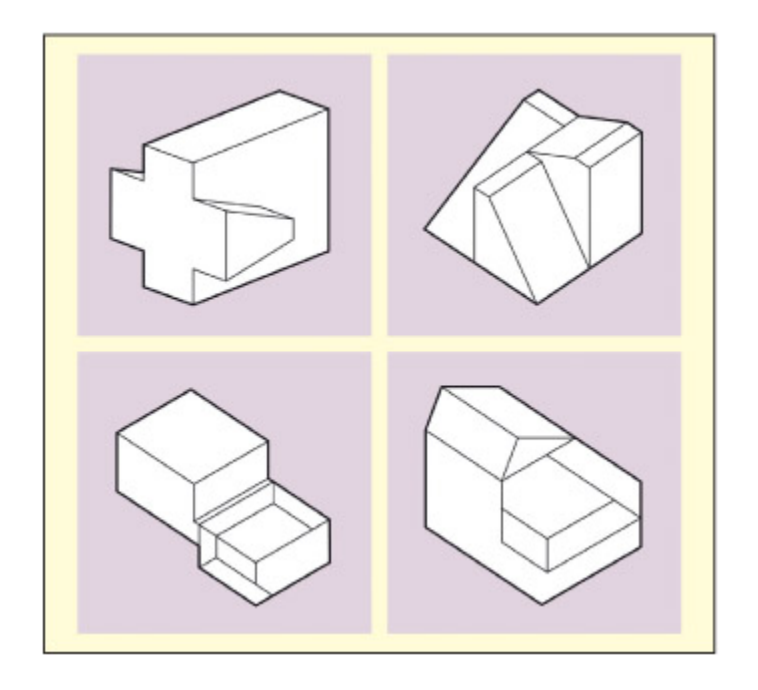
Schacter et al.(1990) 연구에서 사용된 가능/불가능 객체(possible/impossible objects)의 예시이다. 점화 효과는 가능한 객체에서만 나타나며, 이는 점화가 알려진 객체의 지각 저장소를 활용함을 시사한다. 기억상실 환자에서도 정상적으로 나타나는 암묵 기억의 사례이다.
영화 속 기억상실증
2001년 영화 Memento의 주인공 Leonard는 폭행 사건으로 인한 순행성 기억상실 환자로, 새 기억을 형성하지 못한다. 그러나 영화의 묘사에서 그는 자신의 역행성 기억(아내가 살해된 사건 포함)을 유지하며, 단서를 잡으려 펜을 찾는 동안 리허설을 멈추면 단서가 사라지는 작업 기억의 한계도 정확히 보여준다. 다만 영화에서 그가 “단기 기억 문제”라고 묘사하는 것은 부정확하다. The Bourne Identity(2002) 같은 영화는 순수 역행성 기억상실을 보여주지만, 신경학적 원인인지 심인성인지 불분명하다. 영화는 종종 정체성 변화를 보이지만, 신경학적 기억상실에서는 정체성은 보존된다(Klein et al., 2002).
Accounting for the memory deficits in amnesia
Summary
기억상실증은 선언적 기억의 결손으로 가장 잘 설명되며(Squire, 1992), 절차적·지각적 점화·단기 기억은 보존된다. 가장 일반적인 기전적 설명은 응고화(consolidation) 결손이다(Squire, 1992). 응고화는 순간순간의 뇌 활동이 영구적 구조 변화로 전환되는 과정으로, 응고화가 점진적이라면 미완성 기억이 해마 손상 시 사라지는 역행성 손실도 설명할 수 있다. 다른 가설은 해마/MTL이 맥락 단서(Mayes, 1988) 또는 공간 처리(Burgess et al., 2002)에 특화되어 있다고 본다.
To summarize the preceding sections: amnesic patients have impaired episodic memory, typically in both retrograde and anterograde periods. In contrast they have generally spared short-term memory, procedural memory and perceptual priming (a type of implicit memory). Tulving and colleagues (1988) regard amnesia specifically as a difficulty with episodic memory. However, semantic memory is impaired in amnesia including after focal hippocampal lesions, even though it is often less vulnerable to damage than episodic memory (Holdstock et al., 2002; Manns et al., 2003b). As such, Squire and colleagues suggest that amnesia is a deficit in declarative memory (Manns et al., 2003b, Squire, 1992).
Key Terms
Consolidation
The process by which moment-to-moment changes in brain activity are translated into permanent structural changes in the brain.
**응고화(Consolidation)**는 순간순간의 뇌 활동이 영구적 구조 변화(예: 새로운 신경 연결 형성)로 전환되는 과정이다. 응고화가 점진적으로 이루어진다면 해마 손상으로 인한 역행성 기억 손실도 설명 가능하다. 시냅스 응고화(LTP 기반, 1시간 이내)와 시스템 응고화(해마-신피질 간, 수년)로 구분된다(Dudai, 2004).
Functions of the Hippocampus and Medial Temporal Lobes in Memory
Summary
본 절은 해마와 주변 영역이 응고화, 영구 저장, 대규모 공간 기억에서 수행하는 역할을 다룬다. **장기 강화(LTP)**는 1966년 Lømø에 의해 처음 보고된 시냅스 가소성의 기본 기전이다. 시간 기울기(Ribot’s law)는 일생의 초기 기억이 더 잘 보존됨을 보여주며, PZ 사례(Butters & Cermak, 1986)에서 잘 드러난다. 표준 응고화 모델, 다중 흔적 이론, 인지 지도 이론이 각자의 설명을 제시한다.
Consolidation
Summary
기억 형성은 시냅스 후 뉴런이 시냅스 전 뉴런에서 방출된 신경전달물질에 반응할 확률 증가로 시작된다. 장기 강화(Long-term potentiation, LTP; Lømø, 1966)는 짧은 고주파 자극으로 유도되며, 기존 시냅스 단백질의 빠른 변경 후 새로운 단백질 합성으로 시냅스가 수정된다(Pittenger & Kandel, 2003). **Dudai(2004)**는 시냅스 응고화(빠름, 어디서나 발생, LTP 기반)와 시스템 응고화(느림, 해마/선언적 기억과 관련)를 구분한다. 쥐에서 시스템 응고화는 약 1개월 걸리며, 인간에서는 역행성 기억상실 증거로 보면 수년이 걸린다.
The initial formation of memories involves an increase in the probability that a postsynaptic neuron will fire in response to neurotransmitters released from presynaptic neurons. In the laboratory, this has been studied by applying brief, high-frequency stimulation to presynaptic neurons. The induced change in responsiveness of the postsynaptic neuron is termed long-term potentiation (or LTP) and was first reported by Lømø (1966). In awake rats, the effects are sustained over weeks. Dudai (2004) distinguishes between two types of consolidation: a fast synaptic consolidation that may occur anywhere in the nervous system (and based on LTP), and a slower system consolidation that may be related particularly to the hippocampus and declarative memory.
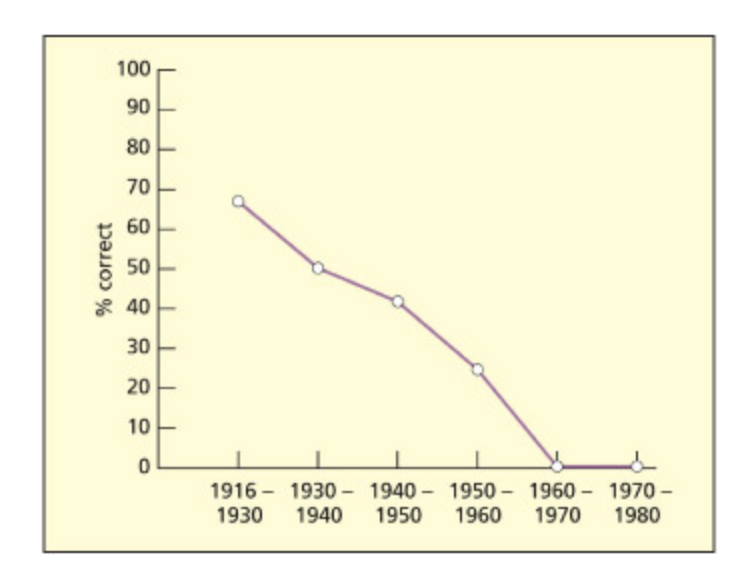
One of the most consistently reported findings in the amnesia literature is that recall of events in the retrograde period shows a temporal gradient such that memories from earlier in life are easier to recall than those later in life. This has been termed Ribot’s law, after its discoverer (Ribot, 1882). For example, Butters and Cermak (1986) reported the case of a college professor, PZ, who became amnesic a couple of years after writing his autobiography. When tested for his ability to recollect events from his life, a clear temporal gradient was found, with more remote memories spared.
Key Terms
Long-term potentiation (LTP)
An increase in the long-term responsiveness of a postsynaptic neuron in response to stimulation of a presynaptic neuron.
**장기 강화(Long-term potentiation, LTP)**는 시냅스 전 뉴런의 자극에 대한 시냅스 후 뉴런의 장기적 반응성 증가를 의미한다. **Lømø(1966)**가 처음 보고했으며, 깨어 있는 쥐에서 효과가 수 주간 지속된다. 시냅스 단백질의 빠른 변경 이후 새 단백질 합성으로 시냅스가 수정된다. 응고화의 기본 기전이다.
Ribot's law
The observation that memories from early in life tend to be preserved in amnesia.
Ribot의 법칙은 기억상실증에서 일생 초기의 기억이 더 잘 보존되는 현상을 설명한다(Ribot, 1882). 표준 응고화 이론에 따르면 오래된 사건일수록 더 많이 응고되어 해마 의존성이 감소하기 때문이다. PZ 사례(Butters & Cermak, 1986)에서 자서전 작성 2년 후 발병한 환자가 명확한 시간 기울기를 보였다.
📊 그림 설명
PZ(1914년생, 저명 과학자)의 일생 사건 회상률 그래프이다(Butters & Cermak, 1986). 1916-1930년 기간 약 65% 정답률에서 1970-1980년대로 갈수록 0%에 가까워지는 명확한 시간 기울기(temporal gradient)를 보인다. 자서전 작성 2년 후 기억상실증이 발병했음에도 역행성 기억은 오래된 시기일수록 잘 보존되었다.
기억상실증 시간 기울기의 다섯 가지 설명(Sanders & Warrington, 1971; Cermak & O'Connor, 1983; Nadel & Moscovitch, 1997; Squire, 1992 등)
- 자극이 시대별로 정확히 매칭되지 않을 수 있다(더 먼 시대 자극이 더 쉬울 수 있음).
- 보이는 역행성 손실이 사실은 위장된 순행성 손상이다(Korsakoff처럼 알코올중독 단계에서 부호화 실패).
- 오래된 기억은 더 자주 리허설되어 의미적/이야기 같은 성격을 띤다.
- 사건이 회상될 때마다 새 흔적이 생성되어 오래된 사건일수록 흔적 수가 많아 손상에 강하다(Nadel & Moscovitch, 1997).
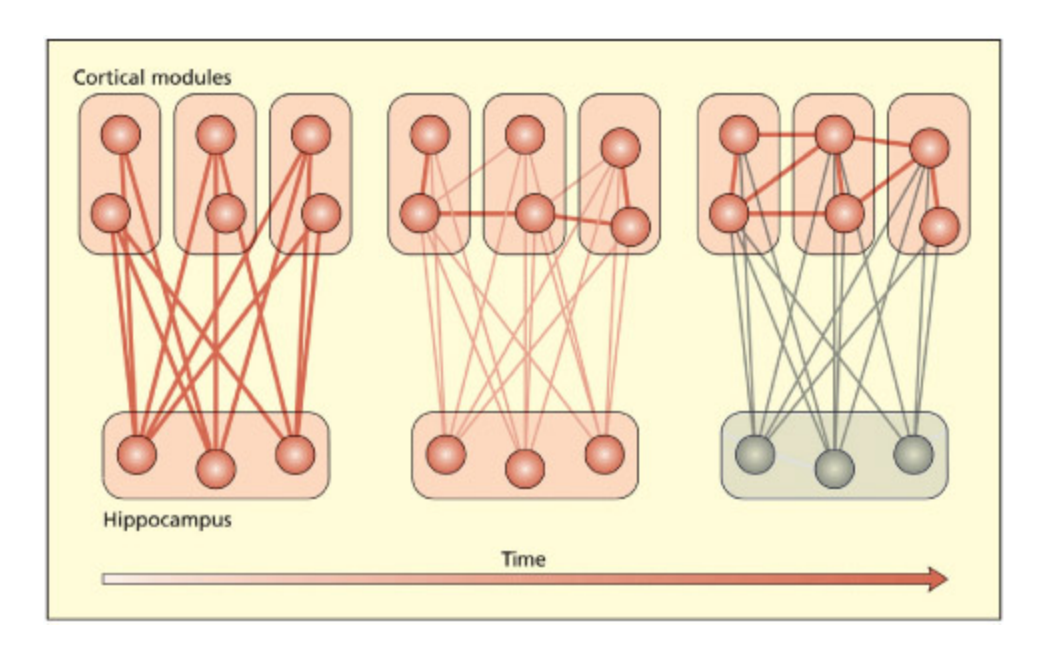
- 해마는 시간 제한적 역할만 하며, 응고된 기억일수록 해마 의존성이 감소한다(Squire, 1992).
McClelland et al.(1995)의 연결주의 모델은 신피질에 새 기억을 즉시 추가하면 파국적 간섭(catastrophic interference)으로 기존 기억이 왜곡되므로, 해마가 빠르게 학습한 뒤 점진적으로 신피질로 통합하는 기전이 필요함을 보여준다. 예를 들어 “펭귄은 날지 못하는 새다”라는 새 지식이 “새는 난다”는 기존 지식을 왜곡하지 않게 하려면 별도(일화)로 표상한 후 점진적으로 망에 통합해야 한다.
📊 그림 설명
해마의 시간 제한적 역할을 가정한 응고화 모델 도식이다(Frankland & Bontempi, 2005). 시간이 흐름에 따라(왼쪽→오른쪽) 해마(하단)와 다양한 피질 모듈(상단) 간 연결이 변화한다. 초기에는 해마가 분산된 기억 측면(지각·정서·언어)을 묶지만, 점차 신피질 간 직접 연결로 통합되어 해마 의존성이 감소한다.
📊 그림 설명
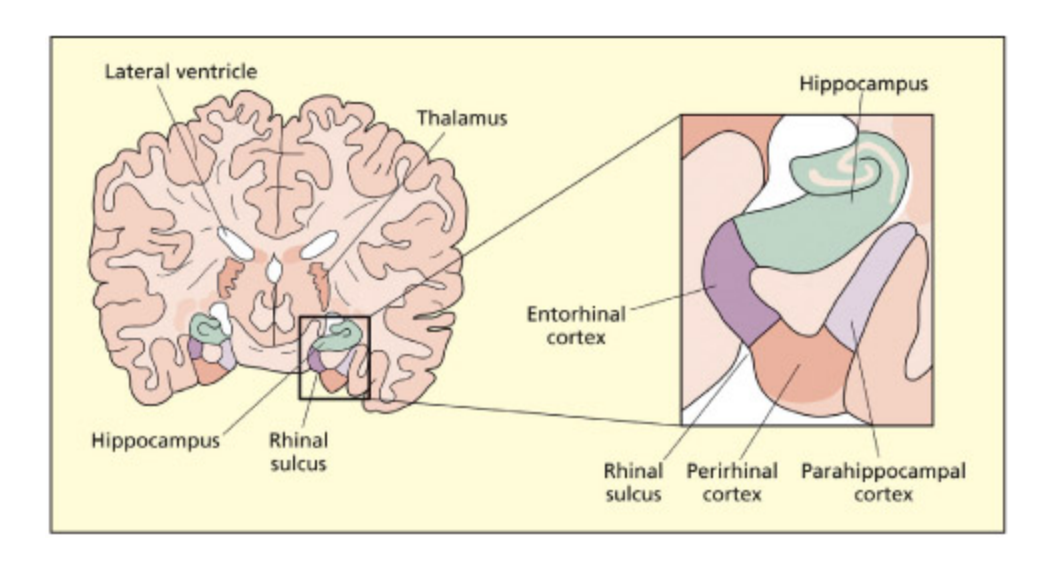
내측 측두엽의 하위 영역을 보여주는 해부도이다. 해마(Hippocampus), 내후각 피질(Entorhinal cortex), 주변후 피질(Perirhinal cortex), 해마방 피질(Parahippocampal cortex), 외측 뇌실(Lateral ventricle), 시상(Thalamus), 비강구(Rhinal sulcus) 등이 표시된다. 각 영역은 서로 다른 기억 기능에 기여한다.
📊 그림 설명
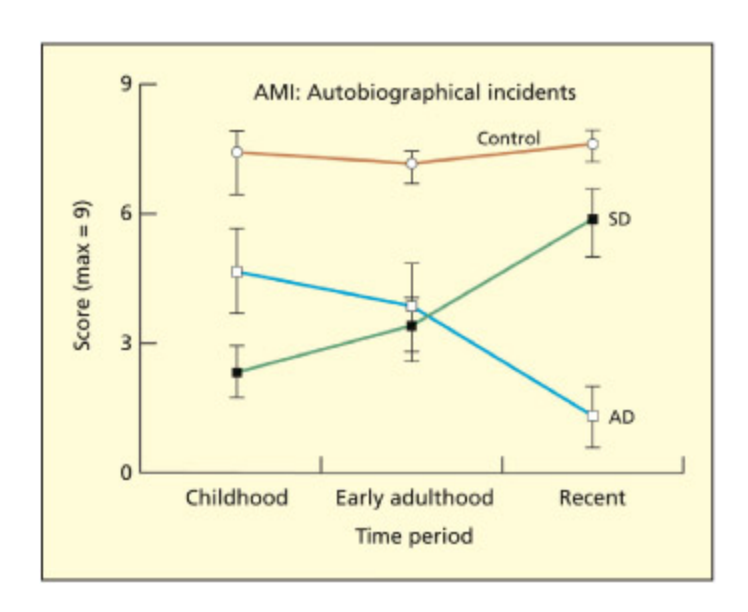
의미 치매(SD) 환자와 알츠하이머병(AD) 환자의 자전적 사건 회상 점수를 시기별(아동기/초기 성인기/최근)로 비교한 그래프이다(Nestor et al., 2002). AD는 최근 기억이 가장 나쁜 전형적 시간 기울기를 보이는 반면, SD는 역전된 기울기(최근 기억이 가장 잘 보존)를 보인다. 이는 해마의 시간 제한적 역할을 지지하는 증거로 해석된다.
Multiple trace theory
Summary
다중 흔적 이론(Nadel & Moscovitch, 1997)은 표준 응고화 모델과 달리 해마가 일부 기억의 영구 저장에 관여한다고 본다. 사건이 회상될 때마다 MTL의 다른 부위에 새 흔적이 생성되어, 오래된 사건일수록 흔적 수가 많아 손상에 강해진다. **Cipolotti et al.(2001)**처럼 일부 환자는 모든 역행성 기억에 손상을 보여 시간 기울기가 없는데, 이는 해마의 영구적 역할과 일치한다. 개정된 이론(Winocur et al., 2010)은 맥락화된 기억(≈일화)이 해마 의존적이고 도식적 기억(≈의미)은 그렇지 않다고 본다.
In contrast to the standard model of consolidation, others have argued that the hippocampus is involved in some permanent aspects of memory storage (Nadel & Moscovitch, 1997). The term “permanent” doesn’t mean that nothing is ever forgotten, only that its role in supporting memory is not time-limited. They cite as evidence the fact that not all amnesic patients show temporal gradients and are impaired, instead, for all remote memories (Cipolotti et al., 2001). The multiple-trace theory has been revised and refined considerably since it was originally described (see Winocur et al., 2010). In particular, the proponents of the model have articulated a clearer description of what kinds of memories are dependent on the hippocampus: namely, contextualized memories but not schematic memories.
In this theory, the process of system consolidation should be construed as transforming memories over time (from contextualized to schematic) and not transferring them, unchanged, from one brain region to another. In fact, the hippocampus has been shown to be involved in imagining future events (Addis et al., 2007; Hassabis et al., 2007) which is consistent with a more general role in binding contextual features rather than simply making past events durable.
Cognitive map theory
Summary
1970년대 **O’Keefe & Nadel(1978)**은 해마가 환경의 공간 지도를 포함한다는 가설을 제시했다. **O’Keefe(1976)**는 쥐 해마에서 특정 위치에서만 강하게 발화하는 **장소 세포(place cells)**를 발견했다. 후속 연구는 장소 세포가 단독으로 공간을 부호화하지 않고 맥락 단서와 통합됨을 보였다(Anderson & Jeffery, 2003). 해마는 타인 중심(allocentric) 지도를 부호화하며, 두정엽의 자기 중심(egocentric) 지도와 구분된다.
Key Terms
Place cells
Neurons that respond when an animal is in a particular location in allocentric space (normally found in the hippocampus).
**장소 세포(Place cells)**는 동물이 타인 중심 공간(allocentric)의 특정 위치에 있을 때 발화하는 뉴런으로, 보통 해마에서 발견된다. **O’Keefe(1976)**가 쥐 해마에 전극을 삽입하여 발견했으며, 여러 장소 세포가 모이면 환경의 지도로 기능할 수 있다. 인간/영장류 장소 세포는 실제 위치뿐 아니라 정신적 위치(예: 주의가 향한 곳)에도 반응한다(Rolls et al., 1997; Ekstrom et al., 2003).
📊 그림 설명
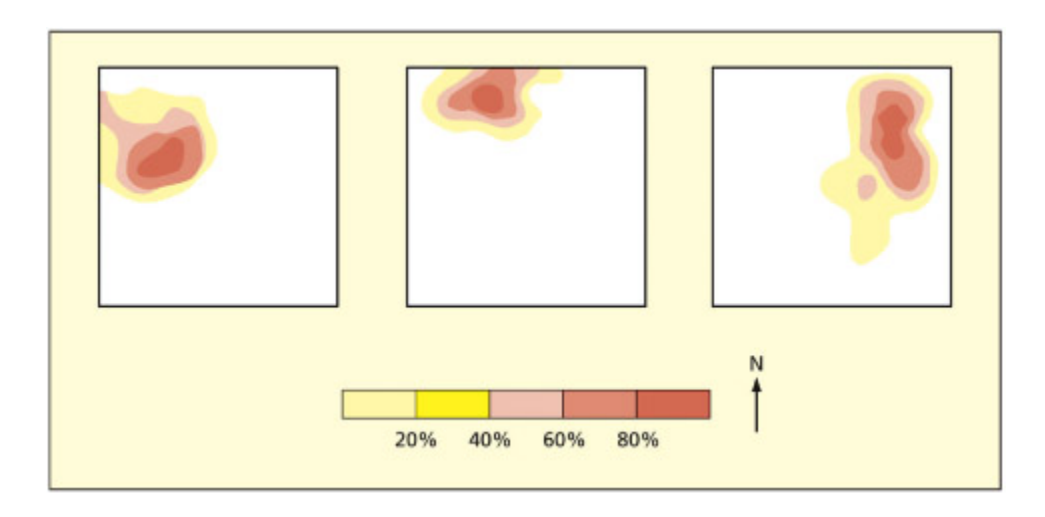
쥐 해마의 세 개 장소 세포의 발화율을 보여주는 그림이다(Chakraborty et al., 2004). 각 정사각형 환경 안에서 어두운 색일수록 발화 확률이 높으며(20%/40%/60%/80% 스케일), 각 뉴런이 환경 내 특정 위치에 반응함을 시각화한다. 단일 세포 기록으로 얻은 자료다.
📊 그림 설명
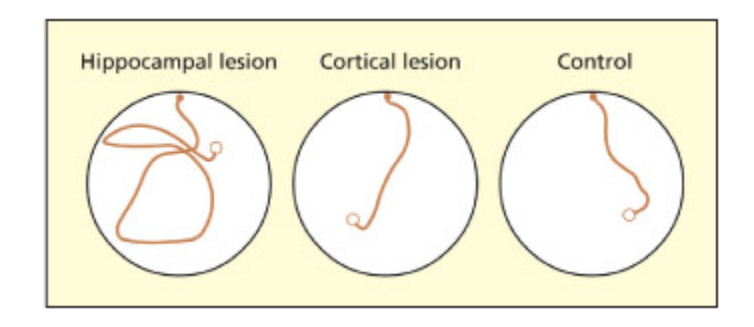
Morris 수중 미로(Morris et al., 1982) 결과이다. 세 조건(해마 손상, 피질 손상, 통제)의 쥐가 우유색 물 속에 잠긴 발판으로 가는 경로가 비교된다. 통제와 피질 손상 쥐는 학습 후 직선으로 가지만, 해마 손상 쥐는 학습하지 못하고 시행착오로 헤맨다. 해마가 공간 지도 저장에 필수임을 보여준다.
**Hartley et al.(2003)**은 가상 마을 탐색이 우측 해마를 활성화함을 fMRI로 보였고, **Spiers et al.(2001a)**은 좌/우 해마 손상 환자에서 다른 손상 패턴을 보고했다: 우측 손상은 길찾기·지도 그리기·장면 인지에 문제, 좌측 손상은 누가 무엇을 주었는지 등 맥락 정보에 문제가 있었다.
Key Terms
Grid cells
Neurons that respond when an animal is in particular locations in an environment such that the responsive locations form a repeating grid-like pattern.
**격자 세포(Grid cells)**는 환경 내 여러 위치에서 발화하며 반응 위치가 반복적인 삼각형 격자 패턴을 이루는 뉴런이다(Hafting et al., 2005). 쥐 내후각 피질(entorhinal cortex)에서 발견되며, 시공간 신호와 운동 신호를 연결하는 기능을 할 가능성이 있다.
London 택시 운전사 사례
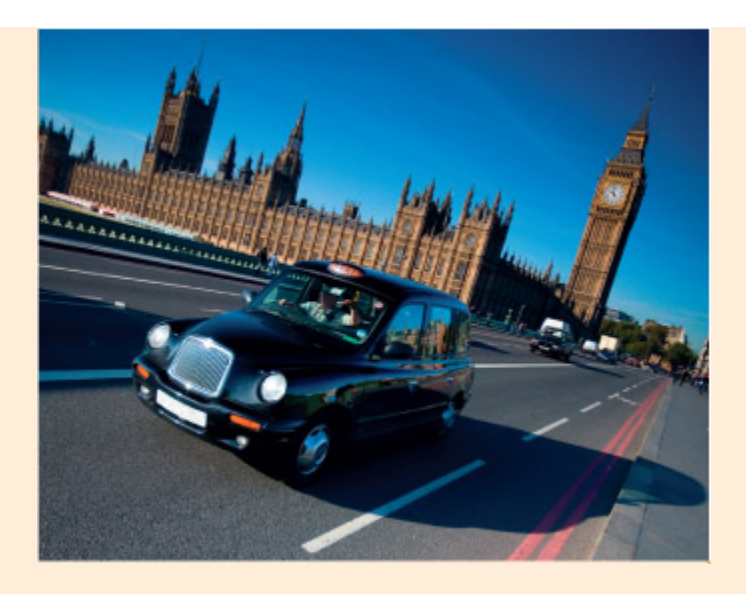
**Maguire et al.(2000)**은 복셀 기반 형태측정법(VBM)으로 런던 택시 운전사(“The Knowledge” 시험 합격자)의 회백질을 분석한 결과, 우측 해마의 부피가 IQ 매칭 대조군보다 크다는 사실을 발견했다. 근무 기간이 길수록 부피가 커지는 상관관계는 영역이 사용에 따라 확장되었음을 시사하며, 직업 선택의 사전 성향에 반대된다. Woollett & Maguire(2011) 종단 연구가 이를 확증했다. 양측 해마 손상을 입은 한 런던 택시 운전사는 주요 도로 지식은 유지했으나 세부 도로는 잊었다(Maguire et al., 2006).
Theories of Remembering, Knowing, and Forgetting
Summary
본 절은 기억 시스템보다 기억 과제에 초점을 두며, 회상(recall)과 인지(recognition), 그리고 친숙성(familiarity)과 회상적 기억(recollection)의 구분을 다룬다. **Mandler(1980)**는 인지 기억이 친숙성(맥락 자유, “안다”는 느낌)과 회상(맥락 의존, 특정 정보 기억)의 두 기전으로 구성된다고 제안했다. 망각의 원인은 부호화, 저장, 인출 단계 각각에서 발생할 수 있으며, 부호화 특이성 가설, 인출 유도 망각, 지시된 망각 등으로 설명된다.
Recall versus recognition and familiarity versus recollection
Summary
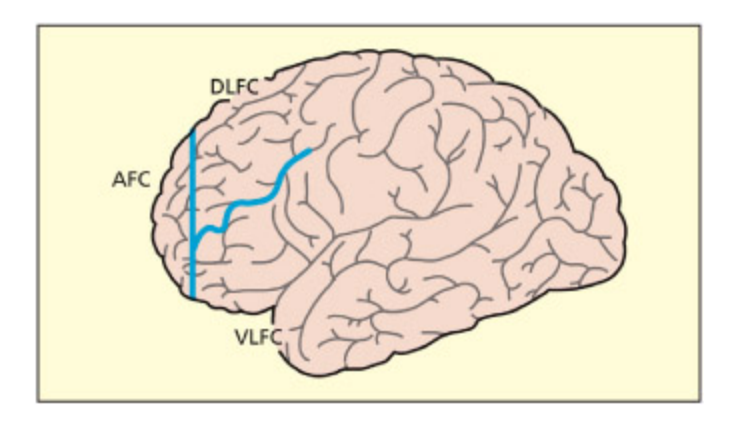
명시적 기억 검사의 주요 유형은 회상(recall)과 인지(recognition)다. **Mandler(1980)**는 인지 기억이 두 별개 기전인 친숙성(맥락 자유, “안다”) 과 회상(맥락 의존, “기억한다”)으로 구성된다고 주장했다. YR 환자(Mayes et al., 2001, 2002, 2004)는 해마에 매우 선택적인 손상을 입었음에도 동종 자극 쌍(단어-단어, 객체-객체)은 잘 인지하지만 이종 쌍(객체-위치, 단어-객체)은 인지하지 못해 회상의 선택적 손상을 보였다. Eichenbaum et al.(2007) 모델은 주변후 피질=항목/친숙성, 해마방 피질=맥락, 해마=맥락 속 항목 결합(회상)이라는 분업을 제안한다.
This chapter has, thus far, concentrated on different types of memory systems. But to what extent do different types of memory tasks use different memory systems? Within the domain of explicit tests of memory (i.e. in which participants are directly asked to remember), the main tasks used are tests of recognition memory and tests of recall. Mandler (1980) proposed that recognition memory consists of two distinct mechanisms and that this could account for its general advantage over tests of recall. One mechanism, familiarity, is considered to be context free and the recognized item just feels familiar. The other mechanism, recollection, is context dependent and involves remembering specific information from the study episode. Recollection and familiarity are associated with different “feelings” or conscious states. These have been called “remembering” and “knowing,” respectively (Gardiner, 2000; Tulving, 1985). Recollection, in particular, has been described as “mental time travel,” in which contextual detail is placed in a personal past (Wheeler et al., 1997).
Key Terms
Recognition memory
A memory test in which participants must decide whether a stimulus was shown on a particular occasion.
**인지 기억(Recognition memory)**은 자극이 특정 경우에 제시되었는지를 판단하는 기억 검사다. 단일 자극 인지(이전에 봤는가?) 또는 강제 선택 인지(둘 중 어느 것을 봤는가?)로 구분된다. 일반적으로 회상보다 수행이 좋다.
Recall
Participants must produce previously seen stimuli without a full prompt being given (compare recognition memory).
**회상(Recall)**은 충분한 단서 없이 이전에 본 자극을 산출해야 하는 검사다. 자유 회상(임의 순서), 순차 회상(주어진 순서), 단서 회상(부분 단서 제공)으로 나뉜다. 거의 전적으로 회상 기제(recollection)에 의존한다고 본다.
Familiarity
Context-free memory in which the recognized item just feels familiar.
**친숙성(Familiarity)**은 인지 항목이 단순히 익숙하게 느껴지는 맥락 자유 기억이다. “안다(knowing)“라는 의식 상태와 연관되며(Tulving, 1985), 주변후 피질(perirhinal cortex)이 핵심 역할을 한다는 증거가 있다(Bowles et al., 2007).
Recollection
Context-dependent memory that involves remembering specific information from the study episode.
**회상적 기억(Recollection)**은 학습 일화의 특정 정보를 기억하는 맥락 의존 기억이다. “기억한다(remembering)“라는 의식 상태와 연관되며, “정신적 시간 여행”(Wheeler et al., 1997)으로 묘사된다. 해마가 핵심 역할을 한다는 증거가 있다.
📊 그림 설명
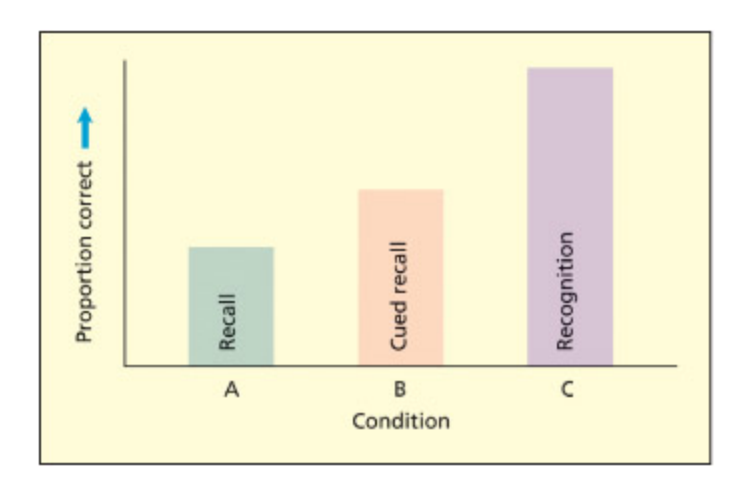
세 가지 기억 검사 유형의 전형적 결과를 보여주는 막대 그래프이다(Parkin, 1999). 회상(Recall) A, 단서 회상(Cued recall) B, 인지(Recognition) C 순서로 정답 비율이 증가하며, 인지가 가장 쉬운 검사임을 시각화한다. Mandler(1980)는 친숙성과 회상의 이중 기전으로 이 우위를 설명한다.
📊 그림 설명
Eichenbaum et al.(2007) 모델 도식이다. **주변후 피질(Perirhinal Cx)**은 항목 표상(친숙성에 중요), **해마방 피질(Parahippocampal Cx)**은 맥락 표상(장면 지각 포함), **해마(Hippocampus)**는 맥락 속 항목 결합(회상에 중요)을 담당한다. 모두 **내후각 피질(Entorhinal Cortex)**을 거쳐 정보가 흐른다.
시험 팁
친숙성 vs. 회상을 영어로 외우자. Familiarity = “Know”(맥락 없이 “안다”는 느낌, 주변후 피질). Recollection = “Remember”(맥락과 함께 “기억한다”는 느낌, 해마). YR 환자처럼 해마만 손상되면 회상은 잃되 친숙성은 유지된다. Bowles et al.(2007)의 주변후 손상 환자는 정반대 패턴(친숙성 손상, 회상 유지)을 보여 이중 해리를 확립한다.
Why do we forget things?
Summary
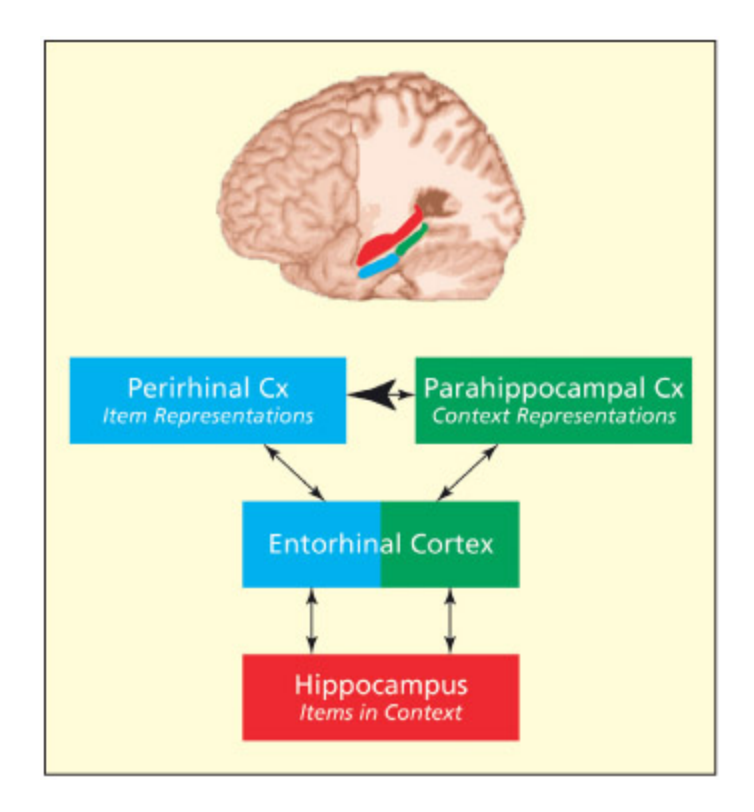
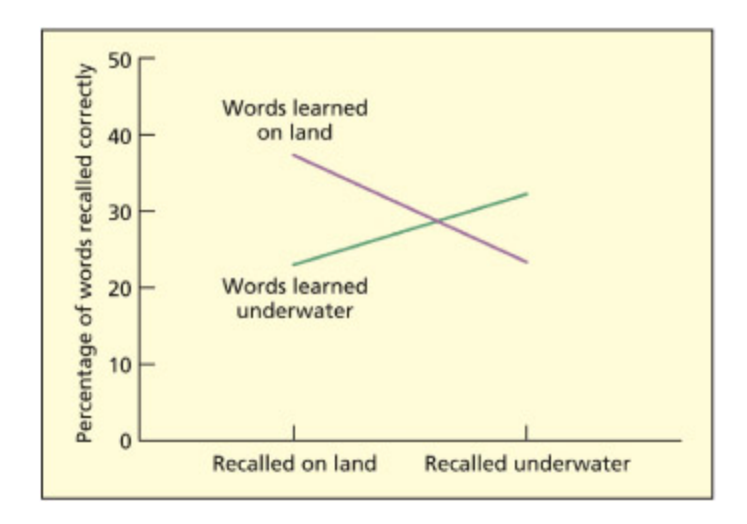
망각은 설계 결함이 아니라 효율적 기억 사용에 적응적일 수 있다. 망각의 원인은 부호화·저장·인출 단계 각각에서 발생한다. 수준 처리 이론(Craik & Lockhart, 1972)은 의미적 처리가 지각적 처리보다 기억에 유리하다고 본다. **Wagner et al.(1998b)**은 부호화 시 좌측 측두엽과 좌측 복외측 PFC 활동이 이후 인지 성공을 예측함을 fMRI로 보였다. 부호화 특이성 가설(Tulving, 1983)은 학습/인출 맥락의 유사성이 기억 가능성을 예측한다고 본다(Godden & Baddeley, 1975 육지-수중 실험). 인출 유도 망각(Anderson et al., 1994)과 지시된 망각(Bjork, 1998) 같은 능동적 망각 기전도 존재한다.
Key Terms
Levels-of-processing account
Information that is processed semantically is more likely to be remembered than information that is processed perceptually.
**수준 처리 이론(Levels-of-processing account)**은 의미적으로 처리된 정보가 지각적으로 처리된 정보보다 더 잘 기억된다는 모델이다(Craik & Lockhart, 1972). 예: “house”에 형용사 생성(→ big)이 운율 생성(→ mouse)이나 글자 세기(→ 5)보다 후속 회상에 유리하다(Eysenck, 1974).
📊 그림 설명
Wagner et al.(1998b)의 부호화 시 fMRI 신호 변화 그래프이다. (a) 좌측 복외측 전전두피질과 (b) 좌측 해마방 영역에서 후속 기억된 단어(녹색)가 잊혀진 단어(보라색)보다 더 큰 신호 변화를 보인다. 부호화 시점의 뇌 활동으로 이후 인지 여부가 예측됨을 입증한다. 시간(0-14초) x축에서 약 4초 부근에서 신호가 최대치에 이른다.
Key Terms
Encoding specificity hypothesis
Events are easier to remember when the context at retrieval is similar to the context at encoding.
**부호화 특이성 가설(Encoding specificity hypothesis)**은 인출 시점의 맥락이 부호화 시점의 맥락과 유사할 때 기억이 더 쉬워진다는 이론이다(Tulving, 1983). **Godden & Baddeley(1975)**는 단어 목록을 육지/수중에서 학습하고 같은 환경에서 검사할 때 회상이 더 좋음을 보였다. 알코올중독자가 술 취한 상태에서 숨긴 물건을 술 깬 상태에서 찾지 못하다 다시 취하면 기억나는 현상(Goodwin et al., 1969)도 같은 맥락이다.
Retrieval-induced forgetting
Retrieval of a memory causes active inhibition of similar competing memories.
**인출 유도 망각(Retrieval-induced forgetting)**은 한 기억의 인출이 유사한 경쟁 기억의 능동적 억제를 일으키는 현상이다(Anderson et al., 1994). 과일-오렌지를 리허설하면 과일-바나나의 회상이 약화되며, 학습조차 하지 않은 경우보다 더 나빠진다.
Directed forgetting
Forgetting arising because of a deliberate intention to forget.
**지시된 망각(Directed forgetting)**은 의도적으로 잊으려는 의지에 의한 망각이다(Bjork, 1998). 첫 목록을 “연습이었다”고 지시받으면 이후 회상이 감소한다. 우측 전두엽 손상은 지시된 망각을 방해하지만 인출 유도 망각은 보존되어 두 기전이 분리됨을 보인다(Conway & Fthenaki, 2003).
📊 그림 설명
Godden & Baddeley(1975) 실험의 부호화 특이성 효과를 보여주는 그래프이다(Baddeley, 1990). 육지에서 학습한 단어는 육지에서 회상 시 약 37%, 수중 회상 시 약 23%이고, 수중에서 학습한 단어는 반대 패턴을 보인다. 학습과 인출 맥락의 일치가 회상을 향상시킴을 입증한다.
Memory distortions and false memories
Summary
구성적 기억(Schacter et al., 1998) 관점은 회상을 저장된 흔적의 인출이 아니라 현재 알려진 것에 기반한 과거 추론으로 본다. Roediger & McDermott(1995) DRM 패러다임은 의미적으로 관련된 단어 목록(예: bed, rest, awake…) 학습 후 제시되지 않은 임계어(“sleep”)를 높은 신뢰도로 잘못 회상하게 만든다. 거짓 인지에는 회상적 경험도 동반되어 단순 친숙성이 아님을 보여준다. Cabeza et al.(2001) fMRI 연구는 참/거짓 인지 모두 해마 활동이 동반되지만 일부 차이가 있음을 보였다.
Key Terms
Constructive memory
The act of remembering construed in terms of making inferences about the past, based on what is currently known and accessible.
**구성적 기억(Constructive memory)**은 회상을 현재 접근 가능한 정보에 기반한 과거 추론으로 보는 관점이다(Schacter et al., 1998). 저장소 비유의 대안으로, 기억 왜곡과 거짓 기억이 이 관점의 핵심 증거다. 과거는 별도 뇌 구조에 보존되지 않고 현재와 같은 구조에서 재구성된다.
False memory
A memory that is either partly or wholly inaccurate but is accepted as a real memory by the person doing the remembering.
**거짓 기억(False memory)**은 부분적으로 또는 전체적으로 부정확하나 본인이 진짜 기억으로 받아들이는 기억이다. DRM 패러다임(Roediger & McDermott, 1995)이 비임상 인구에서 거짓 회상·인지를 안정적으로 유도한다. 거짓 기억은 종종 회상적 경험을 동반하며, 자극이 다른 목소리로 제시되면 임계어 “sleep”이 특정 목소리로 들렸다고 보고하기도 한다(Payne et al., 1996).
The Role of the Prefrontal Cortex in Long-Term Memory
Summary
**Fletcher & Henson(2001)**은 전전두피질의 장기 기억 역할을 “working with memory”(기억과 함께 작동하기)로 요약한다. 작업 기억(working memory)과 기억과의 작동(working-with-memory)은 별개 기전이 아니라 정보가 현재/과거에 귀속되는지만 다르다. 본 절은 부호화(복외측 PFC), 모니터링 및 인출(배외측 PFC), 경험적 상태(친숙성/회상), 출처 모니터링, 시간 맥락으로 나누어 다룬다.
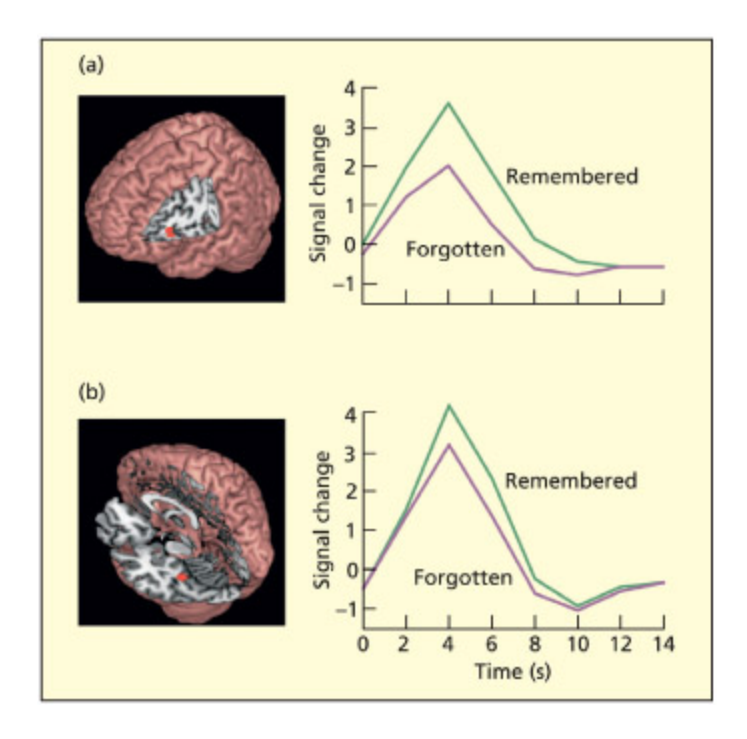
Fletcher and Henson (2001) offer a simple and effective way of characterizing the role of prefrontal cortex in long-term memory: namely “working with memory.” This is obviously a play-on-words with its parallel function in the short-term memory domain, i.e. working memory. Working memory and working-with-memory should not be thought of as separate brain mechanisms: both require maintaining and manipulating information that is currently accessible but differ only in whether that information is attributed to past or present events.
📊 그림 설명
외측 전두엽의 기능적 구분을 보여주는 도식이다(Fletcher & Henson, 2001). 복외측(VLFC), 배외측(DLFC), 전방(AFC, anterior frontal) 세 영역의 위치가 표시되며, 각각이 다른 기억 처리에 관여한다. 작업 기억과 장기 기억 양쪽에서 공통된 분업이 적용된다.
Memory encoding
Summary
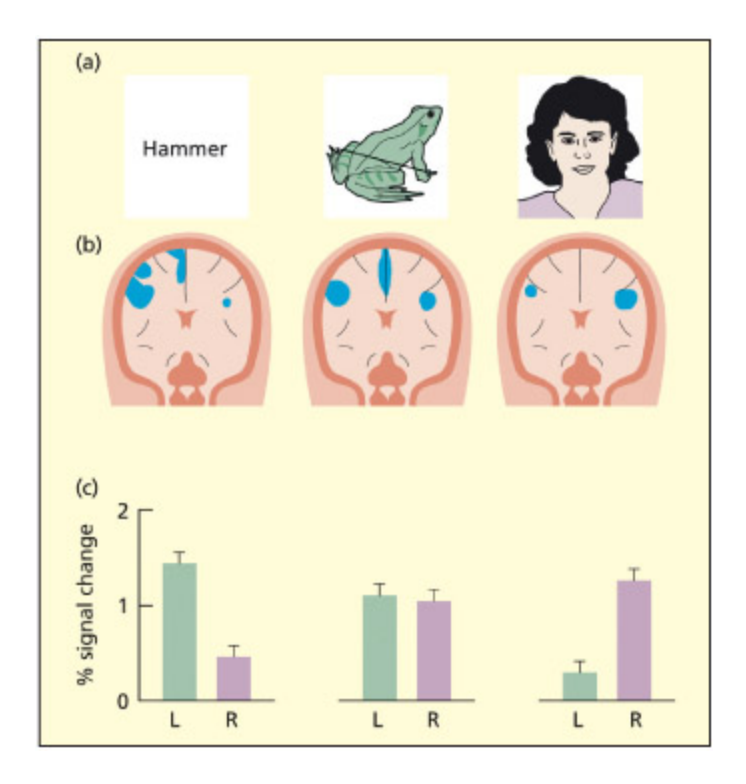
복외측 PFC(좌측 = Broca 영역)는 장기 기억 부호화와 관련되며, 작업 기억의 정보 선택·유지의 부산물로 해석된다. **Wagner et al.(1998b)**는 이 영역 활동이 후속 인지/망각을 예측함을 보였다. 수준 처리 조작(의미 vs. 얕은 처리)에서도 이 영역이 활성화된다(Kapur et al., 1994). 언어 부호화는 좌반구가, 그림/얼굴 부호화는 우반구가 중요하다(Wagner et al., 1998a). 배외측 PFC는 작업 기억 내 정보 조작(순서화 등)에 관여하며, 구조화된 숫자열(예: 2468) 대비 무구조 숫자열(예: 3972) 부호화 시 더 활성화된다(Bor et al., 2004).
📊 그림 설명
Kelley et al.(1998) fMRI 결과로, 단어(“Hammer”), 객체(개구리), 얼굴의 부호화 시 좌/우 전전두 활성화 비교를 보여준다. (a) 자극 유형, (b) 활성화 부위, (c) 좌(L)/우(R) 신호 변화. 단어는 좌측 PFC 우세, 얼굴은 우측 PFC 우세, 객체는 양측이 비슷한 패턴을 보여 부호화의 반구 특이성을 입증한다.
Monitoring and memory retrieval
Summary
배외측 PFC(특히 우반구)는 장기 기억에서 인출된 내용을 평가(모니터링)한다(Fletcher & Henson, 2001). 인출 단서가 최소일 때(자유 회상), 맥락을 회상해야 할 때, 기억 판단 신뢰도가 낮을 때 모두 우측 DLPFC 활성이 가장 크다. **Maril et al.(2001)**은 혀끝(tip-of-the-tongue) 상태(예: Chinatown + director 큐)에서 우측 DLPFC가 가장 활성화됨을 보였으며, 이는 영역이 인출 성공/실패 자체가 아닌 불확실성과 관련됨을 시사한다.
Experiential states
Summary
친숙성과 회상은 MTL 하위 영역의 기여로 자주 논의되지만 전전두 영역도 기여한다. **Hannula & Ranganath(2009)**는 해마 활동이 암묵 기억 측정(이전/새 항목 응시 시간)을 예측하는 반면, 전전두 활동은 의식적 회상 판단을 예측함을 보였다. 한 fMRI 인지 검사에서 좌측 전방 전두는 “기억(remember)” 반응과, 우측 배외측 전두는 “안다(know)” 반응(확신 부족으로 인한 더 많은 모니터링)과 연관되었다(Henson et al., 1999a).
Source monitoring
Summary
**출처 모니터링(Source monitoring)**은 인출된 기억을 원래 맥락에 귀속시키는 과정이다(Johnson, 1988). 사건을 맥락에 위치시키는 것은 출처를 직접 인출하기보다 인출 정보의 질적 특성(지각·시간·공간·의미·정서)에 기반한 능동적 평가 과정이다. Johnson et al.(1988) 실험에서 들은 단어와 상상한 단어가 모두 실험자 목소리일 때 출처 혼동이 가장 많았다. 전전두 손상은 인지 자체는 보존되어도 시공간 맥락 배치에 문제를 일으킨다(Janowsky et al., 1989).
Key Terms
Source monitoring
The process by which retrieved memories are attributed to their original context.
**출처 모니터링(Source monitoring)**은 인출된 기억을 원래 맥락(누가 말했는가, 본 것인가 상상한 것인가 등)에 귀속시키는 과정이다(Johnson, 1988). 회상과 밀접히 관련되지만, Johnson 등은 출처 정보의 직접 인출보다 능동적 평가 과정으로 본다. 외부 사건은 정신적 사건보다 더 풍부한 지각·시공간 세부를 포함한다.
📊 그림 설명
들은 단어(“dog”)와 상상한 단어(“dog”)의 기억을 어떻게 구분하는지를 보여주는 만화 도해이다. 출처 모니터링은 인출된 정보의 질적 특성에 대한 능동적 평가를 포함하며, 단순 인출이 아니다.
Memory for temporal context
Summary
PFC 내 영역이 출처 기억에 다양하게 기여하며, 안와전두 피질(orbitofrontal cortex)이 시간 맥락에 특화될 가능성이 제기된다. 언제 사건이 일어났는지를 평가하는 것은 기억에 시간 도장이 찍혀 있지 않기 때문에 다른 기전(기억 강도, 시간적 인접 항목 연합)에 의존한다. **Duarte et al.(2010)**은 안와전두 손상 환자가 시간 출처 모니터링에 손상을 보이되 공간 출처나 표준 인지/회상에는 손상이 없음을 보였다. **작화증(confabulation)**은 안와전두 손상과 연관되며(Gilboa & Moscovitch, 2002), 거짓 기억의 자발적 또는 유발 생성을 특징으로 한다.
Key Terms
Confabulation
A memory that is false and sometimes self-contradictory without an intention to lie.
**작화증(Confabulation)**은 거짓이며 때로 자기 모순적이지만 거짓말의 의도가 없는 기억이다(Gilboa & Moscovitch, 2002). 안와전두(orbitofrontal) 손상과 연관된다. Damasio et al.(1985) 환자는 포클랜드 전쟁 질문에 “Falklandese를 쓴다”고 자신 있게 답하며 가상의 휴가를 묘사했다. **Schnider(2003)**는 작화증이 관련 없는 기억의 억제 결손으로 발생한다고 본다.
📊 그림 설명
Schnider & Ptak(1999)의 작화증 실험 과제 예시이다. 참가자는 항목이 현재 목록(별표로 표시)에 이전에 제시되었는지 기억해야 한다. 일부 항목(예: 악어)은 여러 목록에 반복 등장하며, 5분/30분 간격으로 4개 목록이 제시된다. 자발적 작화증 환자는 이전 목록의 항목을 현재 목록으로 잘못 보고하는 경향이 있다.
주의
작화증 vs. 거짓 기억을 구분하자. **거짓 기억(false memory)**은 정상인에서도 DRM 패러다임 등으로 유도되는 부정확한 기억이고, **작화증(confabulation)**은 안와전두 손상 환자의 자발적/유발성 거짓 기억으로 종종 자기 모순적이다. Schnider는 작화증을 관련 없는 기억의 억제 실패로 본다(맥락 인출 자체의 결손이 아님).