What is consciousness, and could machines have it?
Overview
- 연구 배경: 의식(의식성)과 무의식적 처리 간의 차이를 밝히기 위해 뇌의 정보 통합 및 전달 메커니즘을 분석하는 필요성 제기
- 핵심 방법론:
- 무의식적 처리(C0)와 의식적 정보 접근(C1)을 구분한 이론 제시
- Global Neuronal Workspace이라는 개념을 통해 정보 통합 및 전달 메커니즘 설명
- 주요 기여:
- 무의식적 처리(C0)에서의 invariants 시각 인식, 강화 학습, 의미 접근 등 실험적 증거 제시
- 의식적 정보 접근(C1)의 핵심은 정보 통합과 전달을 통한 단일 결정 생성이라는 가설 제시- 실험 결과:
- 무의식적 시각 인식 실험에서 반복 억제(Repetition Suppression) 현상 관찰 (fusiform face area에서의 신경 반응 감소)
- 이질적 시각 억제 실험에서 33ms 이하의 자극은 인식 불가능, 66ms 이상 시 인식 가능 시 신경 활성화 증가 (entorhinal cortex에서의 “World Trade Center” 개념 선택적 반응)
- 한계점: 이론적 모델 기반으로 실험적 검증이 제한적이며, 복잡한 인지 과정에서의 적용 가능성은 미비한 상태

What is consciousness, and could machines have it?
Summary
이 섹션에서는 기존 인공지능(AI) 시스템이 인간의 의식을 구현할 수 있을지에 대한 논의를 중심으로, 의식(consciousness)의 본질과 기계가 의식을 가질 수 있는지라는 질문을 다룬다. 저자들은 인간 뇌에서 의식이 발생하는 메커니즘을 분석하며, 의식을 두 가지 정보 처리 과정(C1, C2)으로 구분한다. C1은 정보를 전역적으로 공유할 수 있도록 선택하는 과정으로, 유연한 계산과 보고에 기반하고, C2는 계산의 자기 모니터링을 통해 주관적인 확신이나 오류를 인식하는 과정이다. 그러나 현재의 AI는 인간 뇌의 비의식적 처리(C0)에 해당하는 계산을 주로 수행하고 있으며, 이는 기계가 인간과 같은 의식을 구현하기에는 아직 부족하다는 점을 강조한다. 또한, 뉴로생물학적 통찰(비선형 입력-출력 함수, 합성 투사 계층, 가변 시냅스 가중치 등)를 기반으로 한 인공 신경망의 발전은 인간의 의식을 모방하는 기계의 가능성을 제기하지만, 이는 아직 의식의 본질을 이해하지 못한 상태에서의 접근이라고 지적한다. 저자들은 미래의 인공 의식을 위해서는 인간 뇌가 C1과 C2를 생성하는 아키텍처를 분석하고, 이를 컴퓨터 알고리즘으로 전환하는 연구가 필요하다고 제안한다.
Multiple meanings of consciousness
Summary
이 섹션에서는 “의식(consciousness)“이라는 용어가 과학적 맥락에서 다양한 의미로 사용됨을 강조하며, 특히 의학적 맥락에서 불전달적 용법(예: “환자가 의식을 잃었다”)으로 사용되는 점을 설명한다. 이와 같은 의식의 생리학적 기전 해명은 수면, 마취, 콤마 상태 등에 대한 이해에 중요한 영향을 미치지만, 계산적 영향이 제한적이라 본문에서는 이에 대한 논의를 생략한다. 대신, 의식의 계산적 측면에서 두 가지 핵심 차원인 전역 가용성(C1)과 자기 모니터링(C2)을 구분하여 제시하며, 이 두 차원이 의식적 계산의 본질을 이해하는 데 필수적이라고 강조한다.
C1: Global availability
Summary
이 섹션에서는 의식의 전이적 의미(예: “운전자가 신호등을 인식한다”)를 다루며, 인지 시스템과 특정 사고 대상(예: 연료탱크 경고등의 정신적 표현) 사이의 관계를 설명한다. 이 대상은 언어적·비언어적 보고 등 후속 처리를 위해 선택되며, 이로 인해 해당 정보는 유기체 전체에 글로벌하게 접근 가능(globally available)하게 된다. 이러한 의미에서의 의식은 “정보를 머릿속에 두고 있는 것”과 동의어이며, 특정 시점에 가능해질 수 있는 사고의 넓은 범위 중에서만 글로벌하게 접근 가능한 정보가 C1 의식의 내용을 구성한다.
Insight
정보를 머릿속에 ‘보관’, 즉 의식을 이렇게 해석한다면 memory랑은 떼어둘 수 없겠지.
C2: Self-monitoring
Summary
이 섹션에서는 의식의 또 다른 의미인 자기 참조적 반사성(reflexive)을 다루며, 이는 인지 시스템이 자신의 처리 과정을 모니터링하고 자가 정보를 얻는 자기 참조적 관계(self-referential relationship)를 설명한다. 인간은 몸의 구조, 지식의 존재 여부, 오류 발생 여부 등 다양한 정보를 인지하며, 이는 심리학에서 메타 인지(meta-cognition)로 정의되는 내부 표현의 인식과 활용 능력과 연결된다. 저자들은 C1(글로벌 접근)과 C2(자기 모니터링)가 인식 계산의 직교적 차원(orthogonal dimensions)임을 제안한다. 이는 두 차원이 모두 전두엽 피질에 의존할 수 있더라도, 경험적으로나 개념적으로는 분리될 수 있음을 강조한다. 예를 들어, 보고 가능한 처리(C1)가 정확한 메타 인지(C2) 없이 발생하거나, 자가 모니터링(C2)이 의식적으로 보고되지 않을 수 있다. 또한, C1과 C2 모두와 무관한 무의식적 계산(C0)이 존재하며, 이는 Turing의 원래 통찰인 ‘even sophisticated information processing can be realized by a mindless automaton.‘라는 주장과 일치한다. 신경 과학은 얼굴 인식, 말하기 평가, 의미 추출 등 복잡한 계산이 인간 뇌에서 무의식적으로 이루어질 수 있음을 실증하며, 뇌는 전문적인 처리 모듈과 비슷한 전방향 딥러닝 네트워크(feedforward deep-learning networks)의 작동 방식과 밀접하게 연결된다고 주장한다. 이와 같은 뇌의 구조적 특성과 메커니즘을 이해함으로써 기계가 인지 처리 효율성을 높이는 데 기여할 수 있을 것으로 기대된다.
C1 w/o C2, C2 w/o C1 Examples
Important
“저자들은 C1(글로벌 접근)과 C2(자기 모니터링)가 인식 계산의 직교적 차원(orthogonal dimensions)임을 제안한다. 이는 두 차원이 모두 전두엽 피질에 의존할 수 있더라도, 경험적으로나 개념적으로는 분리될 수 있음을 강조한다.”
- C1: 여러 C0 중 global broadcasting 할 것을 선택해야 하므로, attention에 대응될 수 있고,
- C2: self-reflective인 성격이면서, 내부 정보에 대한 confidence로 해석한다면, logit-entropy라고 볼 수 있음.
⇒ C1, C2 차원이 독립적이라는 것. i.e. attention을 잘한다고 해서, metacognition이 높다고 할 순 없다. 라고 보는 관점. 또는 attention을 잘하는 것과 hallucination이랑은 별개 라고도 해석할 수 있겠지.
Unconscious processing (C0): Where most of our intelligence lies
Summary
이 섹션에서는 인간의 지능이 주로 의식되지 않은 처리(unconscious processing, C0)에 기반한다는 점을 강조하며, 의식의 전통적 정의(C1, C2)와 대비되는 새로운 관점을 제시한다. 프라이밍(priming) 현상은 의식되지 않은 자극이 인지, 의미, 운동 처리 단계에 깊은 영향을 미칠 수 있음을 보여주는 핵심 예시로, 예를 들어 숫자 “4”와 같은 하위 인식 자극(subliminal prime)이 “four”와 같은 목표 자극의 처리 효율을 높이는 것을 설명한다. 신경영상 기법에 따르면, 의식 없이도 대부분의 뇌 영역(대부분의 전두엽, 측두엽, 후두엽 등)이 활성화될 수 있으며, 이는 인간의 지능이 의식적 사고보다 훨씬 더 광범위한 무의식적 처리 과정에 의존하고 있음을 시사한다. 이러한 결과는 기존 의식 이론의 한계를 드러내며, 인공지능 시스템의 의식 유무 판별에 있어 무의식적 처리 메커니즘의 중요성을 재조명한다.
Important
subliminal sitmuli에 대한 primming 결과들을 비롯한 un-consciousness 실험들로 보면, 지능은 오히려 무의식이랑 깊은 관련이 있을 수 있다고 해석하니, black-box를 부수려는 시도는 오히려 멀어지는 접근이라고 볼 수도 있겠네.
Human - AI interpretation
사람 입장에서 좀 보면, 무의식적인 정보 더미인 C0에서 C1에 적절히 attention을 수행하여 global workspace에 올릴 걸 정하는 과정이 이루어지는 것 같은데, C0가 무의식 black-box 같은 특성을 보이는 거니까, attention을 준다고 했을 때, 어떻게 명시적으로 coding할 수 있을지가 어렵겠네. 명시적으로 작성하려는 순간 interpret되어야 한다는 거니까, blackbox 특성이 희석되는 느낌. C0 더미에서 어떻게 잘 골라내는 걸 만드냐가 관건 인 것 같은데, 현대 LLM은 data-driven이니.
Unconscious view-invariance and meaning extraction in the human brain
Summary
이 섹션에서는 인간 뇌가 의식 없이 복잡한 인지 작업을 수행할 수 있음을 실험적으로 보여주는 연구를 소개한다.
예를 들어, 동일한 사람의 얼굴을 다른 시점(view-invariance)에서 역치하 의식적으로 (subliminally) 노출시킨 후에 본인의 얼굴을 인식할 때, 인식 속도가 향상되는 현상은 의식적이지 않은 불변성(unconscious view-invariance)을 시사한다.
또한, 청각-시각 모달리티 간의 subliminal priming를 통해 인간 뇌가 의미 벡터 추출이나 음성-텍스트 변환과 같은 AI에 어려운 계산 작업을 의식 없이 수행할 수 있음을 밝힌다. 특히, subliminal sitmuli를 사용한 semantic violation(예: “가구-개”)에 대한 뇌 반응은 자극이 출현한 후 400ms에 두피하 신경망(temporal-lobe language networks)에서 관측되며(N400), 이는 두 단어 중 하나(subliminal)가 의식적으로 인식되지 않더라도 의미 처리가 가능함을 보여준다.
Cross Modal Subliminal Priming
아주 짧고 희미한 숫자 발음을 noise에 섞어서 prime 자극으로 주고, target이 숫자인 task.
N400
언어 심리학과 뇌과학에서 유명한 뇌파 반응 중 하나.
사람의 뇌는 semantic violation을 접하면, 자극을 본지 약 400ms 뒤에 뇌파의 진폭이 커지는 반응을 보임.
→ 뇌의 error signal
Unconscious control and decision-making
Summary
이 섹션에서는 의식되지 않은 처리(unconscious processing)가 인간의 피질 계층(cortical hierarchy)에서 더 깊은 수준에 이르며, 역치하 의식적 자극(subliminal primes)이 작업 선택이나 운동 반응 억제와 관련된 전전두엽 메커니즘(prefrontal mechanisms)에 영향을 줄 수 있음을 설명한다.
사람의 의사결정(decision-making) 신경 기전은 감각 정보를 누적하여 선택 확률을 변화시키는 과정으로, 이는 역치하 자극(subliminal stimuli)이 존재하더라도 지속되며, 베이지안 추론(Bayesian inference)과 증거 누적(evidence accumulation)이라는 인공지능(AI)의 핵심 계산 기법이 인간의 의식되지 않은 메커니즘(unconscious mechanisms)과 밀접하게 연결되어 있음을 강조한다.
== 사람의 C0랑 AI가 구현된 게 공통적인 mechanism이다.특히, 하의식적 자극(subliminal stimuli)이 인지, 의미, 운동 처리 단계에 영향을 미치는 예시를 통해, 인간의 지능이 주로 의식되지 않은 처리(C0)에 기반한다는 이전 섹션의 주장을 확장하며, 의식의 전통적 정의(C1, C2)와 대비되는 관점을 강화한다.
⇒ 이 관점에서는 Neural Network들은 거대한 통계적인 C0-level이다. 라는 주장.
Bayesian Inference
새로운 증거를 바탕으로 belief state를 updating 하는 통계적 method.
= i.e. Bayes-Rule 써서 probability 계산하겠다.
Unconscious learning
Summary
이 섹션에서는 의식되지 않은 학습(unconscious learning)을 주제로, 강화 학습(reinforcement learning) 알고리즘이 인간과 동물이 과거 보상 기록을 바탕으로 미래 행동을 형성하는 방식을 모델링함으로써 AI 분야에서 초인간적 성능을 달성한 사례를 소개한다. 특히, 인간이 의식 임계값 이하(below the consciousness threshold)로 제시된 자극이나 보상에도 불구하고 학습이 진행되는 현상은 기존 강화 학습 모델이 설명하지 못하는 의식 없는 학습 메커니즘(C0)을 시사한다. 그림 1은 의식되지 않은 처리(C0)를 탐구하는 패러다임 예시로, 하의식적 얼굴 인식 실험과 시각적 억제 상황에서의 증거 축적 현상을 보여주며, 이는 의식적이지 않은 불변성(unconscious view-invariance)과 하의식적 정보 통합(subliminal information integration)을 실증적으로 설명한다. 또한, 전방향 합성 신경망(feedforward convolutional neural networks, CNNs)은 현재까지 인간 뇌의 C0 계산 과정을 잘 모델링하고 있지만, 자기 모니터링(C2)과 같은 의식의 핵심 차원을 구현하기 위해서는 추가적인 알고리즘적 혁신이 필요하다는 점을 강조한다. 계산 모델(computational model)에 따르면, 하의식적 운동 정보는 의식 정보에 통합되어 의사결정 과정을 편향시키고 판단 시간을 단축시킬 수 있으며, 이는 인간의 메타인지(meta-cognition)와 연결되는 중요한 인지 메커니즘으로 작용한다. 이러한 연구는 AI가 인간의 의식 구조를 모방함에 있어 의식 없는 처리(C0)와 의식 있는 처리(C1, C2) 간의 계산적 차이를 명확히 이해하는 데 기초를 제공한다.

Fig. 1. Examples of paradigms probing unconscious processing (C0). (Top) Subliminal view-invariant face recognition (77). On each trial, a prime face is briefly presented (50 ms), surrounded by masks that make it invisible, followed by a visible target face (500 ms). Although subjective perception is identical across conditions, processing is facilitated whenever the two faces represent the same person, in same or different view. At the behavioral level, this view-invariant unconscious priming is reflected in reduced reaction time in recognizing the target face. At the neural level, it is reflected in reduced cortical response to the target face (repetition suppression) in the fusiform face area of the human infero-temporal cortex. (Bottom) Subliminal accumulation of evidence during interocular suppression (16). Presentation of salient moving dots in one eye prevents the conscious perception of paler moving dots in the opposite eye. Despite their invisibility, the gray dots facilitate performance when they moved in the same direction as a subsequent dot display, an effect proportional to their amount of motion coherence. This facilitation only affects a first-order task (judging the direction of motion), not a second-order metacognitive judgement (rating the confidence in the first response). A computational model of evidence accumulation proposes that subliminal motion information gets added to conscious information, thus biasing and shortening the decision.
C0 수준에서 복잡한 처리가 가능하다는 걸 보여주는 실험들
위 Fig는 상하로 두 개로 쪼개서 보면 됨.
무의식적 얼굴 인식 (상단의 실험)
Objective stimulus에서 priming이랑 target이랑 제공된 것으로 이해하면 됨.
2번째가 prime 자극, 4번째가 target 자극.
2번째인 prime 전후로 noise를 재치하여 prime에 대한 인지를 떨어뜨리는 구조.
실험 조건은 3가지로, prime-target 간 관계.Subjective perception : 대부분의 사람들은 target 자극(4번쨰)만 보았다고 보고.
Behavior effect: 참가자는 prime을 보았다고 하지 못했음에도 identical이랑 related 조건이 unrelated 조건보다 빠른 RT(방금 본 사람은 남자인가? 같은 질문에 응답하는).
Neural Effect: FFA가 identical, related 조건에서 덜 활성화됨
무의식적 증거 축적(하단의 실험)
Main paradigm : interocular suppression
- 사람은 양안으로 들어온 정보를 통합하여 처리하는데, 두 눈에 완전히 다른 정보가 입력되면 한쪽을 suppression하는 경향이 있음.
- 이걸 CFS(Continuous Flash Suppression)으로 구현하는데, 한쪽 눈에는 flash를 강하게 flicker로 주고, 다른 한쪽에는 흐릿하게 움직이는 점들을 자극으로 주면, flash만 봤다고 참가자들이 보고하게끔 설계.
- 희미한 자극을 인지를 못하니, C0 level에서만 처리를 거쳤다고 추론할 수 있음.
Objective Stimulus: 해당 실험에서는 진하게 보이는 회전하는 점들이 distractor 즉, flash에 해당함.
Behavioral Effects: coherent 조건에서 task performance가 높게 관찰됨.
Computational modeling: 그래프는 DDM으로 증거 축적량을 그린거라고 한다. ❓
- 정확히 이해는 되지 않으나, 그래프를 통해서 말하고자 하는건, 정보가 축척되는 방식으로 작동된다는 것.
- RT, ACC가 주요 입력 변수로 DDM의 input.
DDM(Drift Diffusion Model)
인지심리학 및 뇌과학에서 decision making process를 설명할 때 사용하는 수학적 모델.
간단한 예시로, 위의 2번째 실험에서 증거 축적을 보면,
DDM은
- Drift(흐름, 경향): 들어오는 정보의 강도(왼쪽의 움직이는 점들이 많으면 왼쪽에 강한 흐름)
- Diffusion: 정보에 섞인 noise
- Threshold: 일정 임계치
- Accumulation: 축적
왼쪽과 오른쪽 space에 정보가 accumulation되는데, 그 정도는 들어오는 정보의 강도에 따라 달라지고, 이게 threshold에 다다르면 그 방향으로 decision이 일어난다고 modeling.
C1: Global availability of relevant information
The need for integration and coordination
Summary
이 섹션에서는 의식(consciousness)의 첫 번째 기능적 정의인 전체 정보의 글로벌 접근 가능성(global availability, C1)을 중심으로, 통합과 조정(integration and coordination)의 필요성을 논의한다. 뇌가 계산적으로 특화된 하위 시스템으로 구성되어 효율적일 수 있지만, 이 구조는 다양한 확률 해석을 통합하여 단일 결정을 내리는 계산적 문제를 야기한다. 예를 들어, 갈증을 느낀 코끼리가 5~50km 떨어진 물가의 위치를 판단하고 그곳으로 직접 이동하는 행동은, (i) 다양한 감각 및 기억 단서를 효율적으로 통합하고, (ii) 대량의 정보 풀을 기반으로 최적 선택을 하는 능력, (iii) 시간에 걸쳐 선택을 유지하는 능력, (iv) 모든 내부/외부 프로세스를 목표 달성으로 조율하는 구조가 필요함을 보여준다. 이와 달리, 박테리아 같은 원시 생물은 감각운동 시스템의 무질서한 경쟁을 통해 결정을 내릴 수 있지만, 시간 지연을 극복하거나 단기적 충동을 억제해야 하는 상황에서는 이 접근법이 한계를 보인다. 따라서 일관된 사고와 전략적 계획을 위한 구체적인 C1 아키텍처가 필수적이라고 강조된다.
NOTE
“뇌가 계산적으로 특화된 하위 시스템으로 구성되어 효율적일 수 있지만, 이 구조는 다양한 확률 해석을 통합하여 단일 결정을 내리는 계산적 문제를 야기한다.” 부분은 하워드 가드너의 지능 분화 이론과도 비슷한 궤. MoE를 생각해보면, expert 간 구조가 동일하고 그 기능도 유사해서 앞으로 이러한 것들도 고려되면 좋을 듯.
의도적으로 System1, system2 담당하게하는 MoE를 만드는 거지.
하나의 expert 고정해두고, logic 훈련 시키고, 다른 path 다시 고정해서 유동적인 걸 학습 시킨 다음, 제약 없이 둘이 섞인 task로 훈련시키면 어떻게 될지 궁금하네.
MoE Expert Structure
Polysemanticity 같은 문제가 있다면, MoE에서 Expert 간 size를 다르게 가저가는 건 어떠할까? 아님 구조도 동일할 필요는 없다고 생각하는데. 굳이 그래야 하느지가 더 의문.
Consciousness as access to an internal global workspace
Summary
이 섹션에서는 의식(consciousness)의 첫 번째 정의인 C1(global availability)이 진화적으로 정보 풀링 문제(information-pooling problem)를 해결하기 위한 정보 처리 구조로 발전했다고 가설을 제시한다. 이 관점에서 C1의 아키텍처는 무의식적 계산의 모듈성과 병렬성을 해소하기 위해 전체적인 정보 통합을 가능하게 하기 위해 진화했으며, 특화된 모듈의 깊은 계층 위에 제한된 용량(limited capacity)을 가진 글로벌 신경 워크스페이스(global neuronal workspace)가 진화했다. 이 워크스페이스는 특정 정보를 선택, 시간적으로 유지하고 모듈 간 공유하는 역할을 하며, 의식(conscious)은 특정 시점에서 이 정신적 공간(mental arena)에 대한 접근 경쟁(selective attention)에서 승리한 표현(representation)이 글로벌 공유와 결정 과정에 선택되는 상태로 정의된다. 따라서 의식은 일시적으로 특정 사고나 사고 흐름이 정신적 과정을 지배하여 다양한 행동(물리적 행동뿐 아니라 에피소딕 메모리에 정보 저장이나 다른 프로세서로의 라우팅 등)을 조율하는 현상으로 나타난다. 이 메커니즘은 통합(integration)과 조정(coordination)을 통해 계산적 문제를 해결하는 핵심 기능을 담당한다.
Relation between consciousness and attention
Summary
이 섹션에서는 의식(consciousness)과 주의(attention)의 관계를 중심으로, 의식의 글로벌 접근 가능성(C1)과 의식되지 않은 처리(C0)의 차이를 명확히 구분하며, 주의의 선택 단계가 의식적 접근과 구분될 수 있음을 강조한다. 윌리엄 제임스(William James)가 제시한 주의의 정의는 C1에 해당하는 단일 정보의 글로벌 워크스페이스 진입을 반영하지만, 주의의 초기 단계는 의식 없이(unconsciously) 수행될 수 있으며, 이는 의식적 접근과는 명확히 구분된 단계이다. 예를 들어, 이중 시각 억제(binocular flash suppression) 실험에서는 한 눈에 제시된 이미지가 다른 눈의 이미지 인식을 억제하는 현상을 통해, 전두엽(lateral prefrontal cortex)과 전두측두엽(anterior temporal cortex) 등 고차원 뇌 영역의 특정 자극에 대한 갑작스러운 신경 활성화가 의식적 인식과 밀접하게 연관됨을 보여준다. 또한, 마스킹(masking) 실험에서는 짧은 지속 시간의 자극이 의식적으로 인식되지 않지만, 일정 시간 이상 지속될 경우 신경 반응이 급격히 증가함을 실험적으로 입증한다. 이와 병행해, 의식되지 않은 처리(C0)의 예로는 불변의 시각 인식(invariant visual recognition)과 강화 학습(reinforcement learning)이 언급되며, 이는 하의식적 자극(subliminal primes)이 시각적, 인지적, 운동적 처리에 영향을 미칠 수 있음을 보여준다. 의식의 글로벌 접근(C1)과 관련된 계산적 특성으로는 실무율적(all-or-none) 선택 및 정보 전달, 단기적 정보의 안정화, 유연한 정보 라우팅 등이 제시되며, 이는 전전두엽(prefrontal cortex)과 같은 뇌 영역에서의 신경 활성화 패턴과 연결된다. 실험 결과에 따르면, 의식적으로 인식된 자극(recognized trials)은 비의식적 자극(unrecognized trials)에 비해 신경 활성화(spiking activity)가 더 높고 안정적이며, 이는 의식의 역할이 정보의 장기적 처리와 유연한 라우팅에 기여함을 시사한다.

Fig. 2. Global availability: Consciousness in the first sense (C1). Conscious subjective percepts are encoded by the sudden firing of stimulus-specific neural populations distributed in interconnected, high-level cortical areas, including the lateral prefrontal cortex, anterior temporal cortex, and hippocampus. (Top) During binocular flash suppression, the flashing of a picture to one eye suppresses the conscious perception of a second picture presented to the other eye. As a result, the same physical stimulus can lead to distinct subjective percepts. This example illustrates a prefrontal neuron sensitive to faces and unresponsive to checkers, whose firing shoots up in tight association with the sudden onset of subjective face perception (31). (Bottom) During masking, a flashed image, if brief enough and followed by a longer “mask,” can remain subjectively invisible. Shown is a neuron in the entorhinal cortex firing selectively to the concept of “World Trade Center.” Rasters in red indicate trials in which the subject reported recognizing the picture (blue indicates no recognition). Under masking, when the picture is presented for only 33 ms there is little or no neural activity; but once presentation time is longer than the perceptual threshold (66 ms or larger), the neuron fires substantially only on recognized trials. Overall, even for identical objective input (same duration), spiking activity is higher and more stable for recognized trials (38).
Evidence for all-or-none selection in a capacity-limited system
Summary
이 섹션에서는 영장류 뇌가 의식적 병목(conscious bottleneck) 구조를 갖추고 있으며, 한 번에 단일 항목만 의식적으로 접근(conscious access)할 수 있음을 실증한다. 예를 들어, 경쟁하는 이미지나 모호한 단어는 모든 가능성을 동시에 처리하지 않고, 주관적으로 하나의 해석만 인식되며, 나머지는 무의식적으로 처리(unconsciously processed)된다. 주의의 깜빡임(attentional blink) 및 심리적 반사 기간(psychological refractory period)과 같은 현상은, 첫 번째 항목(A)의 의식적 인식이 두 번째 경쟁 항목(B)의 인식을 방해하거나 지연시킨다는 점에서, C1 의식(global availability)이 직렬 정보 처리 병목(serial information-processing bottleneck)을 유발함을 보여준다. 특히, A의 의식적 인식만으로도 B의 인식이 방해받는다는 점에서, C1은 자원 제한 시스템(capacity-limited system)에서 모든 혹은 전혀 없는(all-or-none) 선택 메커니즘의 핵심 원인임이 밝혀진다.
Evidence for integration and broadcasting
Summary
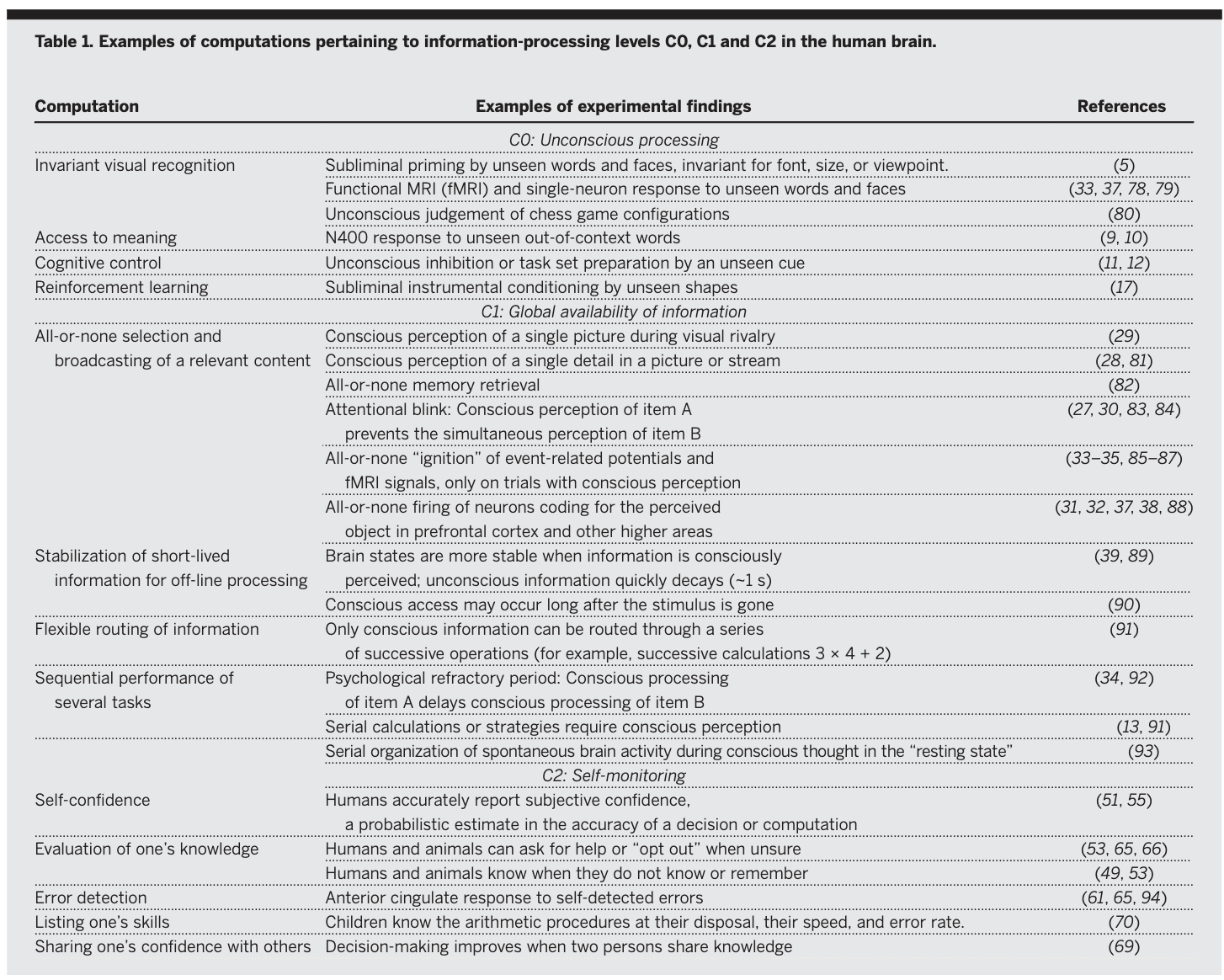
이 섹션에서는 의식의 글로벌 접근 가능성(C1)을 실현하는 뇌의 의식적 병목 현상(conscious bottleneck)에 대한 신경과학적 증거를 제시한다. 인간의 뇌 영상 및 원숭이의 신경 기록 결과에 따르면, 이 병목 현상은 피질 전체에 분포된 신경망(distributed network)을 통해 구현되며, 특히 고차원 연합 영역(high-level associative areas)에 강한 집중도를 보인다. 표 1에 정리된 연구들은 다양한 뇌 영상 기법을 통해 의식적 인식 시 이 네트워크가 실무율(all-or-none) 방식의 점화(ignition) 현상을 보이는 것을 증명했다. 또한 단일 세포 기록(single-cell recordings) 결과에 따르면, 특정한 의식적 인식(예: 얼굴)은 고차원 전두엽 및 측두엽 피질(high-level temporal and prefrontal cortices)의 일부 신경세포가 실무율 방식의 발화(all-or-none firing)로 인코딩되며, 나머지 신경세포는 정지 상태를 유지하는 것으로 나타났다(도 2)(31, 32, 37, 38). 이러한 결과는 글로벌 신경 워크스페이스(global neuronal workspace) 이론과 연결되어, 의식적 정보 통합과 확산 메커니즘의 생물학적 기초를 강화하는 증거로 작용한다.
Stability as a feature of consciousness
Summary
이 섹션에서는 의식(consciousness)의 핵심 특성인 안정성(stability)을 강조하며, 의식적 인식과 무의식적 자극 간의 차이를 분석한다. 실험 결과에 따르면, 의식적 인식은 고차원 피질 영역에서 분산된 활동 패턴을 통해 고품질 정보의 안정적이고 재현 가능한 표현(stable, reproducible representation)을 생성하는 반면, 무의식적 자극은 깊은 피질 네트워크에 영향을 줄 수 있으나 효과가 작고 변동성이 크며, 시간에 따라 빠르게 소멸된다. 특히, 메타안정성(meta-stability)은 다양한 모듈에서 정보를 통합한 후 다시 해당 모듈로 방출하여 유연한 모듈 간 라우팅(cross-module routing)을 가능하게 하는 것으로, 신경계의 정보 통합 메커니즘에 필수적이라고 설명한다. 이는 의식(C1)이 정보 통합 및 조정을 담당하는 구조적 특성과 연결되며, 의식되지 않은 처리(C0)와의 차별화를 명확히 한다. 표 1은 이러한 안정성과 메타안정성의 특성을 정리한 것으로, 의식적 처리의 계산적 우월성을 보여준다.
C1 consciousness in human and nonhuman animals
Summary
이 섹션에서는 C1 의식(global availability)이 인간 신생아뿐만 아니라 동물에서도 나타나는 기본적인 특성임을 강조하며, 비인간 영장류가 인간과 유사한 시각 착각, 주의 깜빡임, 중심 능력 한계 등의 현상을 보인다고 설명한다. 전전두엽(prefrontal cortex)은 인간과 비인간 영장류 모두에서 정보 공유의 중심 장치이자 직렬 병목 구조로 작동하며, 인간 계통에서 전전두엽의 큰 확장은 다감각 수렴과 통합 능력 향상에 기여했을 것으로 보인다. 또한 인간은 하부 전전두엽(inferior prefrontal cortex)에 언어를 통해 정보를 형식화하고 타인에게 보고하는 추가 회로를 갖추고 있어, 이는 정보가 정신 모듈 간 공유가 가능해지므로 C1 의식의 의미에서 의식적 상태가 되는 핵심 요인이다. 즉, 언어는 의식적 인식에 필수적이지 않지만, 언어 회로의 출현은 C1 수준의 정보 공유 속도와 유연성에 큰 영향을 미쳤을 것으로 추정된다.
C1 consciousness is an elementary property that is present in human infants (41) as well as in animals. Nonhuman primates exhibit similar visual illusions (31, 32), attentional blink (42), and central capacity limits (43) as human subjects. The prefrontal cortex appears to act as a central information sharing device and serial bottleneck in both human and nonhuman primates (43). The considerable expansion of the prefrontal cortex in the human lineage may have resulted in a greater capacity for multimodal convergence and integration (44-46). Furthermore, humans possess additional circuits in the inferior prefrontal cortex for verbally formulating and reporting information to others. The capacity to report information through language is universally considered one of the clearest signs of conscious perception because once information has reached this level of representation in humans, it is necessarily available for sharing across mental modules and therefore conscious in the C1 sense. Thus, although language is not required for conscious perception and processing, the emergence of language circuits in humans may have resulted in a considerable increase in the speed, ease, and flexibility of C1-level information sharing.
C2: Self-monitoring
Summary
이 섹션에서는 C2는 스스로에 대한 반추적 사고로 정의될 수 있음을 다룬다. 뇌과학과 심리학의 상당한 증거는 metacognition이라는 단어로 이를 정의하는데, rough하게는 knowing about knowing, cognition about cognition이라고 볼 수 있겠다.
A probabilistic sense of confidence
Summary
이 섹션에서는 인간이 의사결정 시 자신의 선택에 대한 확신(confidence)을 가지는 현상을 확률적 감각(probabilistic sense)으로 정의하며, 이는 결정이나 계산이 올바르게 이루어질 확률을 인식하는 것으로 설명한다. 확신은 학습 과정에서도 중요한 역할을 하며, 인간은 학습한 지식에 대한 신뢰도를 평가해 과거 지식과 현재 증거를 가중치에 따라 비교하는 데 활용한다. 이와 달리 대부분의 현재 신경망(neural networks)은 학습한 내용의 신뢰도나 한계에 대한 메타지식(meta-knowledge)을 부족하게 하며, 확신 모니터링(confidence monitoring) 능력이 결여되어 있다. 다만 생물학적 제약(biologically constrained)을 가진 모델 중 일부는 베이지안 메커니즘(Bayesian mechanisms)을 기반으로 신경회로에서 다수의 확률적 힌트를 통합하는 방식으로 확신의 자동 계산(automatic computation of confidence)을 시뮬레이션하는 데 성공했다. 이러한 모델은 신경 인구(neural populations)가 특정 프로세스 성공 확률을 계산하는 방식을 설명하는 데 유용하지만, 전통적 AI가 다루는 범위만큼의 계산 문제를 해결하지 못하는 한계가 있으며, 딥러닝 네트워크(deep learning networks)에 불확실성 모니터링을 도입하는 데 있어 유망한 방향으로 작용할 수 있다.
Explicit confidence in prefrontal cortex
Summary
이 섹션에서는 전전두엽(prefrontal cortex)에서 발생하는 확신(confidence)의 확률적 특성(probabilistic sense)을 베이지안 접근(Bayesian accounts)의 관점에서 분석한다. 특히, 지역적 피질 회로(local cortical circuits)는 확률 분포를 표현하고 결합하여 처리 과정을 추정하는 메커니즘을 통해 확신의 명확성(explicitness)을 구현할 수 있음을 제시하며, 이는 인간이 의사결정 시 자신의 선택에 대한 신뢰도를 정량적으로 평가하는 데 기여하는 핵심 요소로 설명된다. 베이지안 프레임워크에 따르면, 전전두엽은 다양한 확률 정보를 통합하여 정확성과 불확실성(accuracy and uncertainty)을 동시에 반영하는 확신의 구조적 표현(structural representation of confidence)을 형성하며, 이는 학습 및 의사결정 과정에서의 신뢰도 기반의 적응(adaptive weighting of evidence)과 밀접하게 연결된다.
”…it is useful to distinguish two other essential dimensions of conscious computation.”
Summary
이 섹션에서는 의식적 계산(conscious computation)의 또 다른 핵심 차원인 확신(confidence)의 처리와 관련된 전전두엽(prefrontal cortex)의 역할을 강조한다. 확신 신호(confidence signals)의 명시적 추출 및 조작을 위해 추가적인 신경 회로(neural circuits)가 필요하다는 점이 언급되며, 인간과 영장류, 심지어 쥐에서 수행된 자기 공명 영상(MRI) 및 생리학적 기록은 이러한 확신 처리가 전전두엽과 밀접하게 연관되어 있음을 보여준다. 전전두엽의 비활성화(inactivation)는 1차 과제(first-order task) 수행에는 영향을 주지 않으면서도 2차 판단(second-order judgements, 즉 메타인지(metacognition) 관련 판단)에 특이한 결함을 유발함으로써, 이 회로가 다른 뇌 기능의 수행을 모니터링하는 데 진화적으로 발달했을 가능성을 시사한다.
Error detection: Reflecting on one’s own mistakes
Summary
이 섹션에서는 자기 모니터링(self-monitoring)의 대표적 사례인 오류 탐지(error detection)를 다루며, 인간이 결정 후 자신의 실수를 인식하고 수정하는 메커니즘을 설명한다. 전두엽과 측두엽의 전전두엽(cingulate and medial prefrontal cortex)에서 발생하는 오류 관련 음성(error-relativity negativity, ERN)과 오류 후 양성(positivity upon error, Pe)이라는 두 가지 뇌파(EEG) 성분이, 결정 직후 피드백 없이도 오류를 탐지하는 데 중요한 역할을 한다. 오류 탐지의 가능성을 두 가지로 제시한다. 첫째, 결정 후에도 감각 자극의 증거 축적(sensory evidence accumulation)이 계속되며, 이 증거가 초기 결정과 반대되는 방향으로 가리면 오류가 인식된다. 둘째, 저수준 감각-운동 회로(low-level sensory-motor circuit)와 고수준 의도 회로(higher-level intention circuit)가 동일한 감각 데이터를 병렬적으로 처리하고, 두 회로의 결론이 달라질 때 오류를 신호로 전달하는 방식이다. 이 두 메커니즘은 각각 오류 탐지의 시간적 지연과 빠른 반응 속도를 설명하는 데 유리하다. 특히, 병렬 회로(parallel circuits) 가설은 오류 탐지의 신속성과 일관성을 강조하며, 인간의 자기 반성 능력과 연결되는 자기 참조적 반사성(reflexive self-referentiality)의 신경 기초를 제시한다.
Error detection provides a particularly clear example of self-monitoring; just after responding, we sometimes realize that we made an error and change our mind. Error detection is reflected by two components of electroencephalography (EEG) activity: the error-relativity negativity (ERN) and the positivity upon error (Pe), which emerge in cingulate and medial prefrontal cortex just after a wrong response but before any feedback is received. How can the brain make a mistake and detect it? One possibility is that the accumulation of sensory evidence continues after a decision is made, and an error is inferred whenever this further evidence points in the opposite direction (59). A second possibility, more compatible with the remarkable speed of error detection, is that two parallel circuits, a low-level sensory-motor circuit and a higher-level intention circuit, operate on the same sensory data and signal an error whenever their conclusions diverge (60, 61).
Meta-memory
Summary
이 섹션에서는 인간이 단순히 세계에 대한 지식을 가지는 것을 넘어, 자신이 알고 있는지 혹은 모르는지에 대한 인식(meta-memory)을 다룬다. 예를 들어, 단어가 “혀끝에 닿다”는 경험은 이 개념의 대표적 사례로, 메타메모리(meta-memory)는 기억의 강도와 품질 같은 내부 신호를 모니터링하여 행동을 조절하는 두 번째 차원의 시스템으로 설명된다. 전전두엽(prefrontal cortex)은 이 과정에 핵심적인 역할을 하며, 이 구조의 약물 유발 비활성화는 기억 자체는 보존되지만 메타인지(metacognition) 능력이 손상되는 것으로 나타난다. 메타메모리는 학습 전략 개발(예: 학습량 증가 또는 기억 인코딩 시간 조정)에 필수적이며, 이는 인간의 학습과 교육에 중요한 영향을 미친다.
Reality monitoring
Summary
이 섹션에서는 인간의 뇌가 감각 정보와 기억 표현의 품질을 모니터링하는 데 더해, 자신이 생성한 표현과 외부로부터 유입된 표현을 구분하는 Reality monitoring 기능의 중요성을 강조한다. 특히, 전전두엽(anterior prefrontal cortex)은 이러한 구분 과정에 핵심 역할을 하며, 정신분열병 환자의 환각(schizophrenia hallucinations)은 이 기능의 장애와 관련이 있다는 연구 결과가 제시된다. 비인간 영장류 실험에서는 전전두엽의 신경세포가 일반적인 시각 인식과 기억을 통한 동일한 시각 정보의 유지 사이를 구분하는 데 관여함을 보여주며, 이는 인간과 동물의 현실 인식 메커니즘에 대한 이해를 확장하는 데 기여한다.
In addition to monitoring the quality of sensory and memory representations, the human brain must also distinguish self-generated versus externally driven representations. Indeed, we can perceive things, but we also conjure them from imagination or memory. Hallucinations in schizophrenia have been linked to a failure to distinguish whether sensory activity is generated by oneself or by the external world (62). Neuroimaging studies have linked this kind of reality monitoring to the anterior prefrontal cortex (63). In nonhuman primates, neurons in the prefrontal cortex distinguish between normal visual perception and active maintenance of the same visual content in memory (64).
Foundations of C2 consciousness in infants
Summary
이 섹션에서는 C2 의식(자기 모니터링)이 신생아 단계부터 이미 존재함을 실증한다. 1세 아동은 시각적 판단 과제에서 오류를 범했을 때 오류 관련 음성(ERN)이 관찰되었으며, 1.5세 아동은 보물이 숨겨진 상자 중 하나를 가리킬 때, 초기 선택이 옳았을 경우 보상이 지연된 시간이 더 길었다는 점에서 자신의 결정 정확도를 모니터링하는 것으로 보인다(57, 65). 또한, 자신의 오류 가능성에 대한 사전 추정(prospective estimate)을 바탕으로 도움 요청이라는 선택지를 활용한 사례(66)는 메타인지 정보(metacognitive information)를 의식적으로 경험하고 있음을 시사한다. 이는 C2 메커니즘이 아동이 모르는 영역에 적극적으로 집중할 수 있는 호기심(curiosity)이라는 메커니즘을 가능하게 하는 기초를 제공함을 보여준다.
Dissociations between C1 and C2
Summary
이 섹션에서는 C1과 C2가 의식의 주요 차원으로서 서로 직교하고 보완적인 관계에 있음을 강조한다. 한편의 분리에서는 자기 모니터링(C2)이 의식적 보고(C1) 없이도 존재할 수 있다. 예를 들어, 자동 타이핑 시 타자 오류가 발생하더라도 의식적으로 인지하지 못하더라도 속도가 줄어드는 현상에서 확인되며, 신경 수준에서는 주관적으로 인식되지 않은 오류에도 오류 관련 음성(ERN)이 발생한다. 반면, 다른 측면에서는 의식적 보고(C1)가 존재하더라도 확신(C2)이 부족할 수 있다. 기억을 떠올릴 때 의식적으로 내용이 떠오르더라도 그 정확도에 대한 평가가 부재해 가짜 기억을 유발하는 경우가 있다. 마빈 민스키는 C1 의식이 뇌의 다른 영역에서 일어나는 복잡한 병렬적 계산을 한 부분에서 불완전하게 요약한 것이라 지적하며, 글로벌 워크스페이스(global workspace)가 확률적 정보를 단일 샘플로 축소하는 과정에서 정보 손실이 발생해 인식의 과신을 유발한다고 설명한다. 이는 확률적 계산의 병렬적 흐름을 단일 의식적 샘플로 축소하는 구조적 한계에서 비롯된 것으로, 결과적으로 주체는 자신의 인식 정확도를 과대평가하는 경향을 보인다.
ERN(Error Related Negativity)
EEG(뇌전도, 두피에 전극을 부착하여 뉴런들의 전기적 활동 변화 측정.) 지표 중 하나로 자기 모니터링의 증거로 뇌과학에서 많이 다루어짐. 사람이 실수를 저질렀을 때, 그 실수 직후(50-100ms) 뇌의 전두엽 중앙부(Anterior Cingulate Cortex, ACC)에서 발생하는 negative 전위를 말함.
이 ERN이 스스로의 오류 인지랑 별개로 일어나서, C2 w/o C1이 설명됨.
Synergies between C1 and C2 consciousness
Summary
이 섹션에서는 C1과 C2 의식의 상호작용이 생물체에 시너지 효과를 제공한다고 설명한다. C2의 확률적 메타인지 정보가 C1의 전역 작업 공간에 통합되면, 시간에 걸쳐 유지되고 명확한 장기적 반성에 통합되어 타인과 공유될 수 있으며, 이는 집단 의사결정 시 신뢰도 신호를 공유함으로써 개인보다 우수한 성과를 이끌어낸다. 반대로, C2의 명확한 능력 범위는 C1 정보 처리 효율을 향상시키는데, 예를 들어 아이들이 정신 산술 시 자신의 능력을 평가하고 문제 해결 전략을 수립하는 방식이 이에 해당한다. 이러한 기능은 다양한 모듈 간 신뢰도에 대한 공통 통화(common currency)가 필요하며, 인간은 이를 보유하고 있는 것으로 보인다.
Endowing machines with C1 and C2
Summary
이 섹션에서는 기계에 **C1(글로벌 정보 접근성)**과 C2(자기 모니터링) 능력을 부여하는 방법을 탐구한다. 예를 들어, 자동차의 연료 경고등은 현재 기계에서 **의식 없는 모듈 신호(C0)**의 대표적인 사례로, 경고등이 켜졌을 때 다른 모듈이 정보를 공유하거나 협업하지 않아 연료가 계속 주입되고 주유소를 지나치는 문제가 발생한다. 이와 달리, C1을 구현한 기계는 연료 수준 정보를 공유하여 모듈 간 협업을 통해 문제를 해결할 수 있다. 1960년대에 설계된 **“블랙보드 시스템”**과 최근 Pathnet 아키텍처는 모듈 간 유연한 정보 공유를 가능하게 하며, Pathnet은 유전 알고리즘을 통해 다양한 작업에 적합한 신경망 경로를 학습하여 원숭이와 유사한 의식적 유연성을 보인다.
C2를 구현하려면 기계가 스스로의 능력과 한계를 모니터링하는 자가 인식 기능이 필요하다. 예를 들어, 자동차는 현재 위치와 연료 소비량, 내부 데이터베이스(예: GPS 주유소 정보)를 통합적으로 인식해야 하며, 하위 프로그램의 성공 확률을 추정하고 업데이트해야 한다. 현재 대부분의 기계 학습 시스템은 자기 모니터링(C2) 없이 C0 수준의 작업만 수행하지만, 베이지안 네트워크나 Pathnet과 같은 아키텍처는 확률 분포를 활용하여 자신의 정확도를 추적하고, CNN의 성능을 예측하는 이중 신경망 구조를 통해 메타인지적 내부 모델을 형성하는 데 성공했다.
또한 **C2의 핵심 요소인 ‘현실 모니터링’**은 자가 생성 정보와 외부 정보를 구분하는 능력으로, 정신분열병 환자의 환각과 같은 문제를 해결하는 데 중요하다. 이는 인간의 전전두엽이 감각 정보와 기억 표현의 품질을 모니터링하는 방식과 유사하다. 실험적으로 1.5세 아동은 오류 발생 시 더 오랜 시간 선택한 상자에서 물건을 찾는 자기 모니터링의 초기 증거를 보였으며, EEG 신호는 오류와 관련된 음성을 드러냈다. 이러한 메타인지 능력은 자연스러운 인간 의식에 가까운 기계를 구현하는 데 기여할 수 있다.
How could machines be endowed with C1 and C2 computations? Let us return to the car light example. In current machines, the “low gas”light is a prototypical example of an unconscious modular signal (C0). When the light flashes, all other processors in the machine remain uninformed and unchanged; fuel continues to be injected in the carburetor, and the car passes gas stations without stopping (although they might be present on the GPS map). Current cars or cell phones are mere collections of specialized modules that are largely “unaware” of each other. Endowing this machine with global information availability (C1) would allow these modules to share information and collaborate to address the impending problem (much like humans do when they become aware of the light, or elephants of thirst).
Although AI has met considerable success in solving specific problems, implementing multiple processes in a single system and flexibly coordinating them remain difficult problems. In the 1960s, computational architectures called “blackboard systems” were specifically designed to post information and make it available to other modules in a flexible and interpretable manner, similar in flavor to a global workspace (20). A recent
architecture called Pathnet uses a genetic algorithm to learn which path through its many specialized neural networks is most suited to a given task (72). This architecture exhibits robust, flexible performance and generalization across tasks and may constitute a first step toward primatelike conscious flexibility.
To make optimal use of the information provided by the fuel-gauge light, it would also be useful for the car to possess a database of its own capacities and limits. Such self-monitoring (C2) would include an integrated image of itself including its current location and fuel consumption, for example—as well as its internal databases (such as “knowing” that it possesses a GPS map that can locate gas stations). A self-monitoring machine would keep a list of its subprograms, compute estimates of their probabilities of succeeding at various tasks, and constantly update them (for example, noticing when a part fails). Most present-day machine-learning systems are devoid of any self-monitoring; they compute (C0) without representing the extent and limits of their knowledge or the fact that others may have a different viewpoint than their own. There are a few exceptions: Bayesian networks (54) or programs (73) compute with probability distributions and therefore keep track of how likely they are to be correct. Even when the primary computation is
performed by a classical CNN, and is therefore opaque to introspection, it is possible to train a second, hierarchically higher neural network to predict the first one’s performance (47). This approach, in which a system redescribes itself, has been claimed to lead to “the emergence of internal models that are meta-
cognitive in nature and… make it possible for an agent to develop a (limited, implicit, practical) understanding of itself” (48). Pathnet (72) uses a related architecture to track which internal configurations are most successful at a given task and use this knowledge to guide subsequent processing. Robots have also been programed to monitor their learning progress and use it to orient resources toward the problems that maximize information gain, thus implementing a form of curiosity (74).
An important element of C2 that has received relatively little attention is reality monitoring.

“…the ability to reflexively represent oneself.”
Fig. 3. Self-monitoring: Consciousness in the second sense (C2). Self-monitoring (also called “meta-cognition”), the capacity to reflect on one’s own mental state, is available early during infancy. (Top) One-and-a-half-year-old infants, after deciding to point to the location of a hidden toy, exhibit two types of evidence for self-monitoring of their decision. (i) They persist longer in searching for the hidden object within the selected box when their initial choice was correct than when it was incorrect. (ii) When given the opportunity to ask for help, they use this option selectively to reduce the probability of making an error. (Bottom) One-year-old infants were presented with either a meaningless pattern or a face that was either visible or invisible (depending on its duration) and then decided to gaze left or right in anticipation of face reappearance. As for manual search, post-decision persistence in waiting at the same gaze location increased for correct compared with incorrect initial decisions. Moreover, EEG signals revealed the presence of the error-related negativity over fronto-central electrodes when infants make an incorrect choice. These markers of metacognition were elicited by visible but not by invisible stimuli, as also shown in adults (61).
Bayesian approaches to AI (2, 73) have recognized the usefulness of learning generative models that can be jointly used for actual perception (present), prospective planning (future), and retrospective analysis (past). In humans, the same sensory areas are involved in both perception and imagination. As such, some mechanisms are needed to tell apart self-generated versus externally triggered activity. A powerful method for training generative models, called adversarial learning (75), involves having a secondary network “compete” against a generative network so as to critically evaluate the authenticity of self-generated representations. When such reality monitoring (C2) is coupled with C1 mechanisms, the resulting machine may more closely mimic human consciousness in terms of affording global access to perceptual representations while having an immediate sense that their content is a genuine reflection of the current state of the world.
Concluding remarks
Summary
이 섹션에서는 의식을 특정 유형의 정보 처리 계산에 근거한 물리적 하드웨어(뇌)의 구현으로 정의하는 가설을 제시한다. 이 접근법은 정보 이론적 양만으로는 의식을 설명할 수 없으며, 처리되는 정보의 성격과 깊이도 고려해야 한다는 점에서 기존 이론과 구분된다. **C1(글로벌 정보 접근성)**과 C2(자기 모니터링) 기능을 갖춘 기계는 인간처럼 ‘어떤 것을 보고 있음을 인지하고’, ‘확신을 표현하며’, ‘타인에게 보고할 수 있으며’, ‘모니터링 시스템 장애 시 환각을 경험할 수 있다’는 점에서 의식을 가진 것처럼 행동할 수 있다고 주장한다. 그러나 이는 철학적 질문을 일으키는데, 고차원 인지 기능이 반드시 의식과 연결되어야 하는지, 주관적 경험(“what it is like”)을 계산적 정의로 포착할 수 있는지에 대한 의문이 제기된다. 다만, 경험적으로 인간의 C1과 C2 계산 손실이 주관적 경험의 감소와 상관관계를 보이는 사례가 존재한다. 예를 들어, 주시 시각피질 손상으로 인한 블라인드사이트(blindsight) 환자는 시야 손상 영역의 자극을 위치로 인식할 수 있지만, **C1(보고)**와 C2(결과 가능성 평가) 기능이 상실되어 ‘추측 중’이라고 믿는다. 이는 주관적 경험과 C1/C2 보유 간의 일관성을 보여준다. 철학적 이중주의는 의식을 물리적 상호작용으로 환원할 수 없다고 보지만, 경험적 증거는 특정 계산만으로도 의식이 발생할 수 있음을 시사한다.
Our stance is based on a simple hypothesis: What we call “consciousness” results from specific types of information-processing computations, physically realized by the hardware of the brain. It differs from other theories in being resolutely computational; we surmise that mere informationtheoretic quantities (76) do not suffice to define consciousness unless one also considers the nature and depth of the information being processed.
We contend that a machine endowed with C1 and C2 would behave as though it were conscious; for instance, it would know that it is seeing something, would express confidence in it, would report it to others, could suffer hallucinations when its monitoring mechanisms break down, and may even experience the same perceptual illusions as humans. Still, such a purely functional definition of consciousness may leave some readers unsatisfied. Are we “over-intellectualizing” consciousness, by assuming that some high-level cognitive functions are necessarily tied to consciousness? Are we leaving aside the experiential component (“what it is like” to be conscious)? Does subjective experience escape a computational definition?
Although those philosophical questions lie beyond the scope of the present paper, we close by noting that empirically, in humans the loss of C1 and C2 computations covaries with a loss of subjective experience. For example, in humans, damage to the primary visual cortex may lead to a neurological condition called “blindsight,” in which the patients report being blind in the affected visual field. Remarkably, those patients can localize visual stimuli in their blind field but cannot report them (C1), nor can they effectively assess their likelihood of success (C2)—they believe that they are merely “guessing.” In this example, at least, subjective experience appears to cohere with possession of C1 and C2. Although centuries of philosophical dualism have led us to consider consciousness as unreducible to physical interactions, the empirical evidence is compatible with the possibility that consciousness arises from nothing more than specific computations.