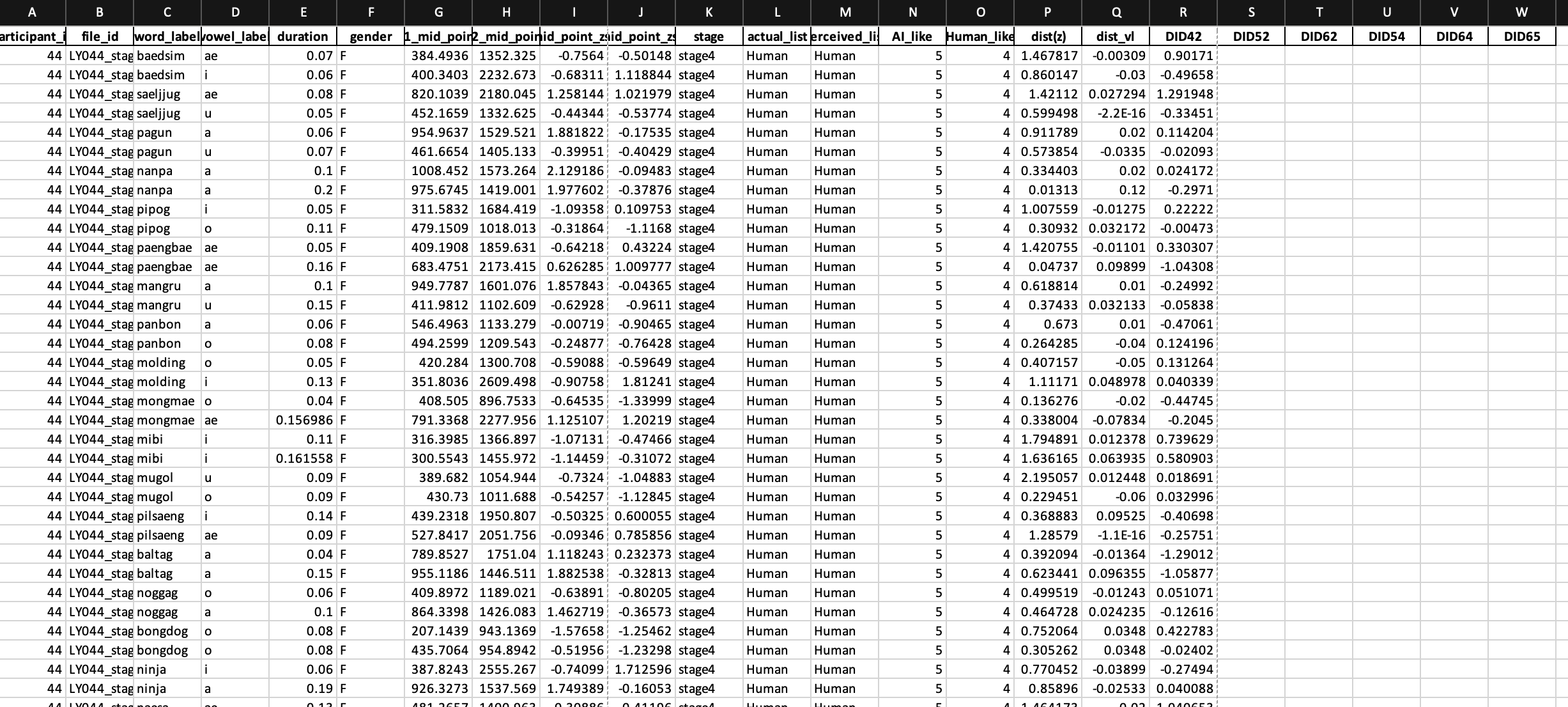
일단 수렴 경향성은 gender가 확실히 관여하는 것처럼 보인다. (평균이 음수쪽 + 분포가 음수 영역에 skewed.)
Question
데이터를 보면서 든 생각은 block에 대한 main-effect가 잡히려면, 일단 수렴을 보이는 사람에 대해서 돌리는 게 맞지 않을까?
보려고 하는게, 일단 수렴하는 사람들이 AI라는 지표에 대해 발산하는지 여부이니까.
그리고 보는 것처럼 남자들은 수렴이 잘 되지도 않은 경우가 있어서, 흠,,
Summary
# gender 차이?formula = 'DID42 ~ C(gender)' # regression formulavc_formula = { # variance component formula "vowel": "0 + C(vowel_label)", "word": "0 + C(word_label)" }re_formula = '~1' # random slope formula / '~C(vowel_label)' 는 수렴하지 않아서 제외.model = MixedLM.from_formula(formula, data=analysis_df.dropna(subset=['DID42'], inplace=False), groups='participant_id', vc_formula=vc_formula, re_formula=re_formula ).fit()model.summary()
intercept 즉, baseline case로 분류된 유의미하게 수렴하는 걸로 값이 잡힘. → 여성은 수렴함.
male variable은 유의미하지 않음. 양수 값이니, 여성 보다는 발산하는 경향이나, 유의미 하지는 않음.
즉, 성비에 의한 차이는 발견되지 않음. : 둘 다 수렴한다고 볼 수는 있겠으나? 위의 histplot의 결과랑은 좀 다른 것 같음.
→ 남녀 데이터 쪼개서 각각 reg.
Multi column
Male
# gender 차이?formula = 'DID42 ~ 1' # regression formulavc_formula = { # variance component formula "vowel": "0 + C(vowel_label)", "word": "0 + C(word_label)" }re_formula = '~1' # random slope formula / '~C(vowel_label)' 는 수렴하지 않아서 제외.model = MixedLM.from_formula(formula, data=analysis_df.dropna(subset=['DID42'], inplace=False)[male_mask], groups='participant_id', vc_formula=vc_formula, re_formula=re_formula ).fit()model.summary()
Female
# gender 차이?formula = 'DID42 ~ 1' # regression formulavc_formula = { # variance component formula "vowel": "0 + C(vowel_label)", "word": "0 + C(word_label)" }re_formula = '~1' # random slope formula / '~C(vowel_label)' 는 수렴하지 않아서 제외.model = MixedLM.from_formula(formula, data=analysis_df.dropna(subset=['DID42'], inplace=False)[female_mask], groups='participant_id', vc_formula=vc_formula, re_formula=re_formula ).fit()model.summary()
혹은 power를 유지하면서 하려면, intercept를 0으로 지정해서 baseline을 삭제.
Summary
# gender 차이?formula = 'DID42 ~ 0 + C(gender)' # regression formulavc_formula = { # variance component formula "vowel": "0 + C(vowel_label)", "word": "0 + C(word_label)" }re_formula = '~1' # random slope formula / '~C(vowel_label)' 는 수렴하지 않아서 제외.model = MixedLM.from_formula(formula, data=analysis_df.dropna(subset=['DID42'], inplace=False), groups='participant_id', vc_formula=vc_formula, re_formula=re_formula ).fit()model.summary()
여성 수렴, 남성 수렴하지 않음.
Summary
여성은 유의미하게 수렴, 그러나 남성은 그렇지 않음. → 위의 gender를 변수로 넣고 회귀한 거랑 상반!
power 생각하면, 위의 gender 회귀가 더 신뢰할만함.
따라서 기술 시에는 성별에의한차이는발견되지않았으나, 전반적으로수렴하는경향성은확인. 그러나남성의경우에는통계적으로확신할만큼데이터가충분치못했거나, 분산이컸다.
by vowel
Summary
# vowel?formula = 'DID42 ~ 0 + C(vowel_label)' # regression formulavc_formula = { # variance component formula #"vowel": "0 + C(vowel_label)", "word": "0 + C(word_label)" }re_formula = '~1' # random slope formula / '~C(vowel_label)' 는 수렴하지 않아서 제외.model = MixedLM.from_formula(formula, data=analysis_df.dropna(subset=['DID42'], inplace=False), groups='participant_id', vc_formula=vc_formula, re_formula=re_formula ).fit()model.summary()
i, u는 매우 유의미하게 수렴.
babel에서는 ae가 잘 수렴한다고 했는데, gender랑 interaction 이었나?
gender X vowel
Summary
# vowel?formula = formula = 'DID42 ~ 0 + C(vowel_label):C(gender)' # regression formulavc_formula = { # variance component formula #"vowel": "0 + C(vowel_label)", "word": "0 + C(word_label)" }re_formula = '~1' # random slope formula / '~C(vowel_label)' 는 수렴하지 않아서 제외.model = MixedLM.from_formula(formula, data=analysis_df.dropna(subset=['DID42'], inplace=False), groups='participant_id', vc_formula=vc_formula, re_formula=re_formula ).fit()model.summary()
수렴 조건:
F
a, ae, i,
M
iu
mask를 사용해서 아래처럼, 모음 별로만 gender effect 계산.
p-val은 줄 수도 있다.
SE=NSD
데이터를 유사한 것만 sampling해서 돌리면, SD가 N 보다 훨씬 크게 줄어드는 경우에 한해.
아닌 case도 있겠지.
데이터 사이즈는 줄어서, power는 줄겟지만,,
그리고 위의 결과가 더 수렴하는 것이 많다.
Multi column
a
ae
i
o
u
Summary
convergence:
F
a, i
M
Analysis2. AI / Human information cue가 convergence에 영향을 주는가?
Summary
list별 차이를 보는게 목적이라 intercept에 baseline 부여.
# vowel?formula = formula = 'DID54 ~ C(actual_list)' # regression formulavc_formula = { # variance component formula "vowel": "0 + C(vowel_label)", "word": "0 + C(word_label)" }re_formula = '~1' # random slope formula / '~C(vowel_label)' 는 수렴하지 않아서 제외.model = MixedLM.from_formula(formula, data=analysis_df.dropna(subset=['DID54'], inplace=False), groups='participant_id', vc_formula=vc_formula, re_formula=re_formula ).fit()model.summary()
단순조건별차이로는유의미한차이없음. 다만, coeff 차이가있으니, sample size 문제일지도,,
baseline을 넣고 각각 수렴 여부를 본다면,,
‘C(actual_list)’ → ‘0 + C(actual_list)’
Warning
여기서 문제인게 task2이전 즉, task1 block까지는 제공하는 정보의 차이가 없어서 모두 균일해야 하지만, 실험 대상자의 데이터를 실제로 보면, 음성 수렴 자체를 하지 않은 그룹이 몰려 있음. 따라서 정말 수렴 →발산을 보려면 수렴한 사람들을 먼저 filtering하고 그들만 tracking해야 함.
# list 별 차이를 task2 이전에 있는지 check. list 분기 전이라 다르면 안 됨.formula = formula = 'DID42 ~ C(actual_list)' # regression formulavc_formula = { # variance component formula "vowel": "0 + C(vowel_label)", "word": "0 + C(word_label)" }re_formula = '~1' # random slope formula / '~C(vowel_label)' 는 수렴하지 않아서 제외.model = MixedLM.from_formula(formula, data=analysis_df.dropna(subset=['DID42'], inplace=False), groups='participant_id', vc_formula=vc_formula, re_formula=re_formula ).fit()model.summary()
그렇다면, 위의 회귀에는 수렴을 하지도 않은 사람들이 들어가 있어서, 이대로 해석하면 안된다.
→ 음성 수렴 기준을 설정하고 이들만 다시 회귀.
Question
음성 수렴 기준: pre-task에서 task2으로 진행했을 때, DID가 음수.
사람마다 여러번 발음해서 가지고 있는 DID가 여러개라, 그 평균이 음수 인걸로 기준.
Check
위 기준에 따라 filtering하면 살아남는 사람들은 list, gender로 아래와 같다.
각 참가자 당 DID42는 300개 있다. 즉, human male class에는 단 4명만 assigned. → 너무 표본이 작은데,,
49명 중 33명(67%)만 수렴.
Summary
# list 별 차이가 task1 - task2에 있는지 check. formula = formula = 'DID54 ~ 0 + C(actual_list)' # regression formulavc_formula = { # variance component formula "vowel": "0 + C(vowel_label)", "word": "0 + C(word_label)" }re_formula = '~1' # random slope formula / '~C(vowel_label)' 는 수렴하지 않아서 제외.model = MixedLM.from_formula(formula, data=analysis_df.dropna(subset=['DID54'], inplace=False)[convergence_mask], groups='participant_id', vc_formula=vc_formula, re_formula=re_formula ).fit()model.summary()
DID 값이 회귀 예측 변수이고, intercept에 baseline case를 넣지 않았으므로, 각각 가설의 기각 여부를 보면 됨. 즉, 각 변수는 전 단계와 달아졌나? 를 의미.
일달 AI, Human case 모두 통계적으로 유의미한 검정이 이루어 지지 않았지만 그래도 coeff를 보면, Human이 더 발산한다.
또한, AI 의 경우, p 값도 굉장히 크니까, 일반적으로 전단계에서 진행된 음성 수렴이 변하지 않고 그대로 유지됐다고 보는 게 타당하다.
그러면 물어볼 수 있는 것은 label 제시한 것이 수렴에 유의미한 차이를 주었나?
→ intercept에 baseline 제거
# list 별 차이가 task1 - task2에 있는지 check. formula = formula = 'DID54 ~ C(actual_list)' # regression formulavc_formula = { # variance component formula "vowel": "0 + C(vowel_label)", "word": "0 + C(word_label)" }re_formula = '~1' # random slope formula / '~C(vowel_label)' 는 수렴하지 않아서 제외.model = MixedLM.from_formula(formula, data=analysis_df.dropna(subset=['DID54'], inplace=False)[convergence_mask], groups='participant_id', vc_formula=vc_formula, re_formula=re_formula ).fit()model.summary()
그것도 아님.
Question
interaction이 있어서 전체적으로 보면 안 잡히는 걸까?
by gender x actual_list
Summary
# list 별 차이가 task1 - task2에 있는지 check. formula = formula = 'DID54 ~ 0 + C(actual_list):C(gender)' # regression formulavc_formula = { # variance component formula "vowel": "0 + C(vowel_label)", "word": "0 + C(word_label)" }re_formula = '~1' # random slope formula / '~C(vowel_label)' 는 수렴하지 않아서 제외.model = MixedLM.from_formula(formula, data=analysis_df.dropna(subset=['DID54'], inplace=False)[convergence_mask], groups='participant_id', vc_formula=vc_formula, re_formula=re_formula ).fit()model.summary()
모든 조건에 대해 통계적으로 유의하진 않지만,
AI 조건에서는 여성은 발산, 남성은 수렴.
Human 조건에서는 여성은 수렴, 남성은 발산. 남성과여성의 pattern이다르다는점은흥미로움.
by list x gender x vowel
Summary
# list 별 차이가 task1 - task2에 있는지 check. formula = formula = 'DID54 ~ 0 + C(actual_list):C(gender):C(vowel_label)' # regression formulavc_formula = { # variance component formula #"vowel": "0 + C(vowel_label)", "word": "0 + C(word_label)" }re_formula = '~1' # random slope formula / '~C(vowel_label)' 는 수렴하지 않아서 제외.model = MixedLM.from_formula(formula, data=analysis_df.dropna(subset=['DID54'], inplace=False)[convergence_mask], groups='participant_id', vc_formula=vc_formula, re_formula=re_formula ).fit()model.summary()
수렴 조건
M, AI,
ae, i, o
F, Human, i
F, AI, o 남성과여성의 pattern이다르다는점은흥미로움.
Analysis3. Post-task block에서 다시 diverge?
Analysis 3-1. pre-task to post-task(!!)
Summary
list 간 차이를 보자.
대상은 수렴이 일어난 사람들에 대해서만,,
# list 별 차이가 task1 - task2에 있는지 check. formula = formula = 'DID62 ~ 0 + C(actual_list)' # regression formulavc_formula = { # variance component formula "vowel": "0 + C(vowel_label)", "word": "0 + C(word_label)" }re_formula = '~1' # random slope formula / '~C(vowel_label)' 는 수렴하지 않아서 제외.model = MixedLM.from_formula(formula, data=analysis_df.dropna(subset=['DID62'], inplace=False)[convergence_mask], groups='participant_id', vc_formula=vc_formula, re_formula=re_formula ).fit()model.summary()
음성 수렴이 일어난 사람들에 대해서 보자면,
AI list의 경우, voice와 상호작용 후 닮아진 정도가 조금 더 남아 있지만,(통계적으로 유의미하게)
Human의 경우, voice와 상호작용 후 다시 원래 발음으로 돌아왔다? (통계적으로 유의미하지 않게)
사실 이 부분에 한해서는 metric이 L2-Euclidean distanced인게 좀 아쉽긴 한데,
by gender x list
Summary
list 간 차이를 보자.
대상은 수렴이 일어난 사람들에 대해서만,,
# list 별 차이가 task1 - task2에 있는지 check. formula = formula = 'DID62 ~ 0 + C(actual_list):C(gender)' # regression formulavc_formula = { # variance component formula "vowel": "0 + C(vowel_label)", "word": "0 + C(word_label)" }re_formula = '~1' # random slope formula / '~C(vowel_label)' 는 수렴하지 않아서 제외.model = MixedLM.from_formula(formula, data=analysis_df.dropna(subset=['DID62'], inplace=False)[convergence_mask], groups='participant_id', vc_formula=vc_formula, re_formula=re_formula ).fit()model.summary()
모든 셀에 대해 통계적으로는 유의미하지 않지만,
AI list는 gender에 무관하게 coeff가 음수 post-task에서도 여전히 수렴 영향이 남아 있고,
/f1-boxplot.png)
/f2-boxplot.png)
/EDA(1118)/f1-boxplot-1118.png)
/EDA(1118)/f2-boxplot-1118.png)
/full-convergence-hist.png)
/full-convergence-mean.png)
/full-convergence-reg.png)
/male-convergence-hist.png)
/female-convergence-hist.png)
/convergence-test-gender.png)
/gender-main-eff-reg.png)
/male-only-convergence.png)
/female-only-convergence.png)
/gender-main-eff-reg-no-base.png)
/vowel-main-effect-mean.png)
/vowel-main-effect-reg.png)
/gender-vowel-interaction.png)
/vowel-gender-interaction-reg.png)
/a-gender-reg.png)
/ae-gender-reg.png)
/i-gender-reg.png)
/o-gender-reg.png)
/u-gender-reg.png)
/DID54-full-table.png)
/DID54-full-reg.png)
/DID54-full-reg-baseline.png)
/DID42-list-main-eff-table.png)
/dist-list-eff-biased.png)
/DID42-list-main-eff-reg.png)
/convergence-filtering-DID42.png)
/DID54-conv-reg.png)
/DID54-conv-reg-bassline.png)
/DID54-gender-list-reg.png)
/DID54-list-gender-vowel-reg.png)
/pre-post-reg.png)
/DID62-list-gender-reg.png)