Nonlinearity
- 복잡한 현실 세계의 복잡한 함수를 다루기 위해
- matrix의 matmul이 결국 linear하니까, non-linear 함수를 중간에 끼지 않는 이상 결국은 하나의 큰 선형 시스템을 벗어날 수 없음. 세상이 선형함수로만 설명 가능할리 없잖아,,
→ 선형 연산을 거듭해도 선형.
Numerical Proof
Assume that,
where , ,
ReLU
one of non-linear activation
In this time, it is impossible to distinguish below 2 models,
where
→ 결국 linear
→ 그러니 non-linear function을 activation으로 사용하자!!
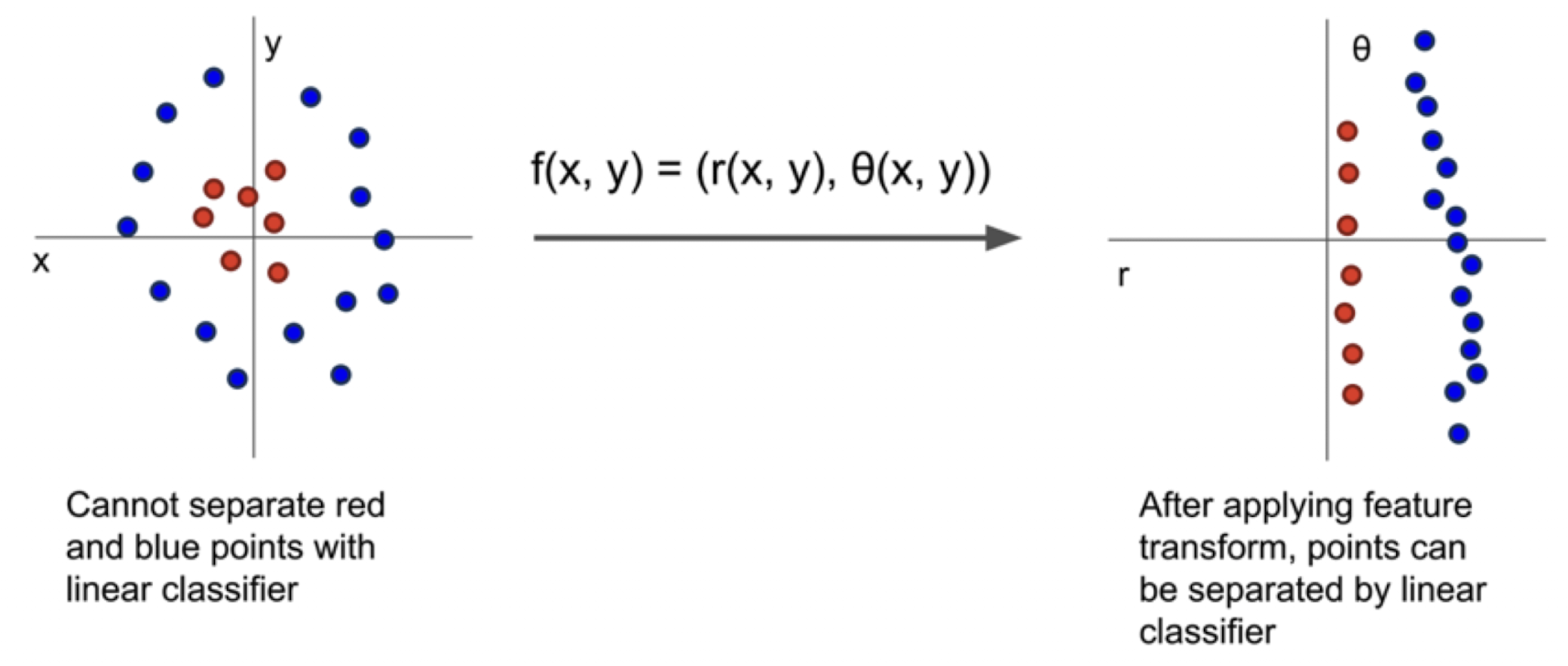
Linearly Separable ← 고민 좀 해보자. 왜 좋냐?
Important
non-linear map은 data를 linearly-separable하게 바꿀 수 있다.
Examples
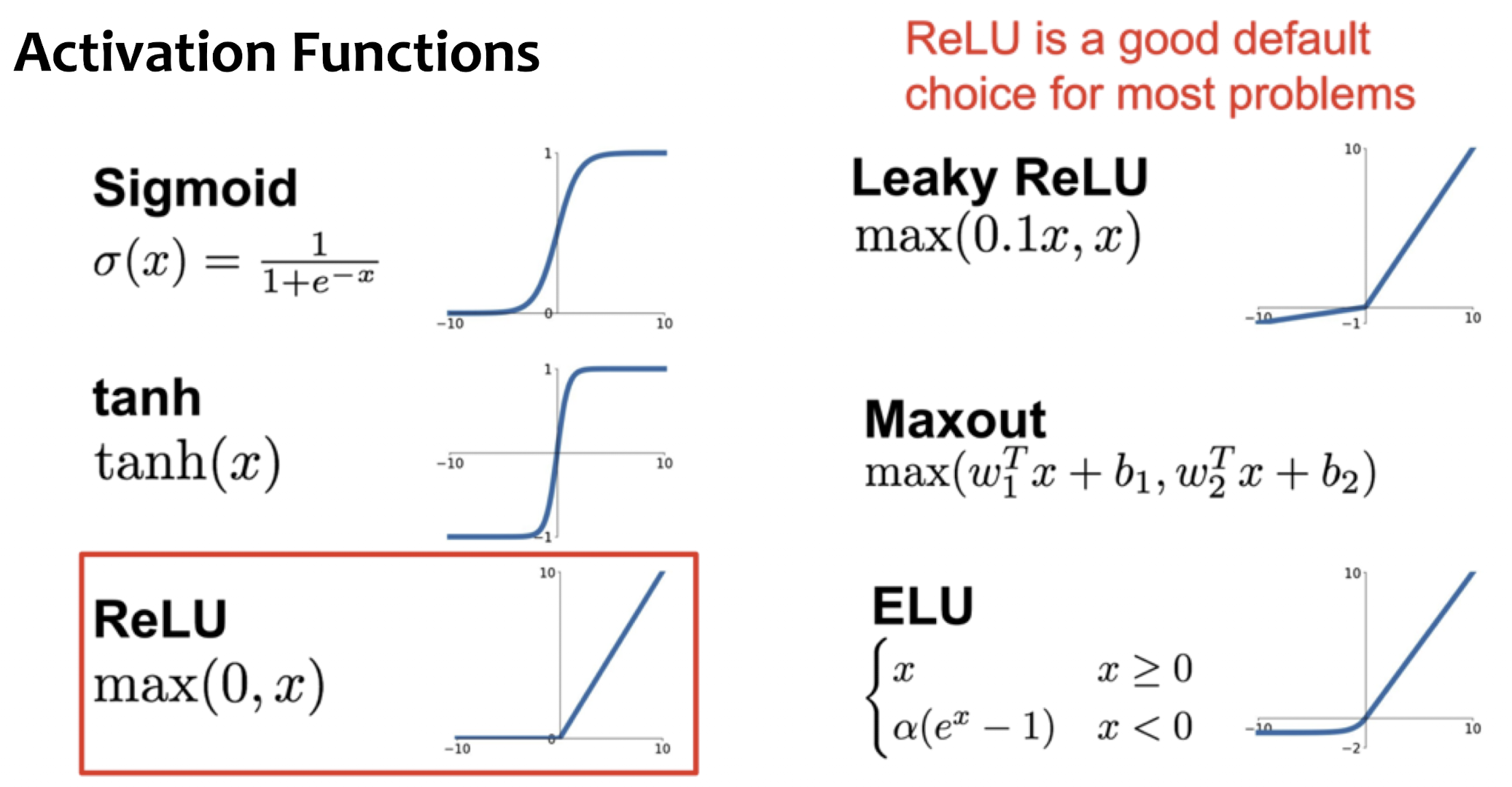
Activation Functions
- 나중에 transformer 계열에 최근 가장 많이 사용되는 GeLU 계열이나 찾아볼 것.
Summary
- No one-size-fits-all: Choice of activation function depends on problem.
- We only showed the most common ones, there exist many more
- Best activation function / model is often using trial-and-error in practice
- It is important to ensure a good “gradient flow” during optimization
Rule of Thumb
- Use ReLU by default(with small enough lr)
- Try Leaky ReLU, Maxout, ELU for some small additional gain
- Prefer Tanh over sigmoid(Tanh often used in RNNs)
ReLU
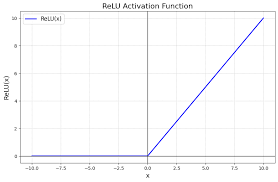
ReLU(Rectified Linear Unit)
- activation 중 하나로 대표적으로 많이 사용됨.
- Does not saturate(for )
- Leads to fast convergence
- Computationally efficient
Problems
- No learning for → dead/dying ReLU
- downstream gradient가 0(input이 0 이하일 때,)
- often initialize with pos. bias ()
- Outputs are not zero-centered → introduces bias after the layer
- sigmoid와 그 gradient는 항상 positive이기 때문에 model wight의 bias
- 라 할 때, =
- 모든 gradient는 동일한 부호를 가짐.
다음과 같이 구현.
ReLU
def relu(x: float) -> float:
	return np.maximum(0, x)
- 단점들 보안을 위해 Leaky ReLU 등이 있음.
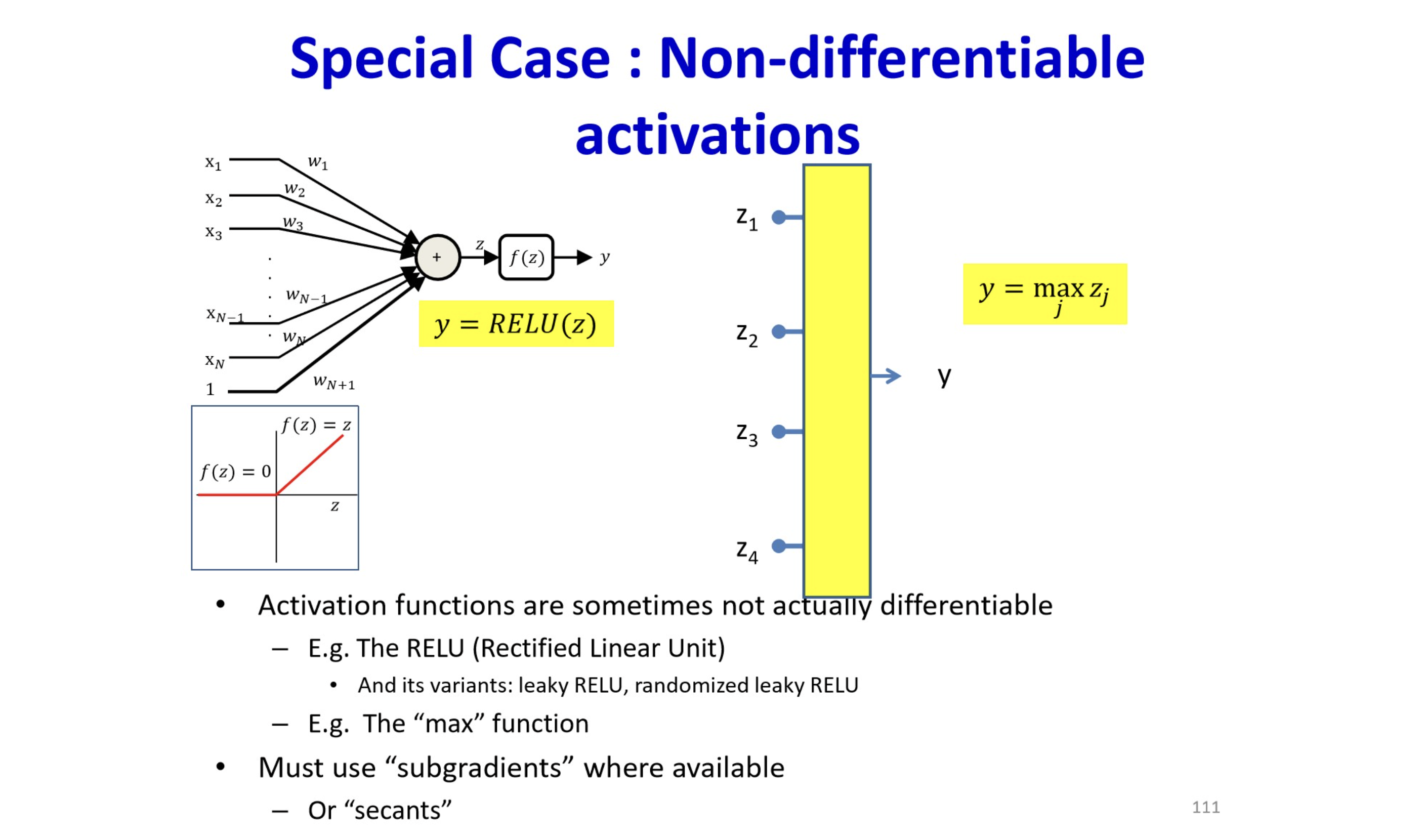
원본 링크How can we calculate non-differentiable function (like ReLU)?
Sigmoid
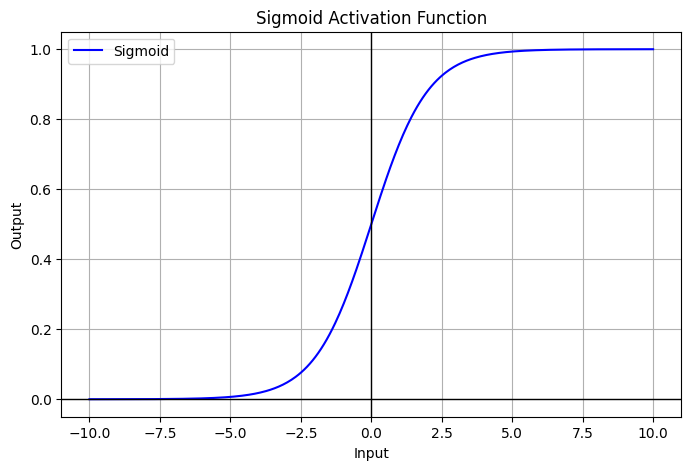
Sigmoid
- activation 중 하나로 대표적으로 많이 사용됨.
- range:
- Neuroscience interpretation as saturating “firing rate” of neurons
Problems
- Saturation “kills” gradient : 입력 값의 절댓값이 커질수록 기울기 소실
- 특히나 layer가 깊어질수록, chain-rule에 의해 곱해지는 term들이 많아질텐데, 그러면 앞 쪽에 있는 layer 들일수록 learning되지 않을 수 있지.
- Outputs are not zero-centered → introduces bias after the layer
- sigmoid와 그 gradient는 항상 positive이기 때문에 model wight의 bias
- 라 할 때, =
- 모든 gradient는 동일한 부호를 가짐.
다음과 같이 구현.
원본 링크Sigmoid
def sigmoid(x: float) -> float:
	return 1 / (1 + np.exp(-x))
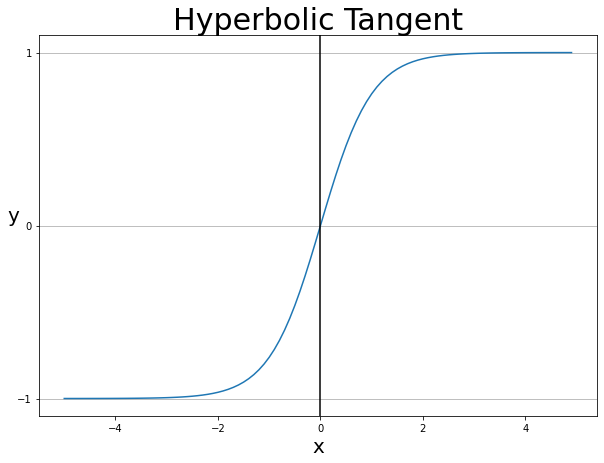
원본 링크tanh
tanh(hyperbolic tangent)
- activation 중 하나로 대표적으로 많이 사용됨.
- range:
- anti-symmetric
- zero-centered
Problems
- Saturation “kills” gradient : 입력 값의 절댓값이 커질수록 기울기 소실
- 특히나 layer가 깊어질수록, chain-rule에 의해 곱해지는 term들이 많아질텐데, 그러면 앞 쪽에 있는 layer 들일수록 learning되지 않을 수 있지.
다음과 같이 구현.
원본 링크tanh
def tanh(x: float) -> float:
	return (np.exp(x) - np.exp(-x)) / (np.exp(x) + np.exp(-x))