MLP(Multi-Layer-Perceptrons)
MLP
Perceptron을 여러 층 쌓은 것.
중간 중간 non-linear function을 사용하여 perceptron을 엮어 더 complex한 function을 approximation 할 수 있음.
Terminology
Net input() = weighted inputs, activation function에 들어갈 값
Activations() = activation function(Net input);
Label output() = threshold()activations of the last layer;Special Cases
In perceptron: activation function = threshold function(step function)
- 위의 그림에서는 threshold가 0으로 잡혀있음.
In linear regression: activation() = net input() = output()
threshold → bias 항으로 몰기
0 & \text{if}\; z \leq \theta \\ 1 & \text{if}\; z > \theta \end{cases}이를 정리해보면,
0 & \text{if}\; z - \theta \leq 0 \\ 1 & \text{if}\; z - \theta > 0 \end{cases}여기서 를 bias 취급하자.
이를 다시 말하면,
기존
input data에서 , 취급하면 notation이 아래와 같이 간단해진다.
MLP - 1 layer
where , are bias
앞에 언급한 대로, 는 bias이므로 input data의 dim을 1 늘리고() 로 처리.Why do we stack more layers?
- 기본적으로 보이는 바와 같이 NN이 깊어질수록 activation을 많이 통과하고 그만큼 non-linearity를 더 부여할 수 있으니 더 complex한 function들을 근사할 수 있지.
- 또한, 데이터를 linearly separable 하게 바꿀 수도 있지.(e.g. kernel trick 처럼)
- data를 Linearly-separable 한 space에 embedding 가능.
MLP - 2 layer
Learning MLP
이전에는 manual 하게 파라미터 값들을 define 해주었는데, 이조차도 모델이 스스로 조정하게 하는 걸 학습”Learning” 이라고 함.
- parameter가 많아지면, manual 하게 지정해주는게 intractable
- automatic하게 data로부터 학습하게 할 수 있다는 장점
→ 이러한 접근을 “data-driven approach” or “end-to-end learning” 이라고 함.Learning Algorithm pseudo-code
Let
- Initialize
- For every training epochs:
- For every :
2-layer Perceptron
## Modified version of above Perceptron_2layers ##
class Perceptron_2layers():
	def __init__(self, num_features, node):
		self.num_features = num_features
		self.node = node
		self.weights1 = np.zeros((self.num_features, self.node), dtype=float)
		self.weights2 = np.zeros((self.node, 1), dtype=float)
		self.bias1 = np.zeros((1, self.node), dtype=float)
		self.bias2 = np.zeros((1, 1), dtype=float)

	def forward(self, x):
		# Forward pass through the network
		# x: (1, num_features) / w1 :(num_features, node) -> z1 : (1, node) -> a1 : (1, node)
		z1 = np.dot(x, self.weights1) + self.bias1 # Linear transformation for hidden layer
		a1 = sigmoid(z1) # Activation for hidden layer
		# a1 : (1, node) / w2 : (node, 1) -> z2 : (1, 1), a2 : (1, 1)
		z2 = np.dot(a1, self.weights2) + self.bias2 # Linear transformation for output layer
		a2 = sigmoid(z2) # Activation for output layer
		predictions = np.where(a2 > 0.5, 1, 0) # Binary predictions
		# z1 : (1, node), a1 : (1, node), z2 : (1, 1), a2 : (1, 1), predictions : (1, 1)
		return z1, a1, z2, a2, predictions

	def backward(self, x, y):
		# Backward pass to compute gradients
		# YOUR CODE HERE
		# x:(1, num_features) / y : (1, 1) / predictions : (1, 1)
		z1, a1, z2, a2, predictions = self.forward(x)
		# errors : (1, 1)
		error_output = a2 - y
		# delta_output : (1, 1) / error_hidden : (1, node)
		delta_output = error_output * sigmoid_derivative(z2)
		error_hidden = np.dot(delta_output, self.weights2.T) * sigmoid_derivative(z1)
		return delta_output, error_hidden, a1

	def train(self, x, y, epochs, lr=1.):
		for e in range(epochs):
			for i in range(y.shape[0]): # batch_size = 1
			# shaping inputs
				xi = x[i].reshape(1, self.num_features)
				yi = y[i].reshape(1, 1)
				delta_output, error_hidden, a1 = self.backward(xi, yi)
				# Update weights
				self.weights2 -= lr * np.dot(a1.T, delta_output)
				self.bias2 -= lr * delta_output
				self.weights1 -= lr * np.dot(xi.T, error_hidden)
				self.bias1 -= lr * error_hidden

	def evaluate(self, x, y):
		# Evaluate the model's performance
		_, _, _, _, predictions = self.forward(x)
		predictions = predictions.reshape(-1)
		accuracy = np.sum(predictions == y) / y.shape[0]
		return accuracy
/../../../AI/Concepts/assets/MLP-perceptron-terminology.png)
/../../../AI/Concepts/assets/MLP-1layer.png)
/../../../AI/Concepts/assets/MLP-1layer-ex2.png)
/../../../AI/Concepts/assets/linearly-separable-dim-incr.png)
/../../../AI/Concepts/assets/MLP-2layer-ex.png)
Vectorization
Vectorization
학습(Learning)을 진행하면, 데이터가 여러 개인데, 이를 처리할 때, 벡터로 묶어서 처리하는 방법. 속도가 빠르다.
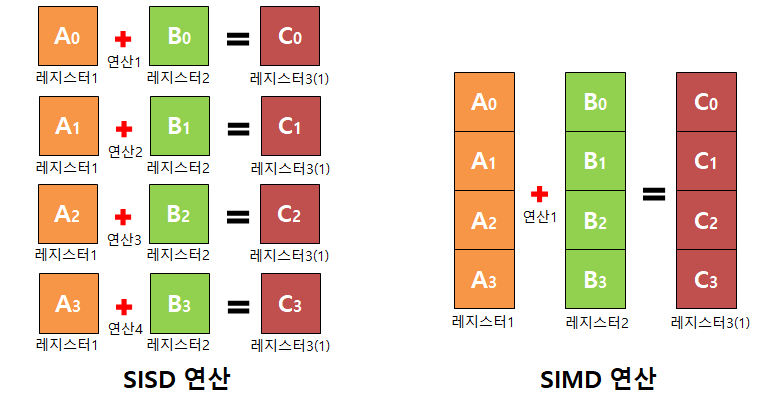
SISDVS SIMD 연산
SIMD: 하나의 명령어로 여러 개의 데이터를 한 번에 처리하는 병렬 방식의 기법의 의미.
- Single Instruction Single Data
SISD: 하나의 명령어로 여러 데이터 동시 처리.
- Single Instruction Multi Data
- 때문에 vector, matrix 연산에 적합.
- 대표적으로 DirectX, OpenGL이 지원.
이를 아래와 같이 코드로 구현해서 비교해보자,
1000000개의 float 정보를 가진 array에 대해 inner product를 진행해보면,Data Preparation
list_size = 1000000
a = np.random.rand(list_size)
b = np.random.rand(list_size)
loop
def loop() -> float:
	c = 0
	for a_i, b_i in zip(a, b):
		c += a_i * b_i_
	return c
list-comprehension
def listcomp() -> float:
	return sum(a_i + b_i for a_i, b_i in zip(a, b))
vectorized
def vectorized() -> float: return np.dot(a, b)원본 링크Results
magic command를 사용해서 비교해본 시행 시간은 다음과 같다.
%time func_name()
loop() listcomp() vectorized() time(ms) 515 549 1.39
Sigmoid
Sigmoid
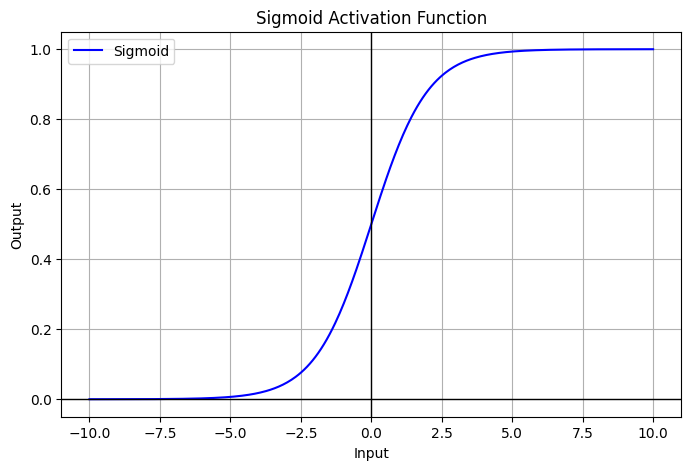
- activation 중 하나로 대표적으로 많이 사용됨.
- range:
- Neuroscience interpretation as saturating “firing rate” of neurons
Problems
- Saturation “kills” gradient : 입력 값의 절댓값이 커질수록 기울기 소실
- 특히나 layer가 깊어질수록, chain-rule에 의해 곱해지는 term들이 많아질텐데, 그러면 앞 쪽에 있는 layer 들일수록 learning되지 않을 수 있지.
- Outputs are not zero-centered → introduces bias after the layer
- sigmoid와 그 gradient는 항상 positive이기 때문에 model wight의 bias
- 라 할 때, =
- 모든 gradient는 동일한 부호를 가짐.
다음과 같이 구현.
원본 링크Sigmoid
def sigmoid(x: float) -> float:
	return 1 / (1 + np.exp(-x))
ReLU
ReLU(Rectified Linear Unit)
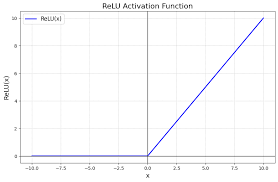
- activation 중 하나로 대표적으로 많이 사용됨.
- Does not saturate(for )
- Leads to fast convergence
- Computationally efficient
Problems
- No learning for → dead/dying ReLU
- downstream gradient가 0(input이 0 이하일 때,)
- often initialize with pos. bias ()
- Outputs are not zero-centered → introduces bias after the layer
- sigmoid와 그 gradient는 항상 positive이기 때문에 model wight의 bias
- 라 할 때, =
- 모든 gradient는 동일한 부호를 가짐.
다음과 같이 구현.
ReLU
def relu(x: float) -> float:
	return np.maximum(0, x)
- 단점들 보안을 위해 Leaky ReLU 등이 있음.
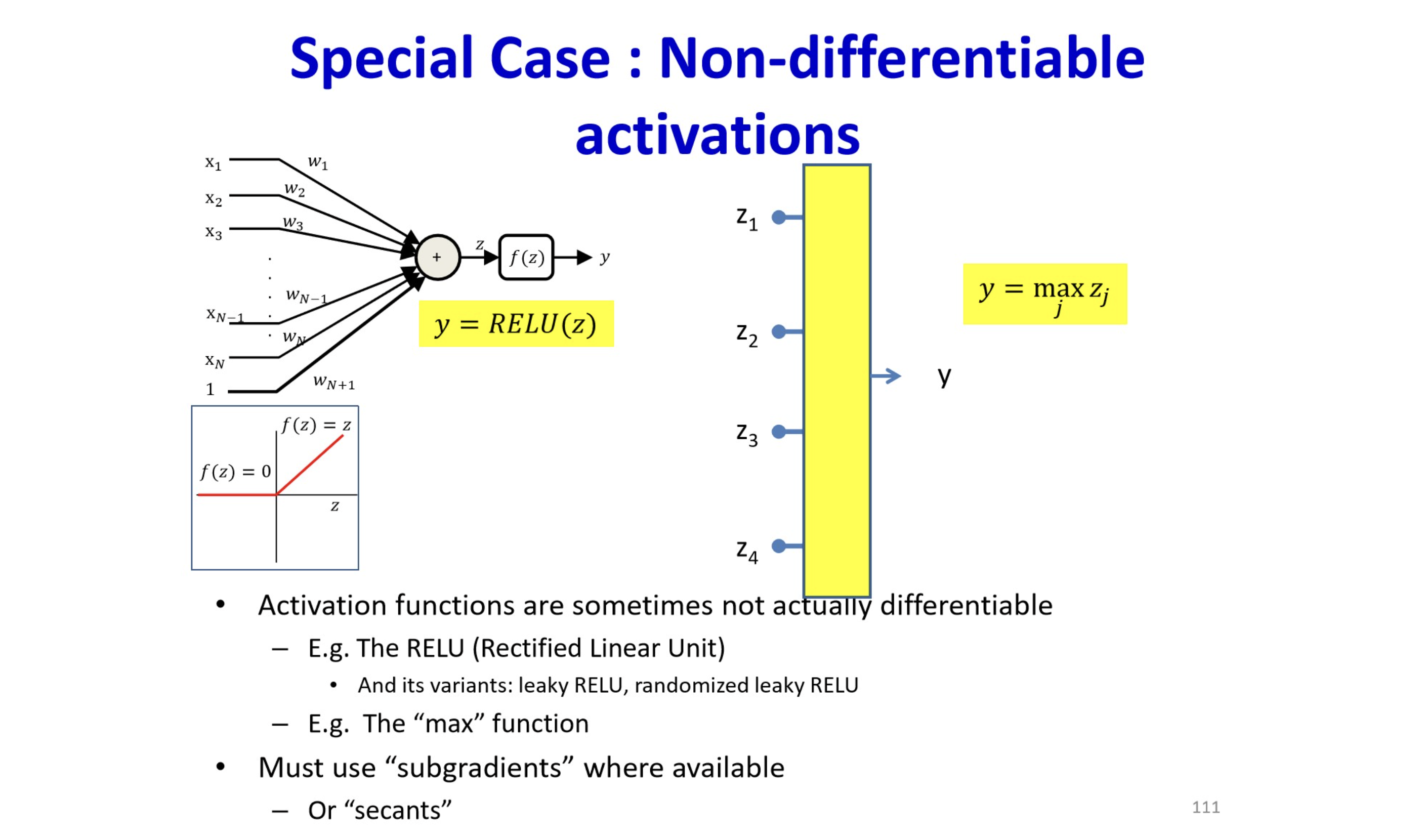
원본 링크How can we calculate non-differentiable function (like ReLU)?
sklearn.datasets
- scikit-learn에서 data generation에 용이함.
Sample Code - Generating
import sklearn.datasets as dt

data = dt.make_classification(
	n_samples = 100,
	n_features = 2,
	n_repeated = 0,
	n_classes = 2,
	n_redundant = 0
)

X, y = data[0], data[1]
y = y.astype(int)
Sample Code - Shuffling
shuffle_idx = np.arange(y.shape[0])
shuffle_rng = np.random.RandomState(123)
shuffle_rng.shuffle(shuffle_idx)
X, y = X[shuffle_idx], y[shuffle_idx]

X_train, X_test = X[shuffle_idx[:70]], X[shuffle_idx[70:]]
y_train, y_test = y[shuffle_idx[:70]], y[shuffle_idx[70:]]
Sample Code - Normalizing
mu, sigma = X_train.mean(axis=0), X_train.std()
X_train = (X_train - mu) / sigma
X_test = (X_test - mu) / sigma
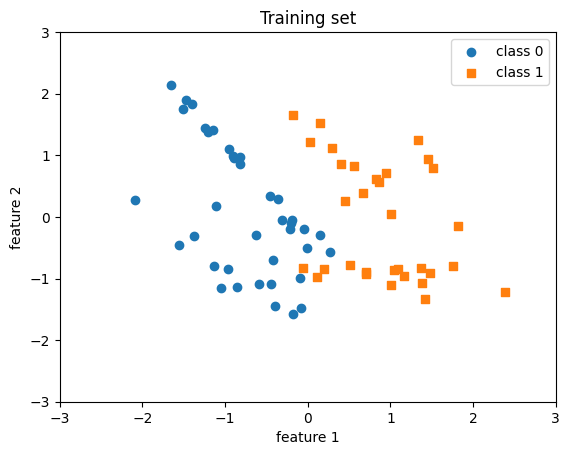
아래 코드로 visualizing하면 다음과 같음.
plot
plt.scatter(X_train[y_train==0, 0], X_train[y_train==0, 1], label='class 0', marker='o')
plt.scatter(X_train[y_train==1, 0], X_train[y_train==1, 1], label='class 1', marker='s')
plt.title('Training set')
plt.xlabel('feature 1')
plt.ylabel('feature 2')
plt.xlim([-3, 3])
plt.ylim([-3, 3])
plt.legend()
plt.show()
원본 링크